
The dashboard looks fine when I first open it.
Not “green across the board” fine. Just… normal. The kind of normal you stop interrogating after enough quiet hours. USDT volume is steady. No spike worth waking someone up. PlasmaBFT keeps closing blocks on schedule, and the page gives you that dangerous feeling that nothing is building underneath.
I’m still staring at it when the first weirdness shows up.
Not from the chain. It never is. It’s from an internal panel that’s basically a “later” tool...useful when you’re explaining a mess, not preventing one. Three sends to the same destination in a tight window. Same size. Same rhythm. Close enough that it looks deliberate if you already know it’s deliberate.
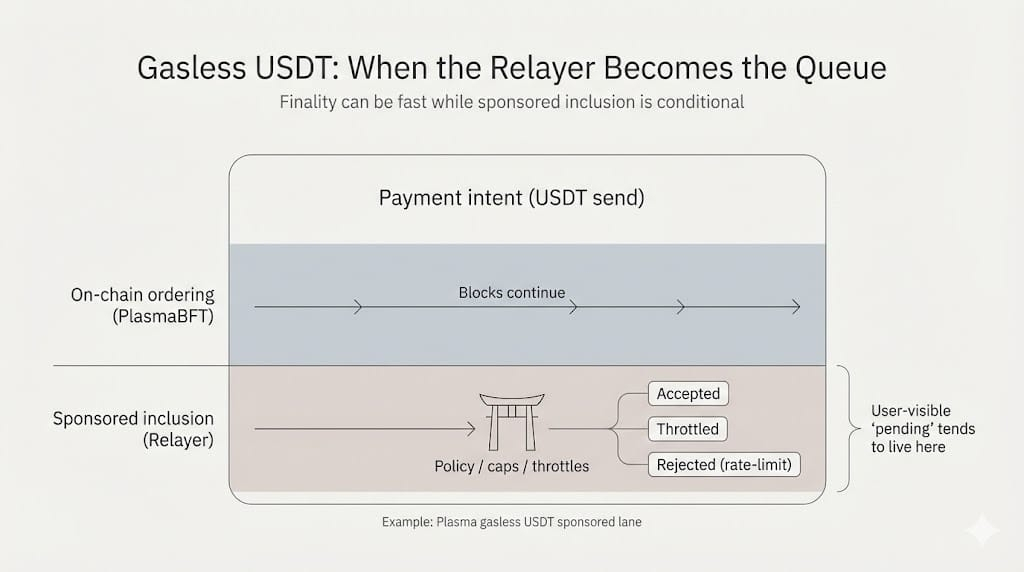
Gasless USDT keeps flowing through Plasma like it always does. Sponsored execution path. Relayer submits. Finality lands before I finish forming the question. The tx hashes are clean. No retries. No stutters. If you only look at Plasma, it’s a normal night.
On Plasma, the ledger is clean; the payout file is where it starts lying.
It’s downstream, where the control was parked because, historically, time helped. On slower rails, lag did unpaid work: it stretched intent, it widened the gap between “sent” and “settled,” it gave risk enough breath to catch up and say “wait, that’s not right.”
Plasma doesn’t give you that breath.
By the time the risk console updates, the shape is already complete. Not forming. Complete. The timestamps line up in the ugliest order: block time first, detection time later, response time later still. You can almost hear the sentence your tools are forcing you to say: “Yes, it settled. Yes, we’re reacting now.”
Another account joins the list. Then another. I refresh and the cluster count jumps again—fast enough to feel like the system is catching up, not protecting.
Someone drops a screenshot in the ops channel. Two circled timestamps. No commentary, because commentary would turn it into blame.
At this point it’s not “fraud” yet. It’s “accounting with consequences.” The relayer isn’t built to hesitate. It enforces what you told it to enforce. Gasless flow doesn’t flinch when something feels odd. PlasmaBFT sealed exactly what it was given, exactly when it was given. The only thing that didn’t keep up was the assumption that controls still sit beside execution instead of behind it.
So the rule gets tightened.
Not dramatically. Just enough. A relayer rate rule flips from “normal” to “tight” and the sponsored path narrows. The change is immediate in the way all blunt fixes are: legitimate users feel it first. Transfers that worked ten minutes ago start bouncing. Support tickets begin stacking while the wording is still being argued about.
And then the freezes start.
Not mid-flight. After landing.
USDT already moved. Balances already reflect it. PlasmaBFT already wrote the order of events in a way nobody can dispute. The freeze looks decisive in an internal dashboard and feels backward in practice, because it isn’t stopping the thing that happened. It’s drawing a line behind it.
A merchant message comes in while we’re still counting: “Payout file doesn’t match my register totals.” They’re not asking about an attack. They’re asking why today’s settlement report includes transfers that now sit next to “under review” flags. That’s the retail-side collision Plasma creates: payments are instant enough to be treated as done, but controls are still human enough to arrive in batches.
Someone asks how many slipped through before the change. Nobody answers right away, because the honest number keeps changing as more logs finish loading and more clusters finish being recognized.
Another refresh. Fewer alerts now. The rule is “working.” But it’s working in a tense nobody wants to sign their name under.
Support pings again: what do we tell users whose transfers are confirmed but whose accounts are suddenly locked? The draft response is technically perfect and operationally ugly: confirmation first, restriction second. Everyone can feel the mismatch, because everyone lived the mismatch.
Back in ops, we’re staring at early transactions that look fine one by one. The third only looks bad because the first two happened. That’s the part nobody likes admitting out loud: Plasma gave us clean, valid sends with sub-second finality. The “suspicious” part is a sequence we only understand once it’s already written.
Someone opens the post-incident doc and types “rule propagation delay,” then deletes it. That sounds like an accident. This wasn’t an accident. This was a design assumption meeting a faster clock.
The accounts stay frozen. The balances don’t move. History is fixed.
In the macro library, a new sentence appears because it has to: “Your transfers are confirmed. Your account is under review.” Calm words, backward order. It’s the only way to describe what just happened without saying the quiet part.
Later that night, another small cluster starts to form. Not enough to trip the new rule. Not yet. Enough to make someone post a tx hash in the channel and wait. #plasma
No one wants to be the person who decides whether the rule learned in time this time.