
@Dusk When people talk about blockchains, the conversation still skews toward traders. It’s prices, liquidity, and the drama of markets that never sleep. But the people who decide whether a system can be used in the real economy usually aren’t traders. They’re auditors, compliance officers, risk teams, and regulators. Their world runs on evidence and restraint. Not spectacle or speed. If you can’t explain it, record it, and verify it later, speed doesn’t really count for much.
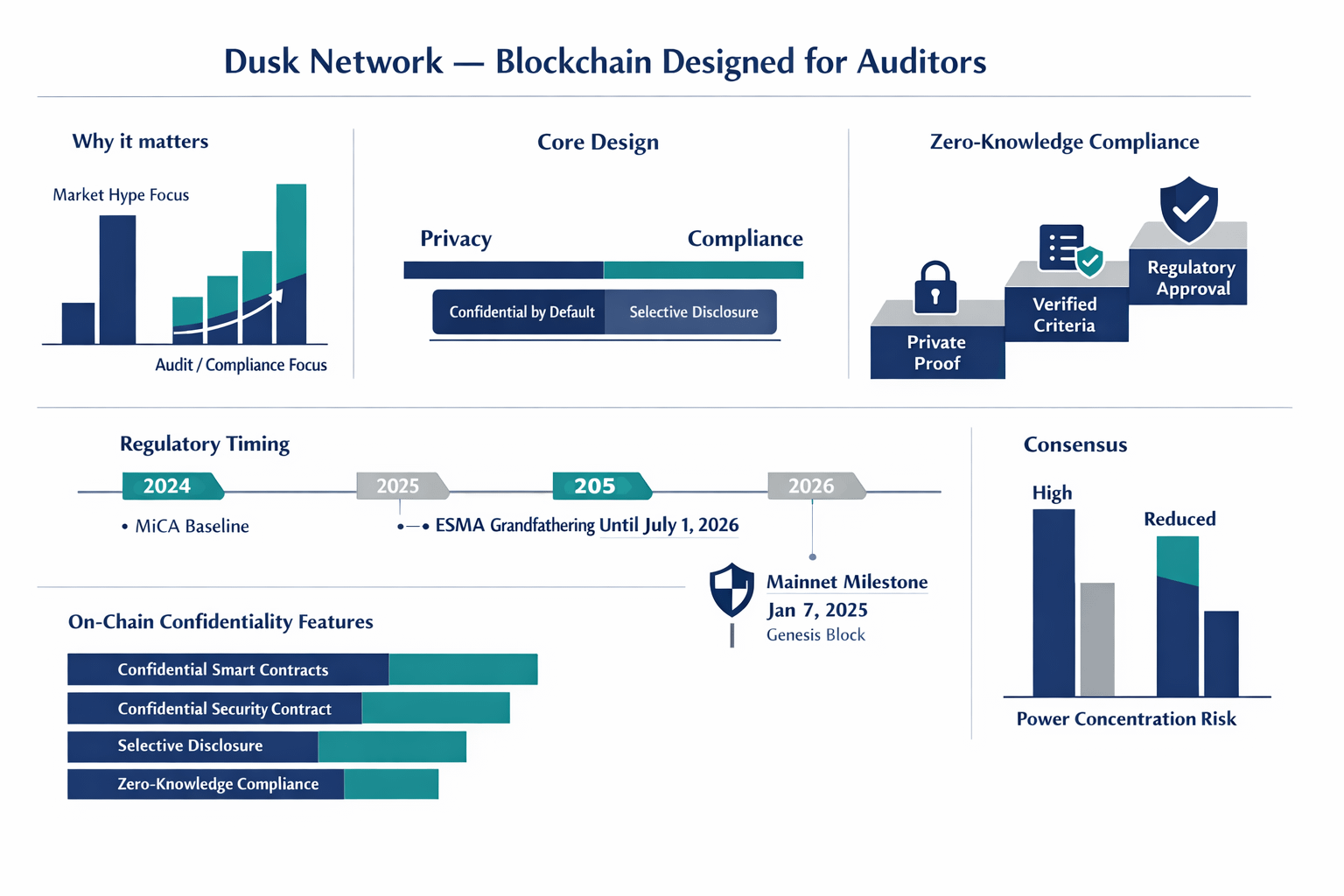
That’s why Dusk Network feels unusually relevant right now. Not because it promises a new kind of hype cycle, but because it is trying to solve a problem that keeps showing up whenever blockchain bumps into real finance: confidentiality. Most financial activity can’t happen in public. Not because everyone is hiding something shady, but because publishing every position, every client relationship, and every negotiation would be commercially reckless. Dusk’s core idea is simple enough to say out loud: make transactions private by default, but still provable when a legitimate party needs to verify what happened. Dusk frames this as bringing privacy and compliance together, including “zero-knowledge compliance,” where participants can prove they meet requirements without exposing the underlying details.
The timing is a big part of why this matters. Tokenization has shifted from a ‘maybe someday’ idea to something firms are actually building plans around. The World Economic Forum’s January 2026 outlook treated it like a real priority, driven by traditional financial players as much as crypto companies. And if that keeps going, a practical question shows up fast: where do regulated assets sit, and how do they move, without exposing everything to the public?”
Regulation is tightening that screw, especially in Europe. MiCA is now the baseline framework, and ESMA has described the “grandfathering” window that can allow some existing crypto-asset service providers to keep operating until July 1, 2026 (or until authorized or refused). In practice, that means a lot of firms are staring at the calendar and asking what their systems will look like when scrutiny becomes routine. When rules harden, “we’ll figure it out later” stops being a strategy.
Here’s where Dusk becomes more than an abstract privacy project. It’s not aiming to hide activity from everyone forever. It’s aiming to make selective disclosure feel normal—closer to how finance already works offline. You don’t publish every invoice to the world. You keep records, limit access, and you can open the books when the right people ask. Dusk is trying to encode that same social contract so that confidentiality and auditability aren’t enemies. That’s the difference between “privacy as secrecy” and “privacy as control.”
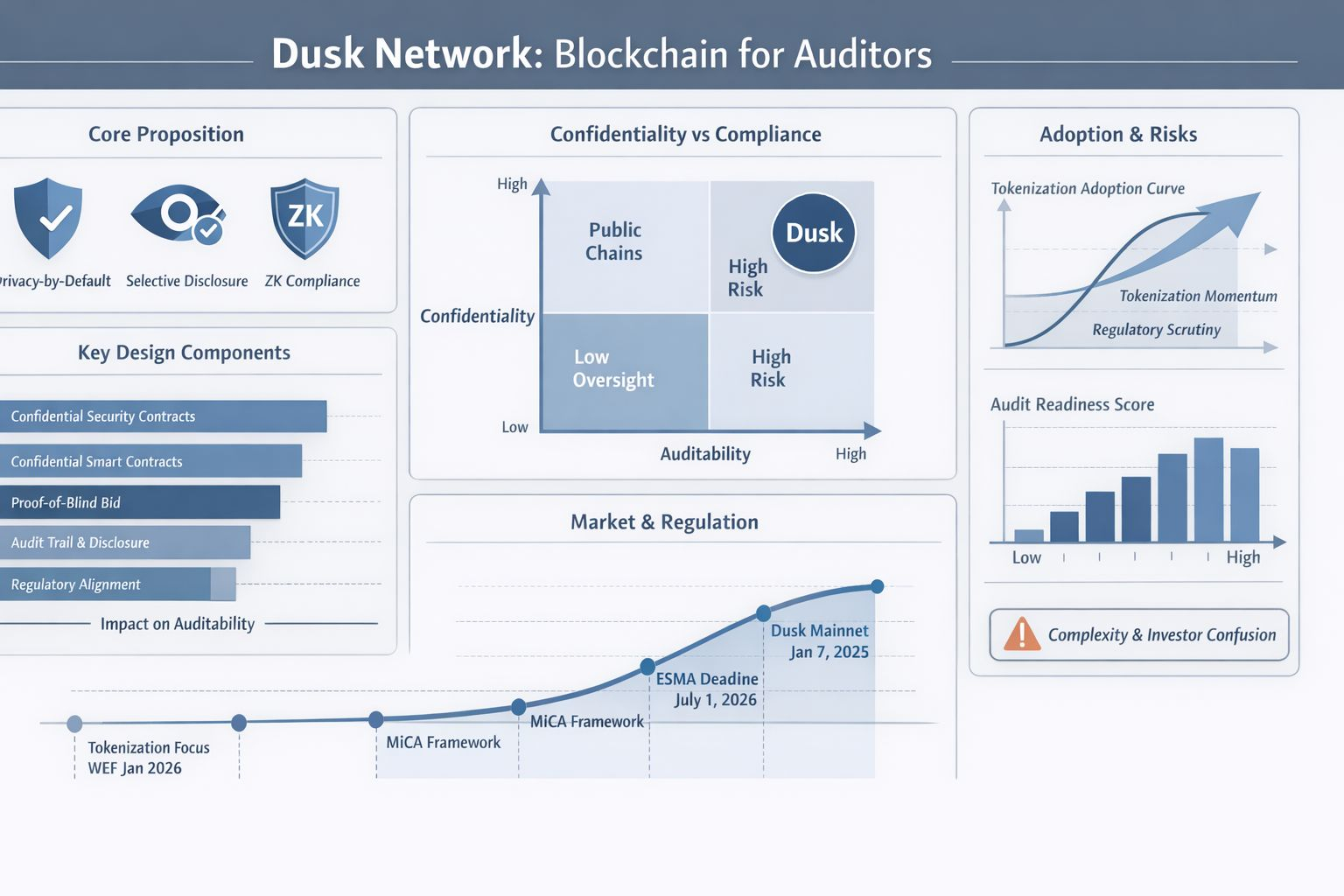
The network’s design choices reinforce that intent. Dusk’s documentation talks openly about securities use cases and a model called the Confidential Security Contract, meant to support the lifecycle management of securities while still supporting full regulatory compliance. It also promotes confidential smart contracts as a native capability, which is basically an attempt to let business logic run on-chain without forcing every sensitive input into public view. That combination is exactly what auditors and issuers care about: not just that a transfer happened, but that it happened under the right rules.
And it isn’t just a whitepaper stance. Dusk’s mainnet rollout was scheduled to produce its first immutable block on January 7, 2025, and the team marked mainnet going live the same day. That matters because auditors, for better or worse, trust what’s running more than what’s promised.
None of this guarantees adoption. Tokenization itself carries risks, and global watchdogs have warned that investors can be confused about whether they hold the underlying asset or merely a token representation, among other concerns. Privacy systems also add complexity, and complexity can make assurance harder if tooling, standards, and reporting don’t keep pace. But Dusk’s relevance is that it’s building for the hard part early: the part where systems must be explainable, controllable, and defensible in front of someone paid to be skeptical.
Even Dusk’s consensus design gestures in that direction. Its whitepaper describes Proof-of-Blind Bid as part of the process for leader selection and consensus, a mechanism meant to avoid the obvious “the richest always wins” feel that worries anyone trying to treat a chain like market infrastructure. You can debate whether it’s the best approach, but the motivation is familiar: reduce concentrations of power that would make governance—and therefore risk—hard to justify.
The reason Dusk belongs in this article, specifically, is that it speaks the language the next phase of blockchain needs. Not just “users” and “throughput,” but controls, selective access, evidence, and audit trails. If blockchains are going to graduate from trading venues to financial infrastructure, someone has to make them boring enough for auditors to sign off on. Dusk is trying to do exactly that.