
 It was more subtle than that.
I kept seeing the name pop up in conversations where people weren’t really talking about “crypto people.” They were talking about games IPs entertainment stuff. Brands. And that always makes me pause because most chains say they want mainstream adoption but they still mostly talk to each other.
What I noticed early on was that @Vanar didn’t sound like it was built for crypto Twitter first. And honestly that made me suspicious at first.
I’ve been around long enough to know that “next 3 billion users” is one of the most overused lines in this space. Everyone wants it. Almost no one actually designs for it.
At first I wasn’t sure what #vanar even was supposed to be. L1? Platform? Ecosystem? Brand chain? It didn’t fit neatly into the usual buckets we use to judge projects. No obvious DeFi flexing. No “fastest TPS” shouting. No cult-like community screaming numbers at you.
That confused me. But I kept watching.
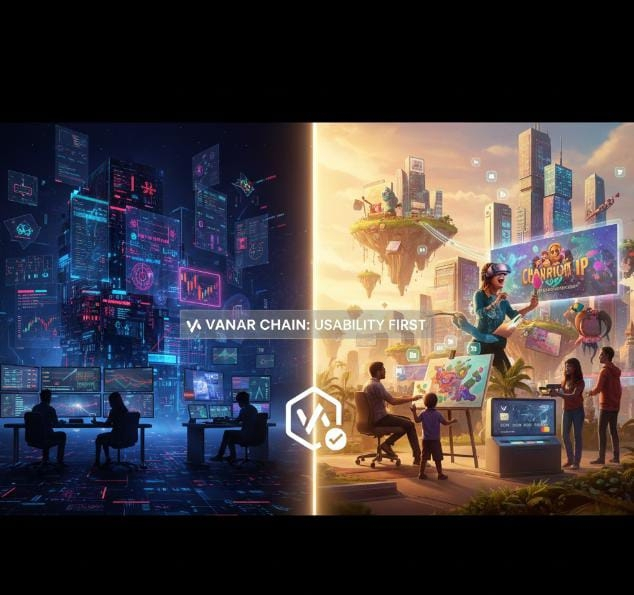
After watching this for a while what started to make sense is that Vanar feels like it was built backwards compared to most blockchains. Instead of starting with tech specs and hoping users show up later it seems to start with actual use cases people already understand games entertainment brands and then quietly builds the infrastructure around that.
That doesn’t mean it’s perfect. Far from it. But it does feel intentional.
The gaming angle is what first pulled me in. Not because I’m chasing the next Axie-style hype cycle I’m tired of that but because the Vanar team actually has background there. You can feel the difference between “crypto people trying to do games” and “people who’ve worked with games learning how to use crypto.”
Projects like Virtua Metaverse didn’t feel slapped together to check a box. The focus wasn’t “look blockchain!” It was more like “how do we make digital ownership and immersion feel normal?”
And that word normal matters more than people think.
Most Web3 products still feel like homework. Wallets. Gas fees. Bridges. Explanations layered on top of explanations. If you’ve been here long enough you tolerate it. New users don’t.
Vanar seems to be betting that the user shouldn’t even care what chain they’re on. They just want to play collect interact or show off something digital that actually has meaning.
Same story with VGN. It’s not screaming about decentralization every five seconds. It’s positioning itself more like an ecosystem where games can exist without every single interaction feeling like a crypto transaction.
One thing that kept bothering me early on was whether this approach would alienate hardcore crypto users. The ones who want full composability deep DeFi integrations permissionless everything. Vanar doesn’t really speak to them directly.
But maybe that’s the point.
Not every chain needs to be the playground for power users. Some need to be the on-ramp where normal people accidentally start using Web3 without realizing it.
That’s where the “brands & IPs” angle started to click for me. Big brands don’t want to babysit users through seed phrases. They want predictable UX controlled environments and systems that won’t break the moment traffic spikes. Vanar’s positioning feels aligned with that reality even if crypto purists roll their eyes at it.
Still I’m not fully convinced yet.
The biggest open question for me is execution at scale. It’s one thing to say you’re ready for millions of users. It’s another thing to actually support them without downtime bugs or awkward compromises that kill the experience. Real-world adoption isn’t forgiving. Gamers don’t care that it’s “early.” Brands won’t tolerate instability.
Another thing that’s still unclear is how sticky the ecosystem will be. Will users come for a game or experience and then stay because Vanar itself adds value? Or will Vanar remain invisible in the background which is great for UX but tricky for long-term network effects?
And then there’s the token side. The $VANRY token exists it powers the network but it doesn’t feel like the emotional center of the ecosystem yet. That could be good less speculation-driven noise or it could become a challenge if value capture isn’t communicated clearly over time.
I’ve also noticed that Vanar doesn’t chase every trend. AI eco metaverse yes those are part of the ecosystem but they’re not being screamed about in isolation. It’s more like they’re being treated as tools not headlines. I respect that but it does mean slower buzz cycles compared to louder chains.
The community vibe is interesting too. Less meme-heavy. More builders creatives and people who talk about products instead of charts. That’s refreshing but it also means it flies under the radar unless you’re paying attention.
I wouldn’t say Vanar is “undervalued” or “guaranteed” or any of that nonsense. I’ve been burned enough times to avoid those words. What I will say is that it feels like one of the few projects actually trying to solve the boring hard part of Web3 making it usable without needing a philosophy degree.
And boring in this space is often where real adoption hides.
I’m still watching. Still skeptical in healthy ways. Still curious.
If Vanar can pull off even half of what it’s quietly aiming for especially in gaming and entertainment it won’t need to shout. People will just start using it and most of them won’t even know they’re “using crypto.”
And honestly that’s probably what real adoption looks like.
