@Plasma . Most market participants are still chasing the modular hallucination a fragmented landscape of rollups and data availability layers while ignoring the only metric that actually captures durable value: the velocity of dollar-pegged assets on a sovereign ledger. While the industry spent the last three years obsessing over "parallelized execution" as a panacea for throughput, they missed the more fundamental architectural rot: the fact that global stablecoin liquidity is currently trapped on aging infrastructure that treats the US Dollar as a secondary guest rather than a primary citizen. Plasma is the first serious attempt to build a Layer 1 that acknowledges the "World Computer" thesis was a noble experiment, but the "World Settlement Layer" is the actual business model.
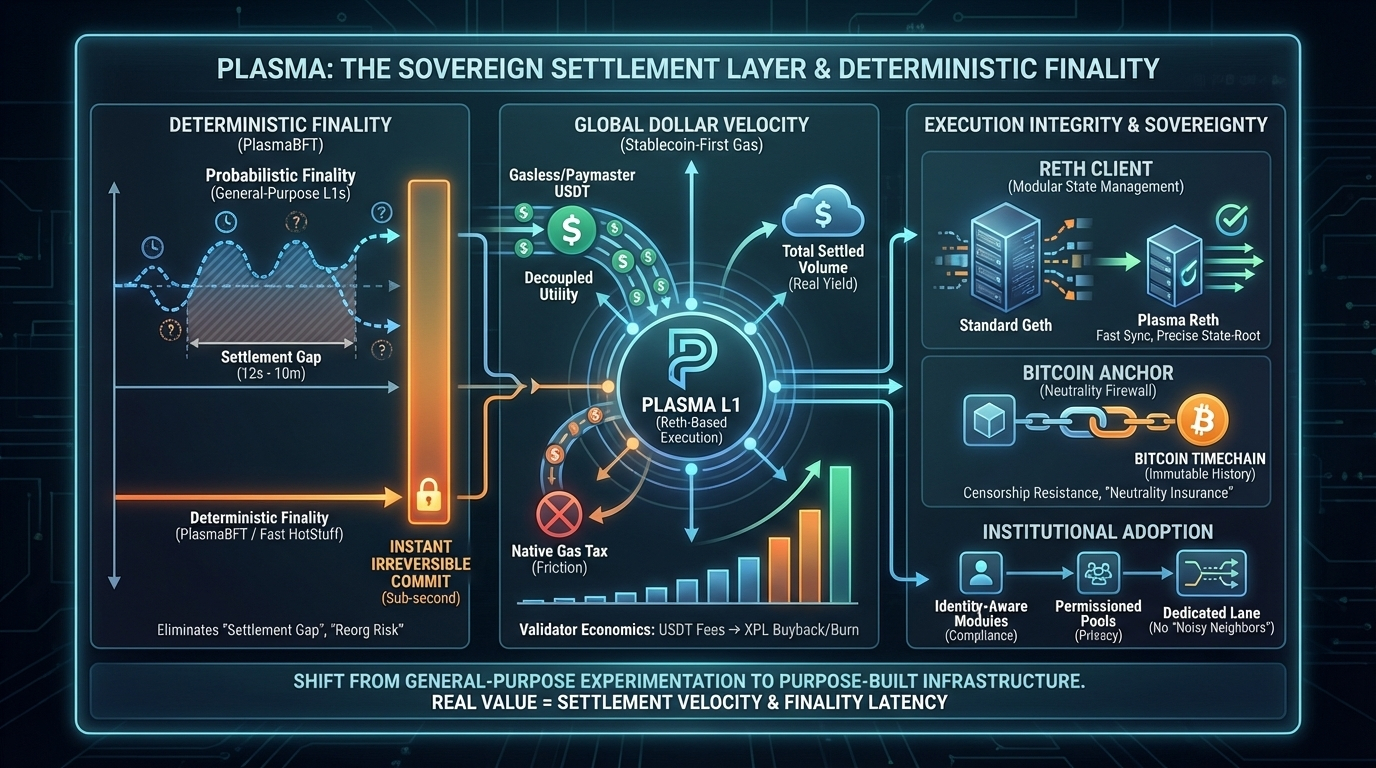
The prevailing market assumption has been that general-purpose chains would eventually optimize for payments through sheer brute-force scaling. This is a fallacy of composition. A chain that attempts to host high-frequency trading, generative NFT mints, and complex lending loops simultaneously introduces a "noisy neighbor" problem that no amount of TPS can solve. For an institution moving $500 million in a single settlement, or a merchant processing ten thousand $5 micro-payments, the risk isn't just throughput; it is the volatility of the settlement environment itself. Plasma’s decision to build on Reth a Rust-based implementation of the Ethereum Virtual Machine signals a shift from broad experimentation to narrow, high-performance execution. Reth isn't just about speed; it’s about modular state management. By utilizing a client that prioritizes efficiency and fast synchronization, Plasma ensures that its state-root can be calculated and verified with a level of precision that standard Geth-based chains simply cannot match. This technical choice is the bedrock of what we must call "Execution Integrity" the guarantee that the state of the ledger is always a true, unlagged reflection of global capital flows.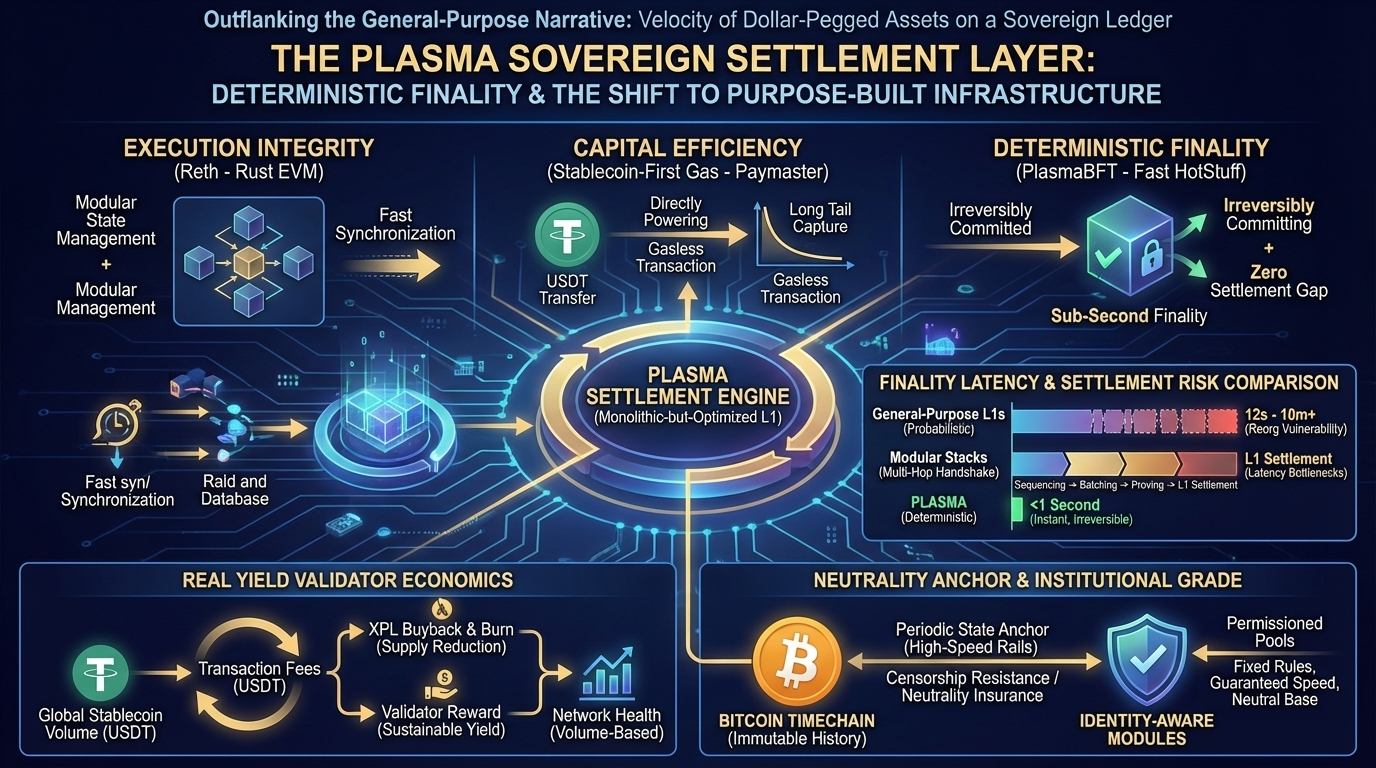
Liquidity behavior on most networks is currently dictated by the friction of the native gas token. The "gas tax" is a massive psychological and structural barrier. On Ethereum, you need ETH to move USDT; on Solana, you need SOL. This creates a circular dependency where a user’s ability to move value is tethered to the price volatility of a speculative asset. Plasma’s introduction of stablecoin-first gas and gasless USDT transfers through its native Paymaster system effectively decouples the utility of the dollar from the volatility of the network. This is not merely a "user experience" upgrade; it is a fundamental shift in capital efficiency. When gas is paid in the asset being transferred, the "minimum viable transaction" drops toward zero. This allows for the capture of the "Long Tail" of global payments remittances and micro-settlements that are currently priced out of Ethereum and functionally insecure on centralized alternatives like Tron.
The consensus mechanism, PlasmaBFT, represents a departure from the probabilistic finality that haunts early generation blockchains. In a probabilistic system, a transaction is "final" after a certain number of blocks are added to the chain, a process that can take anywhere from twelve seconds to ten minutes. For a high.frequency payment rail, this is unacceptable. PlasmaBFT, a variant of the Fast HotStuff algorithm, provides deterministic finality. Once a block is committed, it is irreversible. The sub second finality of Plasma is the "Gold Standard" for settlement risk. It eliminates the "settlement gap" that window of vulnerability where a transaction could theoretically be rolled back or reorganized. This architecture is what attracts durable liquidity; capital goes where it is safest and fastest to settle, not where it is cheapest to speculate.
Validator economics on Plasma must be viewed through a different lens than the traditional "inflationary reward" model. In most PoS systems, validators are paid by diluting the supply of the native token, a model that works until the market stops valuing the token. Plasma’s incentive alignment is built on the reality of transaction volume. By allowing users to pay gas in USDT, the protocol creates a continuous, high volume demand for XPL. The system can effectively swap the USDT collected in fees for XPL on the open market to reward validators or burn a portion of the supply. This creates a "Real Yield" environment where the health of the network is tied directly to the volume of stablecoin settlement rather than the speculative fervor of a bull market. For a validator, the risk profile shifts from "betting on a token price" to "betting on the utility of global dollars."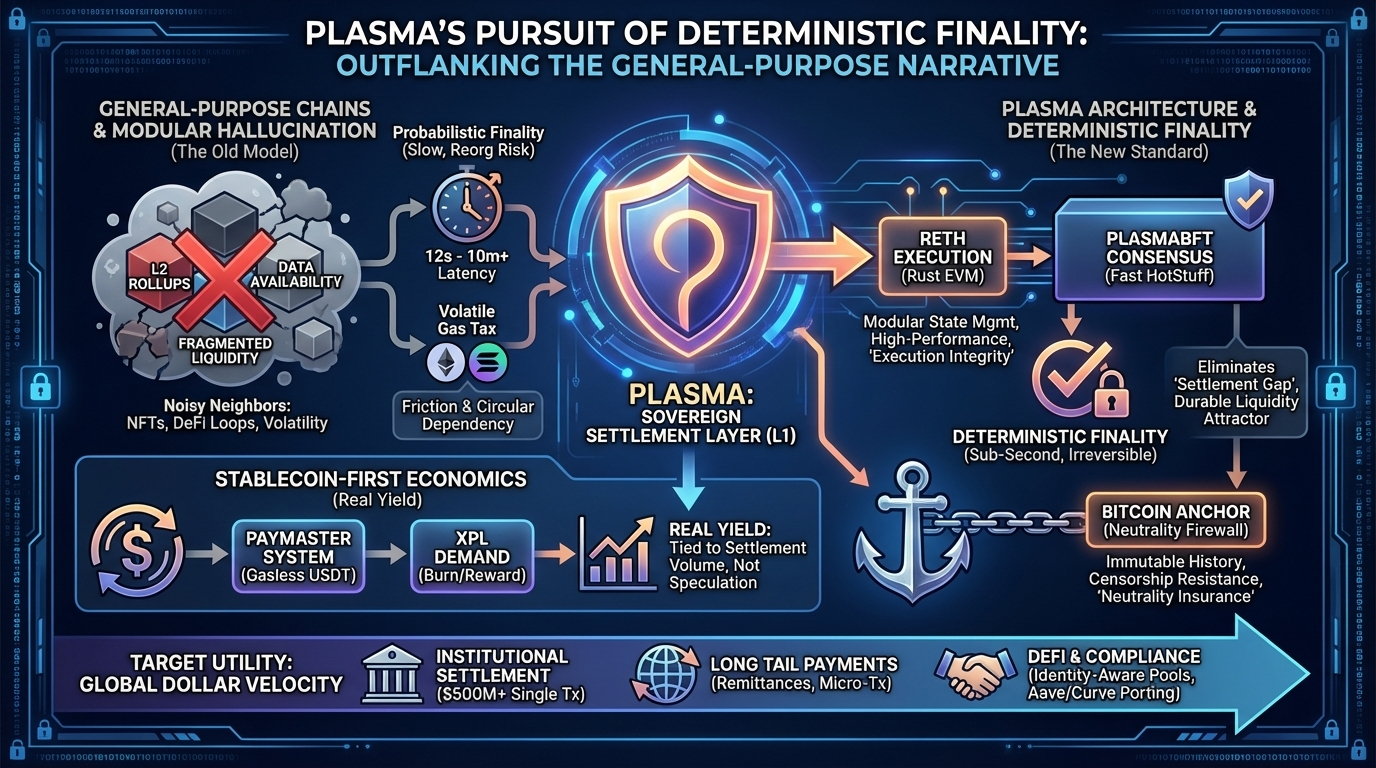
The "Bitcoin Anchor" is perhaps the most misunderstood component of the Plasma architecture. It is often dismissed as a marketing gimmick or a redundant security layer, but its actual function is to serve as a jurisdictional and neutrality firewall. By periodically anchoring the state of the Plasma ledger to the Bitcoin blockchain, the network exports its history to the most immutable and politically neutral database in existence. In an era of increasing regulatory pressure and the potential for "protocol capture" by sovereign entities, anchoring to Bitcoin provides a layer of censorship resistance that cannot be achieved through a siloed PoS validator set alone. It ensures that if the Plasma network were ever compromised at the consensus level, the "truth" of the ledger remains etched into the Bitcoin timechain. For institutions, this is a hedge against administrative and technical failure; it is the ultimate "Neutrality Insurance."
Institutional adoption constraints have historically centered on three things: privacy, compliance, and deterministic settlement. Plasma’s architecture is designed to address these without the performance trade offs of zero knowledge proofs on general purpose L1s. By focusing exclusively on stablecoin settlement, the chain can implement "Identity Aware" modules at the protocol level. This allows for a hybrid environment where institutional users can interact with permissioned pools while still benefiting from the underlying high-speed settlement rails. The reality is that institutions do not want to compete with "degens" for blockspace. They want a dedicated lane where the rules are fixed, the speed is guaranteed, and the security is anchored to a neutral base layer.
We are currently witnessing a silent shift in how capital moves on-chain. The era of the "Generalist L1" is ending, and the era of the "Specialized App-Chain" is beginning. However, most app-chains suffer from the "Liquidity Island" problem.they are isolated and require complex bridging that introduces new attack vectors. Plasma solves this by being a full featured L1 that is also EVM.compatible via Reth. It isn't an island; it’s a high speed highway that connects directly to the Ethereum ecosystem while maintaining its own sovereign settlement rules. This allows developers to port over the entire DeFi stack Aave, Curve, Uniswap without rewriting a single line of code, but with the added benefit of a consensus engine that was actually built for the task of moving money.
The structural weakness of competing designs, particularly the "Modular" stack, is the complexity of the "Finality Handshake." When a transaction happens on an L2, it is "sequenced," then "batched," then "proven," and finally "settled" on the L1. Each step introduces a layer of latency and a different security assumption. In a crisis a high-volatility event where everyone is trying to exit to stablecoins these modular stacks often become bottlenecks. Plasma’s monolithic but optimized approach (using Reth for execution and PlasmaBFT for consensus) removes these intermediate handshakes. It is a "Straight.Through Processing" model for blockchain. In the next major market downturn, the capital that survives will be the capital that was able to reach finality the fastest.
Long term sustainability in this market is not about who can subsidize the most airdrops; it is about who can capture the most "Economic Rent" from actual utility. As the crypto market matures, the "Gas Token" as a speculative vehicle will lose its luster, and the "Settlement Token" as a utility vehicle will take its place. XPL is positioned to be the latter. By anchoring itself to the $150 billion+ stablecoin market, Plasma is essentially building a toll road on the busiest highway in the world. The metrics that will matter for Plasma won't be "Daily Active Users" in the social sense, but "Total Settled Volume" and "Finality Latency."
For the trader and analyst surviving in this market daily, the signal is clear: the market is moving toward "Purpose Built Infrastructure." The noise of the modular vs. monolithic debate is a distraction from the reality that stablecoins are the only assets with consistent, non-speculative demand. Plasma is the first L1 to stop pretending it’s a decentralized version of the App Store and start acting like a decentralized version of the Federal Reserve’s FedWire. It is a cold, calculated, and highly efficient machine designed for one thing: the instant, secure, and neutral movement of digital dollars. In a world of "Vaporware" and "Narrative Rotation," Plasma’s commitment to the boring but essential task of settlement is its most radical and valuable feature.