
The block finalized on Dusk settlement lane, before anyone said “approved.”
Not in a dramatic way. No race. No red light. Just the normal cadence of Dusk doing what it does when the execution path qualifies and nothing blocks it.
The ledger moved.
Somewhere else, a sign-off was still being drafted.
The transition hit its conditions cleanly. Inputs lined up. Disclosure scopes held. The execution context stayed inside the rule frame it was evaluated against. Finality landed where it always lands on Dusk quietly, decisively, without asking who was still in the meeting.
From the chain’s point of view, that was the end of it.
From the organization’s point of view, it wasn’t even supposed to be the middle yet.
There’s a moment like that where two clocks stop agreeing.
On one side, settlement is done. The state exists. It will exist tomorrow. The proof resolves for the viewer set that mattered at execution—Moonlight already drew the line and closed it. Nothing provisional. Nothing waiting. Dusk already closed the question.
On the other side, a permission is still traveling. A manager is reviewing a note. Legal is adding a sentence. Someone wants to be comfortable before they say yes out loud. The process assumes the system will wait.
It doesn’t.
The first sign isn’t an error. It’s a notification that lands too early.
A downstream report updates. A balance changes. A reference appears in a place it “shouldn’t” yet. Someone sees it and asks, “Why is this live?”
Because it is.
The uncomfortable part is that nothing is wrong enough to stop. The ledger didn’t jump a gate. The execution didn’t bypass a rule. It followed them precisely. The only thing it didn’t do was wait for permission that isn’t part of its logic.
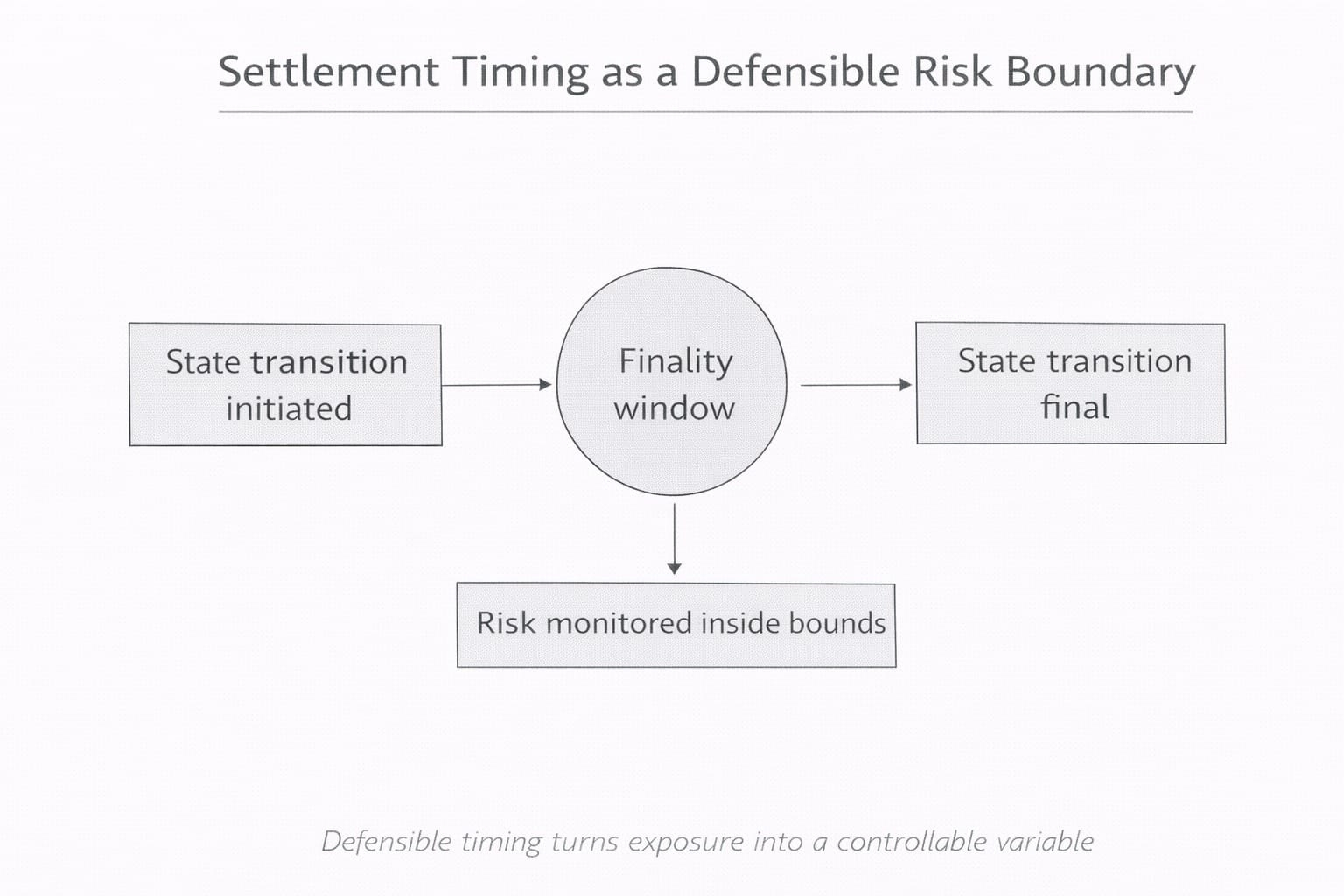
Dusk separates those concerns on purpose.
Finality isn’t a courtesy on a privacy focused L1 like Dusk, built for regulated finance. It’s a condition. Actually... worse than that: once the state qualifies, it finalizes, and nobody in the room gets a vote after. Human approval is a different channel, running on a different clock, with different failure modes. Sometimes those clocks drift.
This is one of those times.
People try to reconcile it backward.
“Can we mark it pending internally?” “Can we treat it as provisional until sign-off?” “Can we roll it back if someone objects?”
None of those questions touch the thing that already happened. They’re about comfort, not validity. The ledger doesn’t recognize “we weren’t ready” as a reversible state.
The proof is already scoped. Disclosure timing already passed its boundary. The people who are entitled can see it. The people who aren’t can’t. There isn’t a switch you can flip to align that with an approval that arrived late.
So the organization hesitates in place.
One team is looking at a finished state they’re not allowed to acknowledge yet. Another is still waiting for permission to say the word “complete.” A third is trying to explain how something is both done and not done, depending on which system you trust. (And you can hear how bad that sounds as soon as you say it.)
Dusk doesn’t help you narrate that gap. It just holds its line.
The ledger stays correct. The execution stays valid. Other transitions keep landing like it’s a normal day. The only tension is human, and it’s loud precisely because the chain is silent.
Eventually the sign-off arrives.
It always does.
Someone types “approved” into a system that thinks it’s closing a loop. But the loop closed earlier, somewhere else, under rules that don’t care about internal pacing. The approval doesn’t unlock anything. It just catches up.
That’s the part that feels backwards the first time you hit it.
You’re used to systems waiting for permission. On Dusk, permission that matters is encoded before execution, not negotiated after. If you want the ledger to wait, you have to make waiting part of the rule. If you don’t, it won’t improvise on your behalf.
So the behavior changes, quietly.
Sign-off moves earlier. Permission gets bound closer to execution. People stop assuming they’ll get a grace period to feel good about what already happened.
Not because Dusk is aggressive.
Because it’s literal.
The ledger told the truth when it mattered.
The meeting was just late.