Most conversations in crypto follow the same script. People talk about decentralization, scalability, speed and adoption. Privacy usually shows up much later in the discussion, if it shows up at all. From my point of view, that’s one of the biggest blind spots in Web3 today. A system can be decentralized on paper and still leave its users completely exposed in practice.
This is where Dusk Network feels different.
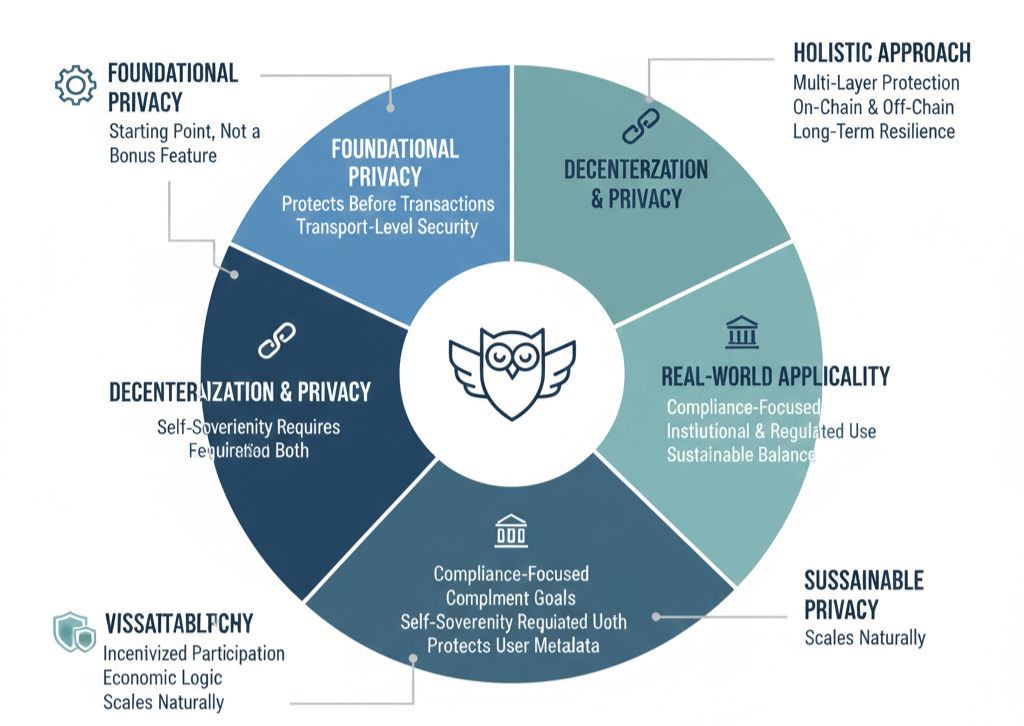
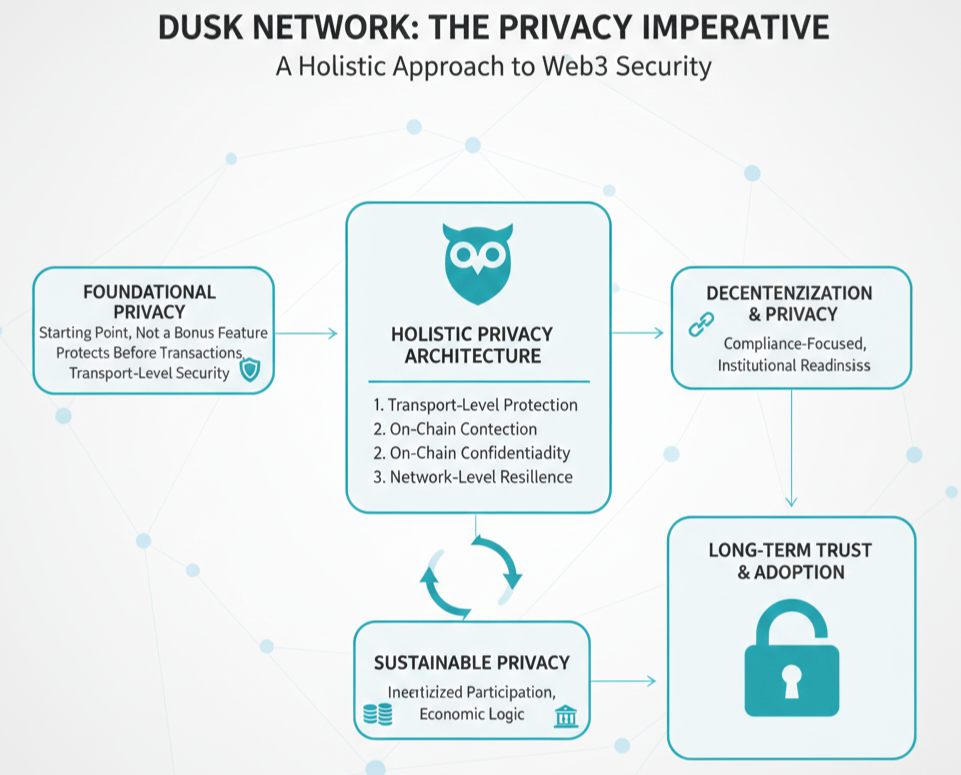
Instead of treating privacy like a bonus feature, Dusk treats it like the starting point. That mindset became especially clear through its Helios Grants Program, a multi-million-dollar initiative designed to fund serious research into zero-knowledge proofs and privacy infrastructure. One of the grants went to a Swiss privacy project focused on protecting data at the transport level, the layer most users never think about but attackers absolutely do.
That decision alone says a lot. Dusk isn’t just interested in hiding transaction details. It’s trying to protect users before a transaction even exists.
Privacy Isn’t Competing With Decentralization
There’s this strange idea in crypto that privacy and decentralization are somehow separate goals or even competing ones. I’ve never bought into that. If anything, I think decentralization without privacy is incomplete. You can distribute nodes across the world but if user behavior, metadata or network traffic can be traced, the system is still vulnerable.
Dusk Network openly challenges this assumption. The core belief is simple: without privacy, crypto cannot function safely. If your IP address can be linked to your wallet, or your activity can be profiled long before anything is signed on-chain, then the promise of self-sovereignty starts to fall apart.
What stands out to me is how grounded this perspective is. Dusk isn’t chasing anonymity for its own sake. It’s focused on privacy that works alongside compliance and real-world requirements. That balance is uncomfortable but necessary, especially if blockchain technology is ever going to be used seriously by institutions, governments or regulated markets.
The Problem Most People Don’t See
One of the most uncomfortable truths in Web3 is that users leak massive amounts of information without realizing it. Even before a transaction happens, data like network routes, timing patterns and connection metadata can reveal who you are and what you’re doing. In many cases, the damage is already done before a wallet prompt even appears.
This is exactly why Dusk’s focus resonates with me.
By supporting transport-level privacy research, Dusk is acknowledging that privacy doesn’t start on-chain. It starts the moment a user connects. Ignoring that layer is like locking your front door while leaving all the windows wide open.
Very few projects are willing to admit this, because fixing it is hard. It requires coordination across infrastructure, incentives and protocol design. Dusk seems willing to do that work.
Making Privacy Sustainable, Not Theoretical
Another thing I appreciate about the ecosystem Dusk is building around itself is that privacy isn’t treated as charity. It’s treated as infrastructure. Participants who help protect the network are rewarded, which means privacy scales naturally as more people join.
That incentive alignment matters more than most people realize. Privacy systems that depend on trust or goodwill tend to collapse under pressure. Systems that reward participation tend to survive.
From my perspective, this is how privacy should work in Web3. Not as an optional toggle or a premium feature but as a default condition maintained by economic logic.
A Different Take on Funding
A lot of criticism around Web3 lately has focused on funding models, especially the heavy influence of venture capital. While that criticism isn’t always fair, it does highlight a real problem: too many projects end up serving investors before users.
Dusk Network’s grant-based approach feels like a quiet rejection of that model. Instead of buying influence, it supports research, experimentation and long-term infrastructure. Projects aligned with Dusk tend to emphasize decentralized governance and community ownership, which, in my opinion, is how this space was always meant to evolve.
Privacy Has to Exist Everywhere
The reality is that privacy problems don’t live in just one place. They exist when users access decentralized services, when transactions are broadcast, when blocks are formed and even when data is indexed or relayed across the network.
What makes Dusk Network compelling is its willingness to tackle privacy across multiple layers instead of pretending one solution fits all. Transport-level protection, on-chain confidentiality and resistance to network-level attacks are all part of the same picture.
That’s not flashy work. It doesn’t generate instant hype. But it’s the kind of work that actually keeps systems alive.
To me, Dusk Coin represents a mindset more than a trend. It reflects patience in an industry obsessed with speed and depth in a space addicted to surface-level narratives. While others focus on what looks good in the short term, Dusk seems focused on what still works when things get difficult.
Privacy isn’t going to become mainstream because people suddenly care more. It will become mainstream when users don’t have to think about it at all, when it’s built so deeply into the system that exposure simply isn’t the default.
That’s the direction Dusk Network is pushing toward. And in a Web3 world that often confuses noise with progress, that approach feels not just refreshing but necessary.