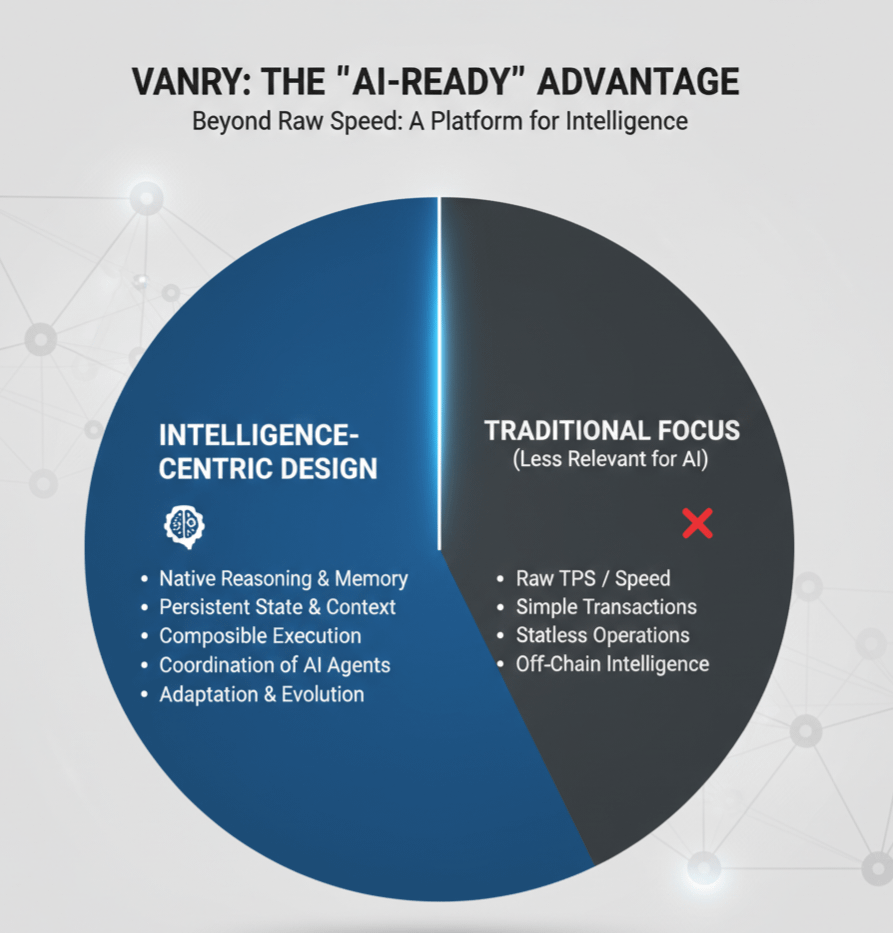
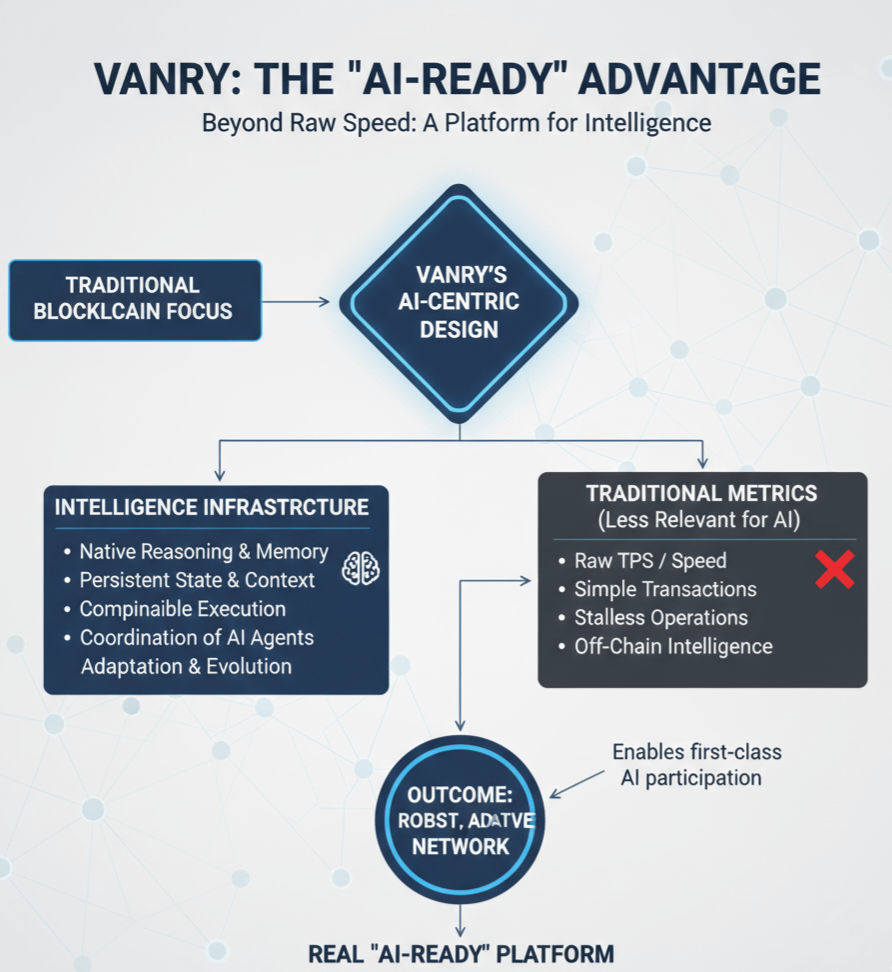
The phrase “AI-ready blockchain” gets tossed around a lot these days, often without much clarity about what it truly entails. Most people assume it simply means fast, cheap or highly scalable but that’s a shallow understanding. From my perspective, AI doesn’t just need speed. It needs a system designed to support intelligence itself, a space where reasoning, memory and coordination can happen natively, rather than being awkwardly added on top. This is where Vanry quietly stands apart from most blockchains.
When I think about what “AI-ready” really means, I don’t think about transactions per second or benchmark charts. I think about whether a network can sustain intelligent systems that operate continuously, interact with each other, adapt over time and evolve without constantly running into infrastructural limits. Vanry feels like it was built with that reality in mind. It’s not about flashy numbers; it’s about the kind of environment that allows AI to exist as a first-class participant.
One of the biggest misconceptions is that AI-ready blockchains are simply the fastest blockchains. This idea comes from applying old mental models to a completely new problem. Speed mattered when blockchains were primarily used for moving tokens or processing simple transactions. But AI systems don’t behave like traditional payments. They are more like living processes that require persistent memory, predictable execution and the ability to coordinate across multiple agents. A chain that can process thousands of transactions per second doesn’t automatically provide those qualities. In fact, prioritizing raw speed often makes systems more brittle and less deterministic, which is exactly the opposite of what AI needs. Vanry doesn’t compete on speed alone. Its focus is on creating a space where intelligent logic can operate reliably and predictably, which, in my opinion, is far more important.
This leads to why metrics like TPS and raw speed are no longer the best way to judge a blockchain’s potential for AI. Transaction throughput was a convenient way to compare networks when activity was simple and linear. But AI workloads expose how meaningless those numbers can be. AI systems need more than quick transactions; they need consistent, composable execution and a chain that can manage complex state without fragmentation. They need an infrastructure that scales intelligence, not just activity. TPS might look impressive on a leaderboard but it tells you very little about whether a blockchain can support autonomous systems that think, learn, and interact over time. Vanry’s architecture seems aligned with this reality. It prioritizes structured execution and intelligent state management over flashy benchmarks, which is exactly what AI requires.
Many of the assumptions that guided traditional blockchain design are now outdated. For instance, the idea that blockchains are primarily settlement layers limits their potential. This assumption treats the blockchain as a passive ledger, where intelligence always has to live off-chain. AI flips this notion on its head, demanding that the blockchain itself becomes an execution layer capable of running complex reasoning. Another outdated belief is that statelessness is always ideal. Stateless systems may scale more easily but AI depends on memory, evolving context, and persistent state. A blockchain that ignores this will struggle to support real intelligent processes. There’s also the misconception that determinism and flexibility are mutually exclusive. In reality, AI needs both: deterministic foundations to maintain trust and flexible logic to adapt and grow. Vanry seems to understand this balance intuitively.
From my point of view, what makes Vanry genuinely AI-first isn’t any single technical feature, it’s the philosophy behind its design. It doesn’t feel like a blockchain that simply added AI capabilities later; it feels like it was built with the expectation that intelligent systems would be its primary users. AI isn’t treated as an external add-on but as a native participant in the ecosystem. That mindset changes everything, from how execution is structured to how coordination and incentives are designed. Instead of forcing AI into frameworks built for simple transactions, Vanry reshapes the framework itself to accommodate intelligence.
In the future, the most valuable blockchains won’t be the ones with the fastest numbers or the loudest marketing. They will be the ones that quietly and reliably support complex, autonomous systems without friction. From where I stand, Vanry is aiming for that future and that’s what being AI-ready truly means.