

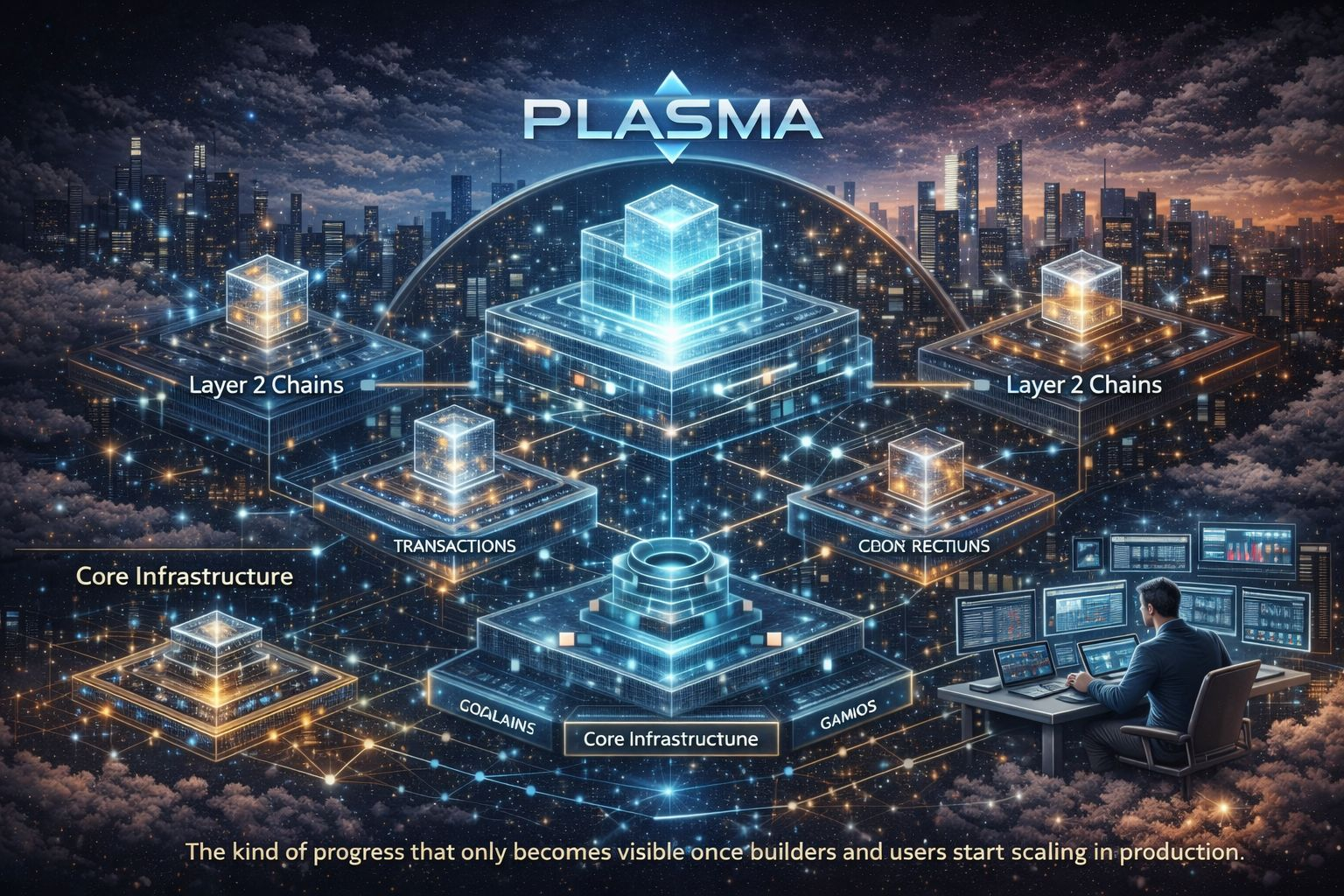
Plasma has entered a phase where progress is measured less by headlines and more by structural refinement. Recent updates and announcements point to a clear strategic direction: Plasma is prioritizing reliability, scalability, and developer-ready infrastructure over short-term experimentation. In an environment where many networks optimize for attention, Plasma is focusing on the less visible work that determines whether applications can actually operate at scale.
At its core, Plasma’s mission remains tightly scoped around scalability. Rather than positioning itself as a general-purpose narrative chain, Plasma continues to emphasize its role as infrastructure — a network designed to support high transaction throughput, predictable costs, and stable execution. This focus is increasingly relevant as Web3 applications mature and move from pilot phases into sustained production environments, where performance consistency matters more than novelty.
One of the key themes emerging from recent Plasma updates is optimization at the protocol level. Improvements to transaction handling, batching mechanisms, and network coordination signal an effort to reduce friction for applications operating under real load. These changes may not appear dramatic on the surface, but they directly affect how developers design systems, manage costs, and plan long-term deployment. Scalability, in practice, is less about theoretical limits and more about how a network behaves when usage is continuous rather than episodic.
Plasma’s ecosystem tooling has also seen incremental but meaningful refinement. Developer-facing components are being aligned toward smoother onboarding and clearer operational workflows. This includes better visibility into network behavior, improved documentation pathways, and infrastructure components designed to reduce the complexity of launching and maintaining applications. The underlying message is consistent: Plasma is optimizing for builders who intend to stay, not for experimental traffic that disappears after incentives fade.
Another important signal from recent announcements is Plasma’s emphasis on application readiness rather than abstract scalability claims. By tightening the relationship between the core network and its surrounding tooling, Plasma is positioning itself as an execution layer that can support diverse application categories — from transactional systems to interactive platforms — without forcing developers to engineer around infrastructure constraints. This is a subtle shift, but it reflects a growing understanding that developer experience is inseparable from network performance.
From an architectural standpoint, Plasma continues to reinforce its role as a scaling layer rather than a competing base layer. This positioning allows it to focus resources on efficiency, throughput, and coordination instead of spreading effort across unrelated features. In a multi-layer blockchain environment, this specialization is increasingly valuable. Applications do not need every network to do everything; they need components that do specific jobs reliably. Plasma’s recent direction aligns closely with this modular reality.
Ecosystem signals also suggest a more disciplined growth strategy. Rather than accelerating expansion through aggressive incentives, Plasma appears to be concentrating on organic usage driven by application needs. This approach typically results in slower headline growth, but it tends to produce more durable ecosystems. Networks built on sustained demand rather than transient rewards are better positioned to weather shifts in market sentiment and user behavior.
Importantly, Plasma’s recent progress highlights a broader trend within blockchain infrastructure: the transition from experimentation to operational maturity. As applications demand higher uptime, clearer performance guarantees, and predictable execution environments, scaling layers must evolve accordingly. Plasma’s updates indicate that it is responding to this shift by refining the fundamentals rather than reinventing its identity.
In practical terms, this means Plasma is becoming less about promise and more about presence. Its value proposition is increasingly tied to what it enables today — stable throughput, efficient execution, and a development environment that supports long-term planning. These qualities rarely dominate conversation cycles, but they are the characteristics that determine which networks remain relevant once speculative cycles subside.
Viewed through this lens, Plasma’s latest announcements reflect a network settling into its role. It is not attempting to redefine blockchain architecture overnight, nor is it competing for narrative dominance. Instead, it is reinforcing the infrastructure layer that allows applications to scale quietly and consistently. In a space where attention often moves faster than adoption, Plasma’s measured progress suggests a long-term orientation — one built around execution, not excitement.