
Plasma. The most significant shift in the 2026 market structure is not the rise of a new asset class, but the quiet, systematic dismantling of the gas-token tax in global financial settlement. For years, the crypto industry operated under the delusion that a general-purpose "world computer" could also serve as an efficient payment rail, ignoring the fundamental reality that high-velocity commerce cannot survive on infrastructure that requires a dual-asset overhead. Every participant who has ever been stranded with a thousand dollars in stablecoins but zero in native gas tokens knows this isn't just a UX hurdle it is a structural failure of capital efficiency. Plasma is the first credible attempt to unbundle the settlement layer from the speculative execution layer, treating the stablecoin not as a guest on the network, but as its primary reason for existence.
The core thesis of Plasma centers on the obsolescence of the "all-purpose" blockchain. In the current market, we are seeing a violent bifurcation between chains built for high-leverage DeFi and those built for the boring, high-volume reality of global payouts, payroll, and merchant settlement. While Ethereum remains the gravity well for long-tail assets and complex state-management, its fragmentation across dozens of Layer 2s has created a "bridging tax" that institutional capital is increasingly unwilling to pay. Plasma circumvents this by positioning itself as a sovereign Layer 1 that borrows its historical truth from Bitcoin while maintaining the execution flexibility of the Ethereum Virtual Machine. This isn't a compromise; it’s a recognition that the "security" most L2 sequencers offer is actually a centralization risk in disguise. By anchoring state commitments to the Bitcoin blockchain, Plasma creates a neutral, censorship-resistant floor that exists outside the jurisdictional reach of any single sequencer or validator set.
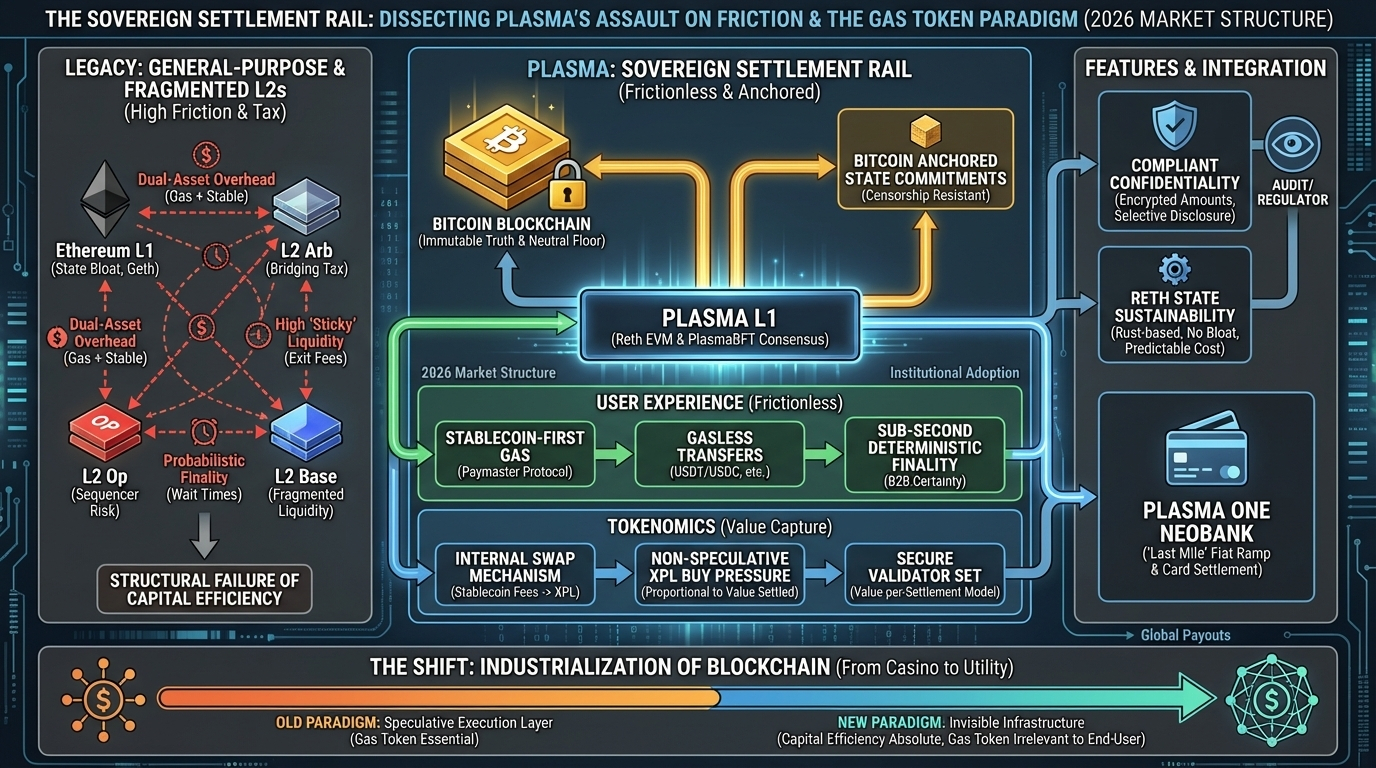
From an infrastructure perspective, the choice of Reth the Rust-based implementation of the EVM signals a shift toward state-management sustainability. In the legacy Geth-dominated world, state bloat was a slow poison that forced a trade-off between decentralization and performance. Reth allows Plasma to push sub-second finality through its PlasmaBFT consensus without the typical degradation in node stability. For a trader, "finality" is often a theoretical metric, but for a settlement rail, it is the difference between a successful B2B transaction and a capital-management nightmare. When a transaction is finalized on PlasmaBFT, it is deterministic. There is no probabilistic "wait for ten blocks" anxiety. This architectural certainty is what allows institutional players to treat on-chain liquidity as "cash equivalent" rather than "pending settlement."
Liquidity behavior on Plasma reveals a silent shift in how capital flows through the ecosystem. On general-purpose chains, liquidity is often "sticky" for the wrong reasons users are trapped by high exit fees or the friction of acquiring gas. On Plasma, the introduction of gasless USDT transfers and stablecoin-first gas creates a high-velocity environment where capital moves according to utility rather than friction. When a user can send 50,000 USDT and the recipient receives exactly 50,000 USDT without either party ever touching a native XPL token, the blockchain finally begins to behave like a financial utility rather than a casino. This abstraction layer is powered by a protocol-level paymaster system that sponsors stablecoin transfers, funded initially by the ecosystem’s structural incentives and eventually by the spread in secondary services. It effectively turns the blockchain into a "freemium" rail for the assets that matter most.
The validator economics of such a system initially seem counterintuitive. If the network is giving away its primary product blockspace
for "free," how does it maintain a secure, incentivized validator set? The answer lies in the shift from a "tax-per-transaction" model to a "value-per-settlement" model. While simple transfers are sponsored, complex smart contract execution and priority sequencing still require XPL. More importantly, the system implements an internal swap mechanism where stablecoin fees are automatically converted into XPL in the background. This creates a constant, non-speculative buy-pressure for the native asset that is proportional to the network’s actual utility. Unlike the inflationary spirals seen in many 2021-era Layer 1s, Plasma’s tokenomics are designed to capture the "settlement float." As more volume moves through the chain, the demand for XPL to secure those transactions scales with the value being settled, not just the number of clicks on a screen.
Institutional adoption has historically been strangled by the "public ledger paradox": businesses need the transparency and speed of a blockchain but cannot afford to leak their entire treasury history or payroll data to the public. Plasma’s implementation of "compliant confidentiality" addresses this head-on. By allowing for encrypted transaction amounts that are selectively disclosable to auditors or regulators, it removes the last major barrier for enterprise-grade adoption. This isn't "dark pool" privacy designed for obfuscation; it is "business-grade" privacy designed for operational security. In a 2026 regulatory environment where the US Clarity Act and Europe’s MiCA have forced a cleanup of offshore practices, this middle-ground architecture is exactly what attracts durable, long-term capital that would never touch a fully anonymous chain.
Looking at the competitive landscape, the structural weaknesses of the "modular" narrative are becoming apparent. The current trend of separating data availability, execution, and settlement into different layers has led to a fragmented user experience where liquidity is isolated in silos. A user on one L2 cannot easily settle with a user on another without navigating a labyrinth of bridges and third-party relayers, each adding a layer of risk and cost. Plasma’s "monolithic-but-anchored" design provides a single, unified environment where stablecoin liquidity is concentrated. This concentration is a magnet for market makers who thrive on the efficiency of a single, high-performance order book rather than fighting for scraps across twenty different sequencers.
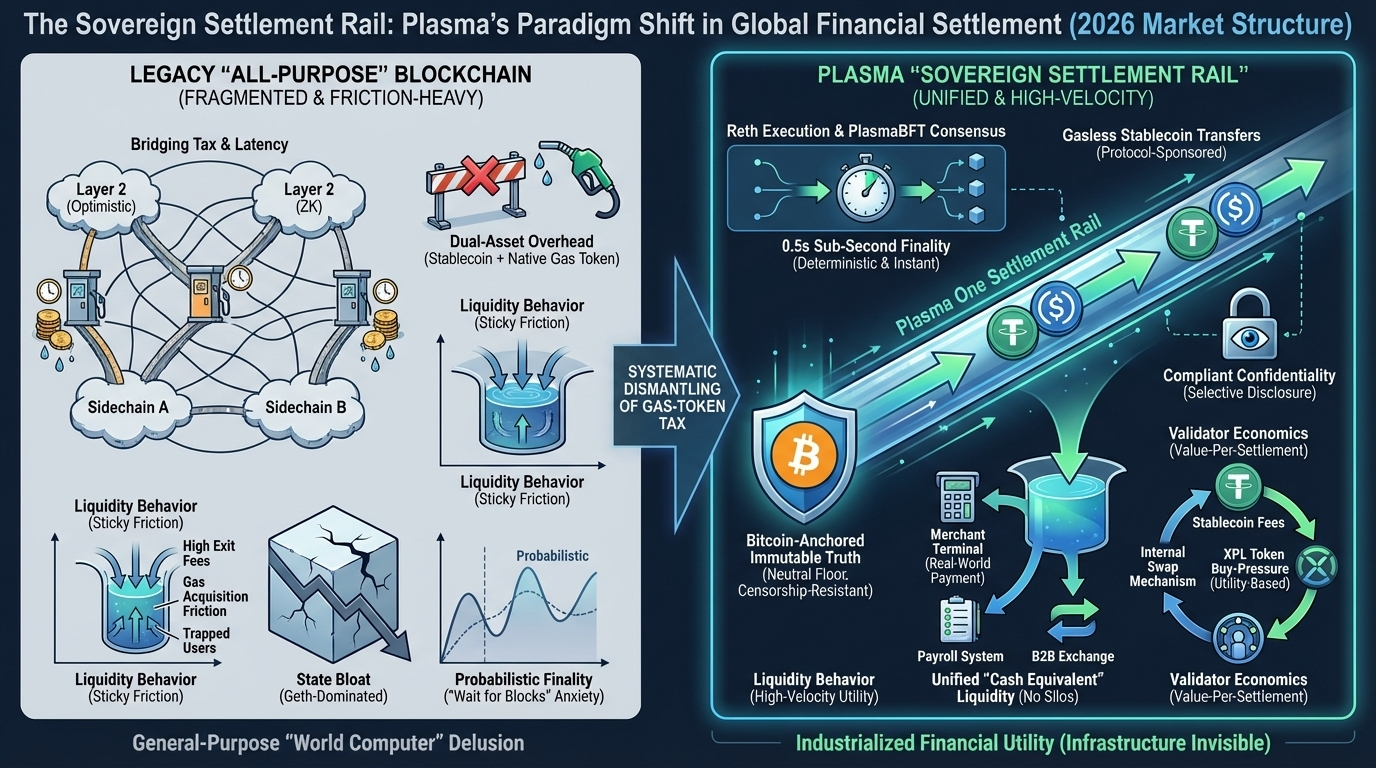
The relationship between Plasma and the Bitcoin network is also widely misunderstood as a marketing gimmick, but the reality is much more tactical. In an era of increasing geopolitical tension and regulatory overreach, the "neutrality" of a chain is its most valuable asset. Bitcoin is the only asset that the global market has collectively agreed is neutral. By anchoring to Bitcoin, Plasma inherits a level of censorship resistance that a standalone PoS chain simply cannot match. If the Plasma validator set were ever compromised or pressured by a specific jurisdiction, the Bitcoin-anchored history would serve as an immutable record that prevents the rewriting of state. For a multi-billion dollar treasury, that "disaster recovery" guarantee is more important than any "high-TPS" headline.
The real-world integration of Plasma through the Plasma One neobank serves as the final piece of the puzzle. It acts as the "last mile" for on-chain capital, bridging the gap between the Reth execution layer and the physical world of merchant terminals. When a user earns a 10% yield on their stablecoin balance within the Plasma ecosystem and then spends it via a debit card that settles instantly on-chain, the distinction between "crypto" and "finance" disappears. We are moving away from an era where we "trade crypto" and into an era where we "use rails." The chains that survive the next three years will be the ones that recognize they are not the stars of the show—the assets they carry are.
Sustainability in the crypto market is no longer about high APRs or flashy partnerships; it is about the cost of maintaining the state versus the value that state provides. By specializing in stablecoin settlement, Plasma avoids the "garbage in, garbage out" problem that plagues general-purpose chains where 90% of the blockspace is occupied by transient, low-value data like memecoin spam or NFT mints. Because the network is tuned for value-dense transactions, the cost of running a node remains predictable, and the hardware requirements stay within the reach of professional validators without requiring a supercomputer. This lean architecture is the only way to survive a long-term contraction in speculative interest.
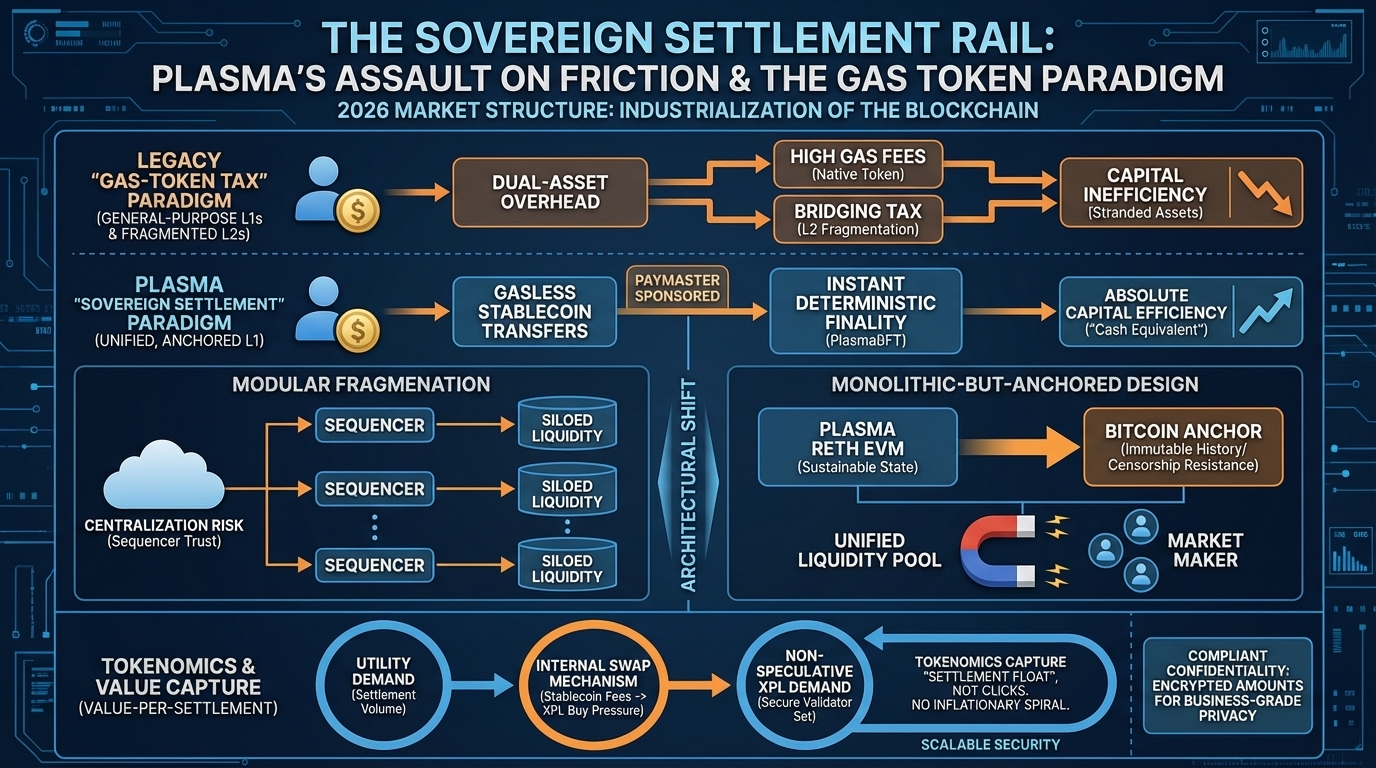
Ultimately, Plasma represents the "industrialization" of the blockchain. It is the transition from the "garage build" phase of Ethereum to the "global utility" phase of financial infrastructure. For those of us who have survived the volatility of the last decade, the appeal of Plasma isn't in its potential for a 100x pump, but in its potential to make the native "gas token" irrelevant to the end-user. The market is finally maturing enough to realize that if you have to explain what "gas" is to a user, you have already lost the battle for adoption. Plasma wins by making the infrastructure invisible, the settlement instant, and the capital efficiency absolute.