
When I first looked at Plasma, it was not because I was hunting for another new chain narrative. It was because a pattern kept showing up in the boring parts of crypto, the parts people only talk about after something breaks. Stablecoins were doing more real work than most tokens, but they were still forced to move through systems that feel like they were designed for anything except money movement. You could see it in every little friction point: the user who has USDT but cannot pay gas, the business that wants to settle invoices but ends up juggling three networks, the treasury team that cares about certainty more than composability. Plasma caught my attention because it treats that friction as the core problem, not an edge case.
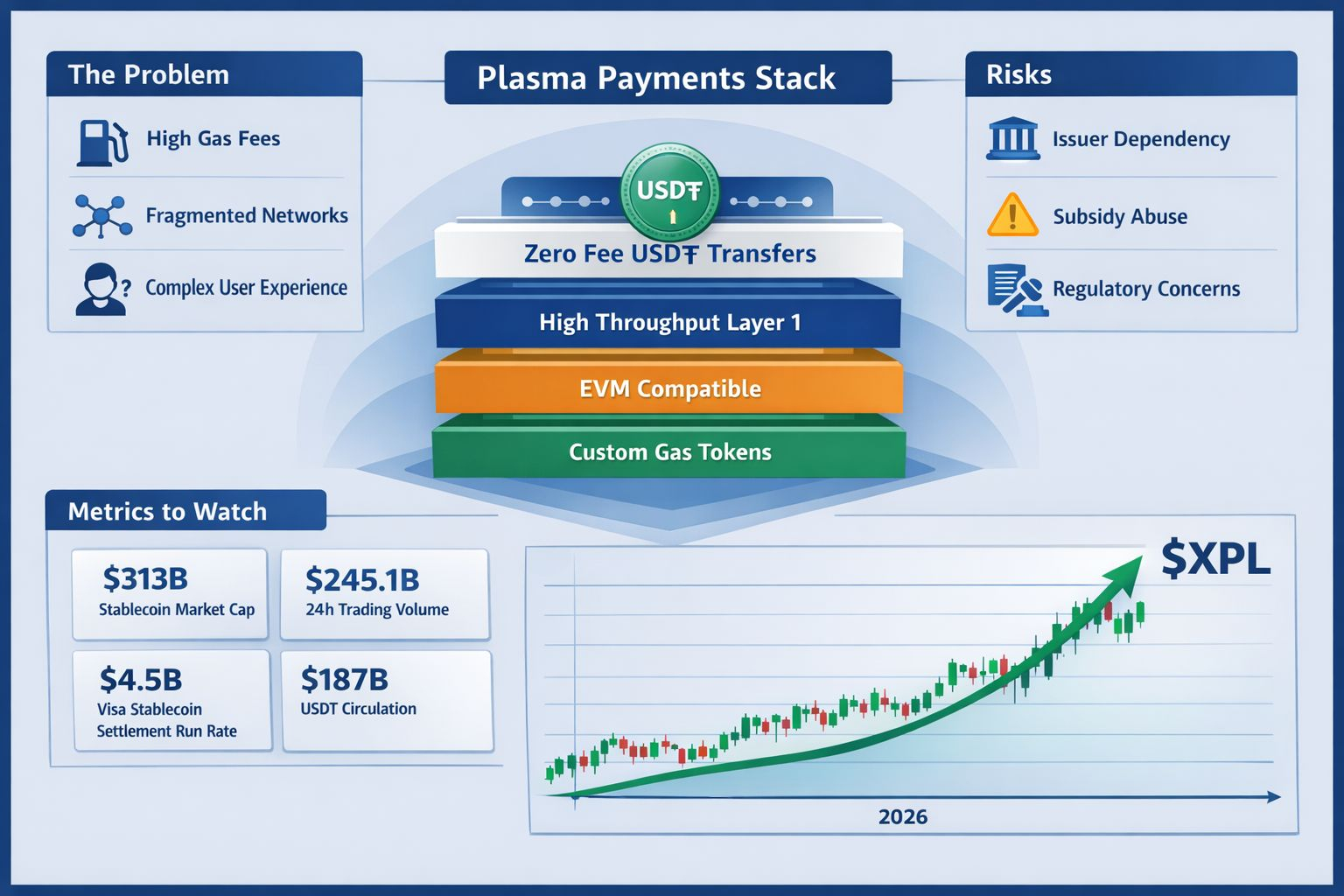
The timing helps explain why this angle is suddenly loud. The stablecoin market is not a niche corner anymore. On CoinMarketCap, the stablecoin category is sitting around $313.0 billion in market cap, with roughly $245.1 billion in reported 24 hour trading volume. Those numbers are easy to misread, so the context matters. Market cap there is basically outstanding supply, a proxy for how much dollar like liquidity is parked onchain. The 24 hour volume is largely exchange driven churn, so it exaggerates “economic activity” in the everyday sense, but it still tells you something real: stablecoins are the grease in the pipes, and the pipes are busy.
You can triangulate the same trend from other places. A recent Yahoo Finance piece citing DeFiLlama data said stablecoin market cap hit a peak around $311.3 billion on January 18, 2026, and was hovering near $309.1 billion a few days later. That is not a speculative spike, it is a steady accumulation that looks a lot like people using these instruments as financial plumbing. Meanwhile, Visa is publicly talking about stablecoin settlement, but even it frames the scale honestly: stablecoin settlement via Visa is at an annual run rate of about $4.5 billion, compared with Visa’s total payments volume around $14.2 trillion. That gap is the story. Stablecoins are everywhere in crypto, but still early in mainstream payments, and the infrastructure in between is where most of the leverage sits.
Plasma’s bet is that if you design a chain as if it is a payments network first, you end up making different choices than if you design a chain as a general purpose world computer and then bolt payments on later. Plasma describes itself as a high performance Layer 1 built for USD₮ payments, near instant transfers, low fees, and EVM compatibility. The key detail is not EVM, lots of teams can say EVM. The key detail is that it is willing to special case stablecoin flows at the protocol level, because it assumes the primary job is moving a dollar token from A to B reliably at scale.
The most concrete expression of that is the “zero fee USD₮ transfers” mechanism. Plasma’s docs describe a protocol maintained paymaster contract that sponsors gas for eligible USD₮ transfers, covering the gas cost for standard transfer calls with lightweight identity checks and rate limits enforced at the protocol level. If you have been in crypto long enough, you know why this matters. Gas is the tax that breaks UX, and it breaks it in a very specific way. It forces users to hold a volatile asset they did not want, just to move the stable asset they actually came for. Underneath the surface, that also creates compliance and support headaches, because people get stuck before they even make their first payment.
What Plasma is really doing there is taking a wallet and customer support problem and turning it into a protocol primitive. On the surface, it looks like fee free transfers. Underneath, it is a controlled subsidy system with eligibility logic and limits, meaning the chain is explicitly budgeting for payments like a payments company would. That enables a cleaner user journey and more predictable costs for developers. It also creates new risks. Someone has to decide what “eligible” means, and someone has to pay for the subsidy. If the checks are too strict, you lose the simplicity that made the idea attractive. If the checks are too loose, you invite abuse, and abuse in fee subsidy systems tends to show up quickly.
This is where Plasma’s stablecoin first posture gets interesting, because it forces you to ask what “decentralization” even means in the context of payments. In a general purpose chain, you usually treat neutrality as a default, and you tolerate messy UX because you get permissionless flexibility. In a payments rail, neutrality is still valuable, but operational clarity matters more than ideological purity. Plasma is implicitly saying that the product users want is not “permissionless gas markets,” they want money movement that feels steady, earned, and predictable.
Another design choice follows from that. Plasma says it supports custom gas tokens and is engineered for performance, with the ability to process thousands of transactions per second. Again, the number is easy to wave around, but the context is that payments traffic is bursty and operationally sensitive. A chain can handle high TPS in a lab and still fail as a payments system if it cannot deliver consistent confirmation times under load, or if fees spike at the worst possible moment. The stablecoin payments world punishes variance. A wallet can be slow and users shrug. A payment rail is slow and the business stops trusting it.
It also helps explain why Plasma is tied so explicitly to USD₮. Tether’s USDT is still the dominant dollar token, with circulation reported around $187 billion in mid January 2026. If you are building for “real world money movement,” you do not start by asking which stablecoin is philosophically preferred, you start by asking which one people already use in size, in emerging markets, and across exchanges. The distribution is the moat, and USDT’s distribution is very real.
That said, building a chain around USDT also concentrates your dependency. Reuters reporting on Tether’s reserves and activities is a reminder that stablecoins live in a hybrid world, part crypto rail, part financial issuer. If issuer risk re prices, if there is regulatory pressure, if banking relationships change, your “money movement chain” inherits those shocks whether you like it or not. So Plasma’s upside is aligned with USDT adoption, but its tail risk is also aligned with USDT specific events.
The funding and backers signal what Plasma thinks it is competing with. Plasma announced it raised $24 million across seed and Series A led by Framework Ventures and Bitfinex, with participation that includes trading and market structure names like DRW and Flow Traders, plus others. A later Plasma post describes a strategic investment from Founders Fund. Read that as a clue about the intended endgame. This is not just “let’s get some DeFi apps.” It is closer to “let’s build a settlement network that institutions and payment companies can reason about.”
You can see the broader market pressure in parallel moves. Polygon Labs is openly targeting stablecoin payments and has announced acquisitions in that direction, with deal value reported over $250 million. That is not a Plasma specific datapoint, but it frames the environment. Multiple teams are converging on the same conclusion: stablecoins are becoming a primary product, and the infrastructure stack around them is fragmented.
The obvious counterargument is that you do not need a new chain for this. You can do fee abstraction, gas sponsorship, and stablecoin centric UX on existing L2s or appchains. That is true, and it is the baseline Plasma has to beat. Plasma’s response, implicitly, is that doing it at the protocol level lets you make tighter guarantees and simpler defaults. The question is whether those guarantees hold when the chain is stressed, when subsidy budgets are attacked, and when compliance expectations rise. Payments infrastructure is not tested by hackathons, it is tested by months of boring throughput, edge cases, chargeback like disputes, and the slow grind of operational risk.
If this holds through 2026, what it reveals is a larger shift in crypto’s center of gravity. For years, we treated stablecoins as an add on, a convenient unit of account for trading. Now they look more like the first product that actually escaped the lab. That momentum creates another effect: once stablecoins are the product, everything else becomes support infrastructure. Wallet design, onramps, KYC layers, paymasters, monitoring, even consensus tuning start to look like payment company decisions, not crypto ideology debates.
My working thesis is that 2026 is the year the market stops arguing about whether stablecoins “count” as real payments and starts competing on the boring parts: uptime, predictability, compliance posture, integration cost, and distribution. Plasma is built around that worldview. It might win because it is focused. It might lose because distribution and trust are brutal moats, and payments is where reputations go to die. Early signs suggest the opportunity is real, but it remains to be seen whether the model scales without centralizing too much control in the name of smoother UX.
The sharpest way I can put it is this: the next phase of crypto will not be decided by who can do the most things, it will be decided by who can do one thing, moving dollars, with a texture that feels steady enough that nobody has to think about it.