
Dusk Network is a Layer-1 blockchain designed to bring privacy, regulatory compliance, and programmability to tokenized financial markets. Unlike traditional public blockchains where all activity is transparent, Dusk aims to combine confidential transactions with on-chain compliance, making it attractive for institutional and regulated asset issuance. 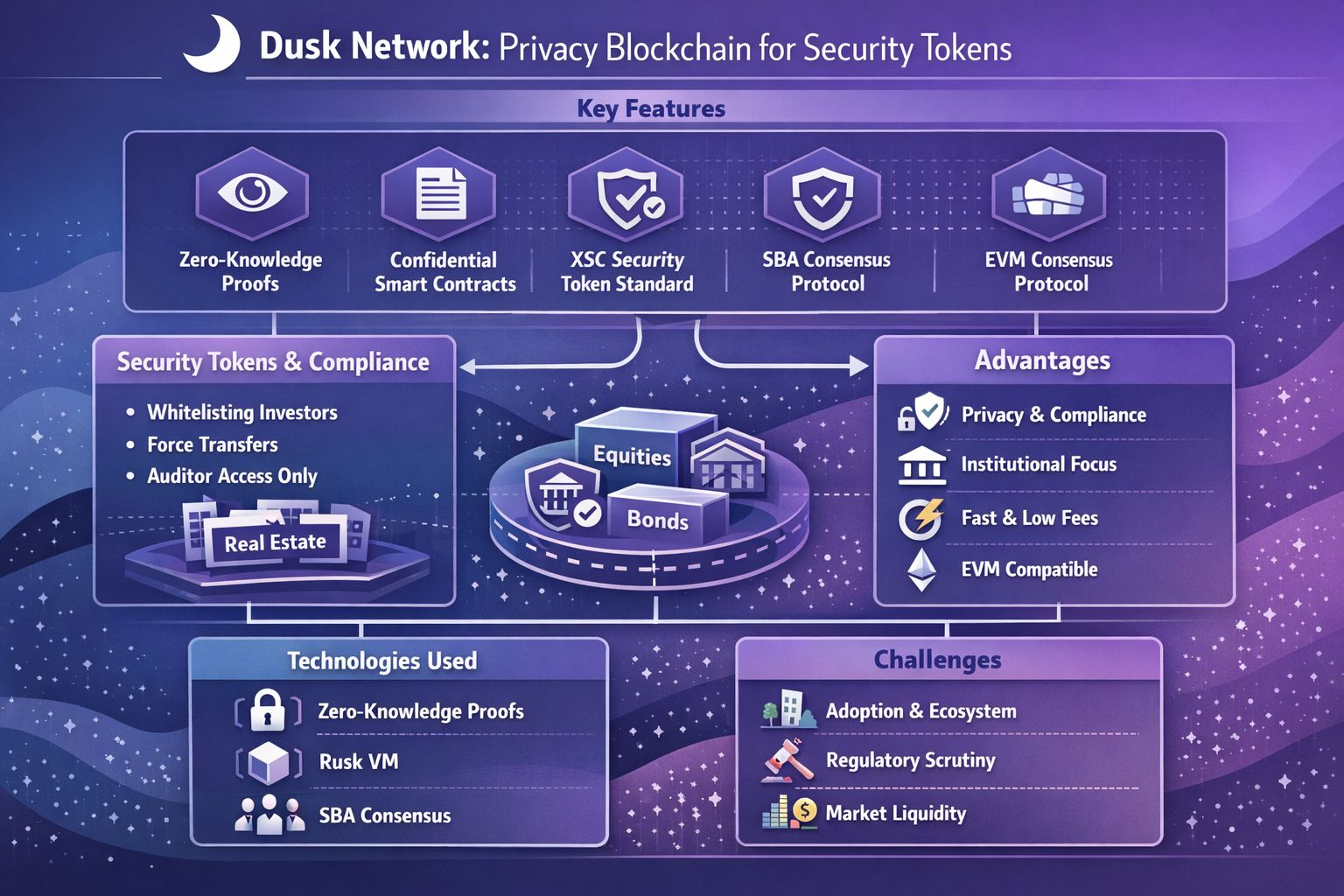
What Is Dusk Network?
Dusk Network positions itself as a blockchain built specifically for regulated finance and security tokenization, offering privacy by default while enabling compliance with financial regulations such as MiCA and MiFID II. It supports both confidential and transparent transaction models, allowing users and institutions to choose the level of privacy required.
At its core, Dusk combines:
Zero-knowledge cryptography to keep transaction details confidential.
Native support for compliant issuance and trading of security tokens.
EVM-compatible development tools, privacy primitives, and an efficient consensus protocol.
Key Technologies and Standards
1. Zero-Knowledge Privacy Tools
Dusk uses advanced cryptographic techniques — including zero-knowledge proofs, stealth addresses, and ring signatures — to hide transaction data like amounts, parties, and identities from public observers.
2. Confidential Transaction Models
Dusk supports multiple transaction standards:
TC (Transparent Token Contract) — similar to typical ERC-20 style tokens.
XC (Confidential Token Contract) — privacy-first token transfers.
XSC (Confidential Security Contract) — a standard tailored for security tokens with regulatory compliance, whitelisting, force transfers, and corporate actions built into smart contracts.
3. Privacy-Preserving Smart Contracts
The platform’s smart contract environment — including the Rusk virtual machine — allows developers to write contracts where inputs and outputs can remain encrypted yet verifiable. This is ideal for business logic that must stay confidential, such as financial settlement or automated dividend distribution.
4. Segregated Byzantine Agreement (SBA) Consensus
Dusk uses a variant of Proof-of-Stake with Segregated Byzantine Agreement, incorporating privacy-friendly leader selection and fast transaction finality, designed to scale while keeping the network secure and decentralized.
Security Tokens and Regulatory Compliance
A major differentiator for Dusk is its deep focus on security tokens — tokenized versions of real-world financial instruments like equities, bonds, and other securities. These tokens are not only programmable but also built to reflect legal obligations like investor eligibility, audits, and reporting.
The XSC standard allows companies to embed compliance features directly into the token’s logic, enabling functions such as:
Whitelisting accredited investors
Forced transfers for corporate actions
Auditor-only access to private state
These capabilities aim to bridge the gap between traditional financial markets and decentralized blockchain technology.
Advantages of Dusk Network
✔ Privacy + Compliance:
By default, transactions and smart contracts can remain private, yet selective disclosures can be made for auditing or regulatory needs.
✔ Designed for Institutional Use:
Dusk’s tooling and token standards reflect the real needs of regulated markets, prioritizing compliance alongside decentralization.
✔ Fast Finality & Low Fees:
Designed with an efficient consensus model for quick settlement and cost-effective transactions, appealing to business applications.
✔ EVM Compatibility:
Developers familiar with Ethereum tooling can build on Dusk while accessing privacy and compliance features.
Challenges and Considerations
⚠ Adoption & Ecosystem:
Real-world utilization of privacy blockchains for regulated markets remains early, and actual deployment by institutions will require legal certainty and ecosystem growth.
⚠ Regulatory Scrutiny:
Privacy-oriented technologies sometimes attract regulatory scrutiny due to concerns about illicit activity, meaning Dusk’s compliance layers must remain robust.
⚠ Market and Liquidity:
As with many niche blockchain projects, token liquidity and market interest can vary, especially beyond major exchanges.
Conclusion
Dusk Network stands out as one of the few blockchains tailored for tokenized finance with privacy built in. By integrating privacy technology with on-chain compliance and enterprise-ready token standards like XSC, it aims to unlock a new category of regulated blockchain applications. Its success, however, depends on adoption by institutional players and regulatory clarity in major markets.