
When considering decentralized storage, we often think about metrics such as storage throughput, node redundancy, and distribution.
While these metrics may display a technically impressive system, they don’t answer the important question: what does storage actually do, and what purpose does it ultimately serve? Walrus shifts the perspective on decentralized storage.
Rather than viewing it as a neutral technical layer, Walrus treats it as a proactive infrastructure for maintaining digital continuity.
Walrus is less concerned about the micro-ecosystem of data storage and more focused on the macro-ecosystem of data persistence, evolution, and accessibility over time.
Walrus development can be understood through two complementary prototypes. The first validates operational reliability in the present. The second explores the expansion of decentralized storage into long-term global data infrastructure. Together, these prototypes illustrate a progression from functional proof toward systemic infrastructure evolution.
Walrus Now Prototype: Reliability as Foundational Trust
Keeping speculative innovation in check, the Walrus Now prototype emphasizes execution discipline. Most notably, it shows that decentralized storage can achieve comparable reliability to centralized cloud infrastructures. This phase is centered on reliable blob storage, structured data verification, and retrieval performance that is stable.
Developers building decentralized apps and early adopters in need of reliable storage primitives are the most likely candidates for this prototype. Walrus proves that by focusing on stability, it is reasonable to expect decentralized networks to enable enterprise data persistence at an affordable access and performance consistency.
From operational perspective, the Walrus Now prototype illustrates data fragmentation, the processes of retrieval, and the cryptographic integrity verification done eff irely. Complex coordinated node distribution is hidden from users who are simply interacting with storage services and that is the most important feature. By keeping experimental features to a minimum, Walrus develops the credibility of the infrastructure and the trust necessary for a long term commitment.
Walrus Future Prototype: Expanding Toward Data Civilization Infrastructure
While the current prototype tests for reliability, the Walrus Future prototype examines decentralized storage as a programmable data orchestration layer. This prototype phase takes Walrus from being a storage solution into a digital ecosystem that supports complex infrastructures.
Future designs predict storage networks that service AI-data pipelines, enterprise archival systems, decentralized media distribution, and applications with disparate datasets. It adds data orchestration, automated data lifecycle governance, intelligent blob control, and cross application interweaving.
This prototype is focused on investors and infrastructure planners looking at the strategic value of decentralized storage as a digital civilization building block. Although some components remain on the experimental side, strategically, they showcase Walrus’ ability to grow with data demand. The Future prototype shows that decentralized storage has the potential to become adaptive service-layer infrastructure and not remain as stagnant storage middleware.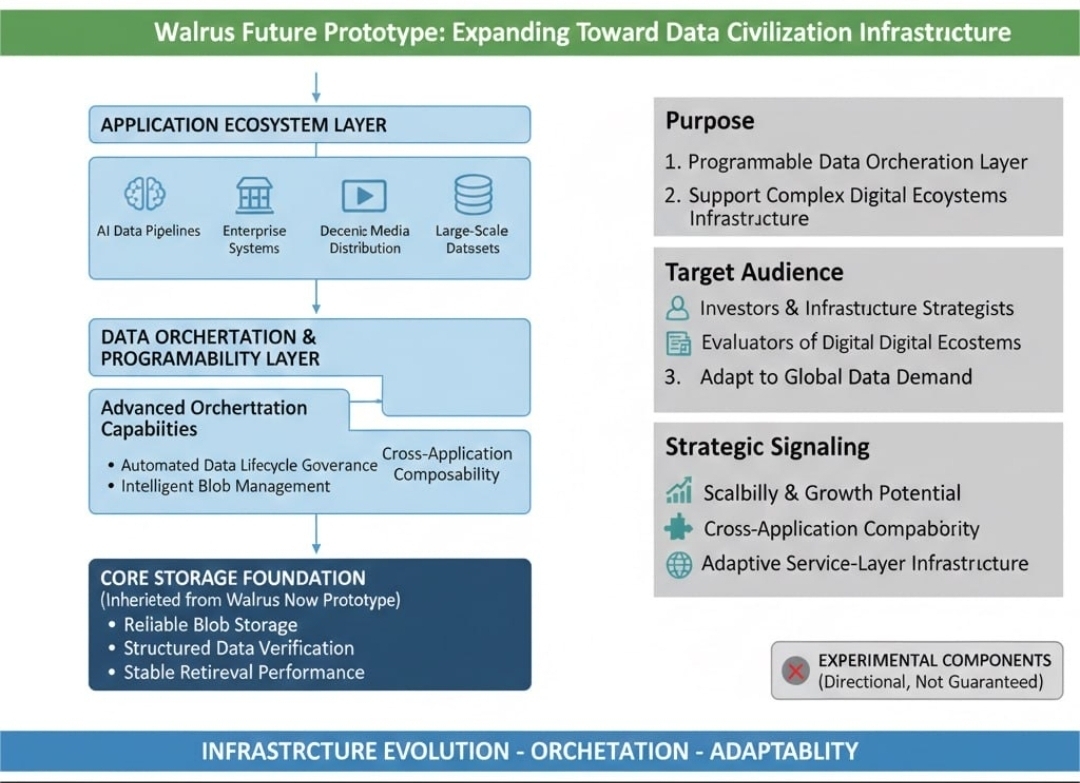
Walrus Memory Vault: Bringing Empathy to Storage
Tagline: “The internet never forgets unless you tell it how to”
The Walrus Memory Vault is an example of customer-first, decentralized storage. While value is created at the technical level, storing emotional connections is one of the biggest challenges of decentralized design. The Memory Vault makes an emotional connection by innovatively converting storage to a personal data sovereignty platform.
The Memory Vault allows users to utilize Walrus's infrastructure to create a decentralized personal vault and protect their digital life. The Memory Vault redefines storage, focusing on the emotional connection of preserving a digital legacy instead of preserving an abstract technical functionality.
Users can upload and vault highly sensitive and valuable assets such as documents, photos, personal messages, creative works, and personal data. Each asset is stored as a Walrus blob, which incorporates decentralized redundancy, cryptographic proof, and secure retrievability.
The Memory Vault is more than just storage; it also features programmable data governance. Users can specify access control entries that determine who can see, access, or obtain certain data. Users can also set up time-locks to delay data access, which can be configured to release data after certain periods of time, such as years.
Emergency access delegation allows certain users to retrieve important information after certain parameters have been met. With these features, your storage system evolves into programmable systems that act as programmable systems for inheritance.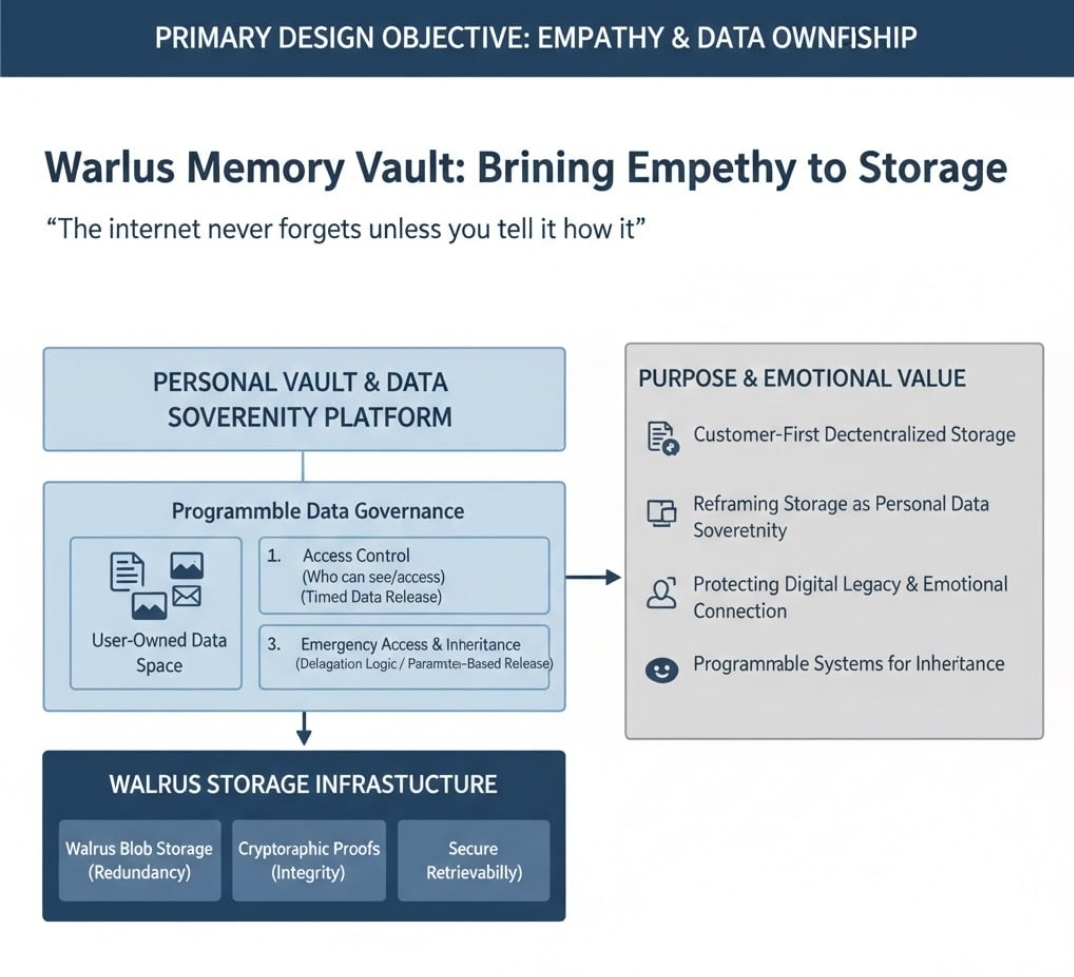
Demonstration Workflow: Experience as Infrastructure Validation
The Memory Vault demonstration showcases Walrus' infrastructure capabilities within a hands-on user experience. The user uploads a file to the Walrus Network and sets file access to a specific time in the future. The system uses blockchain technology to mimic time progression. When the time lock expires, the file is released, demonstrating the execution of the governance and access rules for that file.
This demonstration captures and validates numerous capabilities of the system, including reliabily of blob storage, strong cryptographic access controls, and automated system management, or in this case, file lifecycles. More importantly, it converts complex infrastructure into common user experience, deepening the ecosystem's understanding.
Strategic Infrastructure Implications
The Memory Vault serves a greater purpose in highlighting Walrus' value within the ecosystem. If distributed storage can reliably and securely store highly personal and sensitive information over extended periods of time, it can also preserve important information for enterprises, manage datasets for AI training, manage systems for regulatory compliance, and efficiently manage the transfer of digital assets across generations.
Walrus stands out by applying three specific principles of infrastructure: consistent dependability, programmable governance, and utility as center of focus. Harnessing this eclectic blend enables Walrus to function as not just storage infrastructure, but as a Digital Continuity Architecture of a lasting nature.
Conclusion: Storage as Continuity Engineering
Walrus Storage is a more than just storage solution. It is a manifestation of a shift in storage decentralization philosophy. It shows that storage infrastructure is about more than just keeping files. More importantly, it is about keeping a temporal record of a person's identity, creativity, knowledge, and history in the digital realm.
With its dual-prototype developmental approach combined with the practical use demonstration model, Walrus charts a clear course towards data permanence on a civilizational scale, beginning with reliable decentralized storage. The design of the structure acknowledges the fact that digital data is becoming more and more interwoven with human existence.
Walrus does not store data like other storage facilities do.