
I started paying attention to Dusk the same way I start paying attention to any chain that claims it can work with real finance: I looked for the boring parts. Not the slogans, not the partnerships, not the one clean demo, but the spots where systems usually crack under real-world pressure. In regulated markets, the failure mode is almost always the same: privacy and compliance get treated like opposites, so you end up choosing one and then bolting the other on later with paperwork, whitelists, or trusted middleware. That works until you try to onboard a serious issuer, a broker, or a fund, and suddenly “onchain” turns into a long email thread.
Right now, traders can at least anchor the conversation with hard numbers. As of February 6, 2026, DUSK is trading around $0.088 with a market cap around $43–44M and roughly $17M in 24h volume, depending on venue snapshots. That’s not a “the market has decided” valuation, it’s a “the market is still waiting for proof of sustained usage” valuation. And that framing matters, because Dusk’s pitch is not just faster blocks or cheaper fees. It’s an architecture designed around a specific constraint: you should be able to transact and run logic privately, while still being able to prove compliance to the right counterparty when you must. Dusk has been explicit that it’s targeting financial applications that need confidentiality without turning into an un-auditable black box. 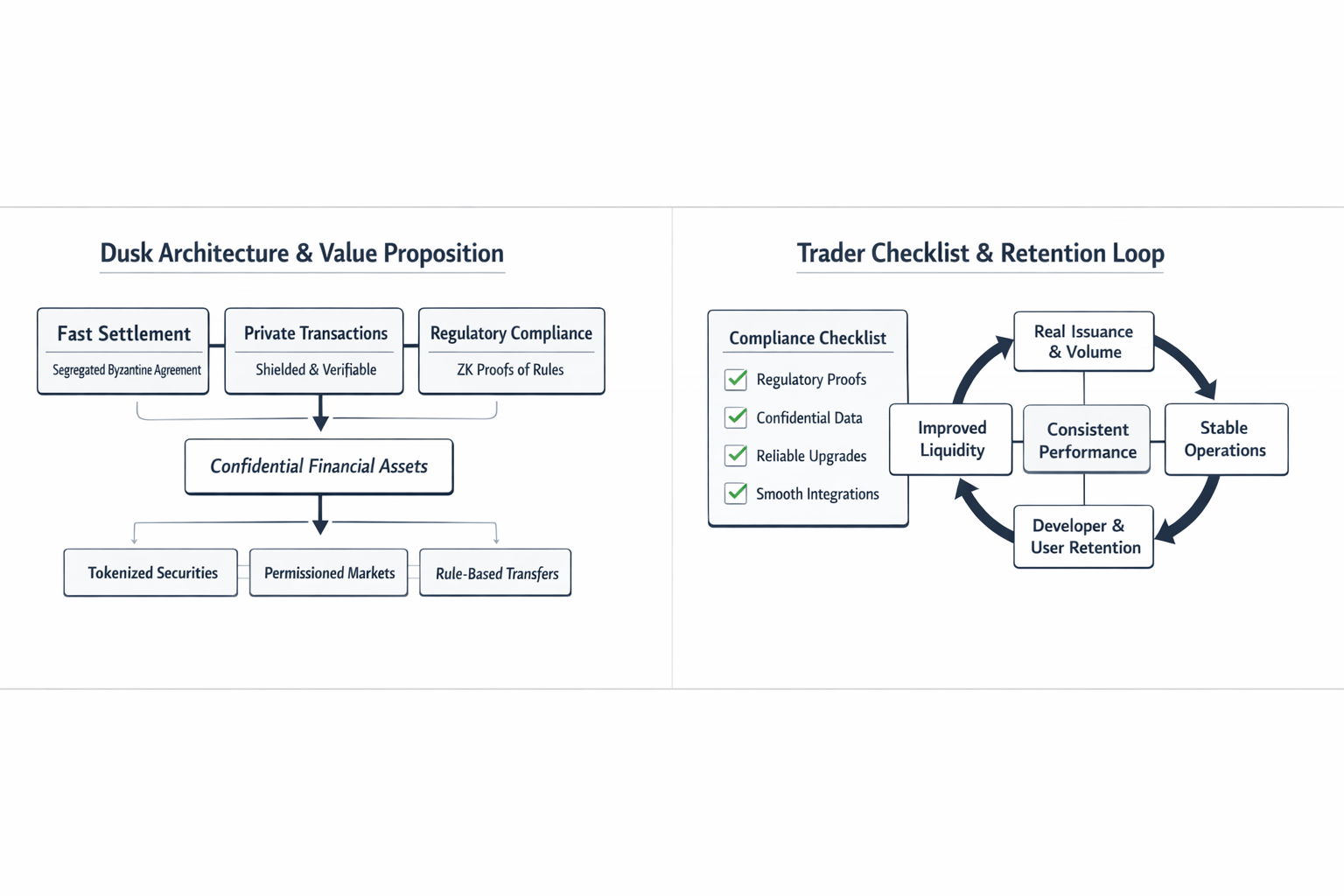
The simplest way to understand the architecture is to split it into three jobs that usually fight each other on other chains: settle transactions quickly, keep sensitive information off the public timeline, and preserve verifiability so the system is not “trust me, bro.” Dusk leans on a proof-of-stake consensus design they call Segregated Byzantine Agreement, built to reach fast finality without needing every validator to see everything in the clear. That “segregated” idea is important because traditional transparency is not neutral in finance. If every trade, balance, and counterparty is broadcast to the whole world, you do not get “fairness,” you get surveillance and front-running incentives. Dusk’s underlying design goal is closer to how institutions already operate: most details are private by default, but you can produce proofs and disclosures to specific parties when required.
That brings you to Phoenix, Dusk’s privacy transaction model. The practical promise of Phoenix is not invisibility for its own sake. It’s that transactions can be shielded from the public while remaining verifiable at the protocol level, and later selectively disclosed to an auditor, regulator, or authorized counterparty. Dusk has published Phoenix 2.0 specifications as part of pushing that model closer to institutional requirements, which is a polite way of saying: the privacy layer has to survive contact with compliance checklists.
If you’ve never worked inside a regulated environment, here’s the real-world translation. A bank or broker does not want your entire ledger. They want proof that this specific transfer satisfied these specific rules: the sender was authorized, the receiver was eligible, limits were respected, sanctions screening was passed, and the asset did not move in a way that violates the instrument’s constraints. On most chains, the crude way to do this is to force everything into the open, or to rely on permissioned rails and administrators. Dusk’s bet is that zero-knowledge proofs let you keep the data private while proving the rule checks happened. The project’s public technical direction points to PLONK-style proving systems implemented in Rust, which is one of those details that sounds academic until you realize it’s about performance, auditability, and not having your critical cryptography depend on fragile glue code.
Where I think traders sometimes misread Dusk is that they look for “the app” that makes it obvious overnight. But this kind of chain is closer to plumbing than to a consumer product. The value shows up when boring workflows stop breaking. I felt this personally a couple years ago when a team I knew tried to push a tokenized instrument concept through a compliance review. The crypto side assumed “onchain transparency” would make everyone comfortable. The compliance side had the opposite reaction: they saw permanent public exposure of counterparties and flows, and they immediately asked how you prevent competitive leakage, how you protect client privacy, and how you avoid turning every transaction into a broadcast of sensitive business relationships. The project didn’t die because the token model was wrong. It died because the infrastructure story could not satisfy both privacy and audit demands without adding trusted intermediaries. That’s the niche Dusk is explicitly trying to fill.
Now, the retention problem. In crypto we talk about retention like it’s a consumer metric, but infrastructure has its own version: do serious builders keep building after month three, and do serious users keep transacting after the first operational scare. Chains targeting regulated finance have an even harsher retention curve because onboarding is expensive. If your stack forces issuers to redo legal work every time a minor protocol change happens, or if compliance proofs are unreliable, or if confidential transactions make integrations messy, teams quietly walk away. Nobody announces it. The GitHub slows down, the pilots never graduate, and liquidity becomes purely speculative. That’s why architecture decisions matter more than narrative here. A compliance-ready chain is only “ready” if it behaves predictably for long periods, through upgrades, audits, and market volatility.
Looking ahead to 2026, the version of Dusk that matters is not “a privacy chain,” it’s “a settlement layer that can host confidential assets and rule-based transfers without forcing the world to choose between secrecy and oversight.” The most realistic upside is not a single viral app, it’s a gradual accumulation of regulated use cases where confidentiality is a prerequisite: tokenized securities, permissioned-but-public market structures, and onchain workflows where disclosure is granular instead of global. The risk is equally straightforward: if the proving and disclosure UX remains too complex, or if liquidity and developer tooling fail to reach escape velocity, the market will keep pricing it like a niche experiment no matter how elegant the cryptography is.
If you’re trading or investing, the call-to-action is simple: stop treating “compliance-ready” like a slogan and start treating it like a checklist you can verify over time. Track whether real volume follows real issuance, whether integrations simplify or sprawl, whether upgrades improve predictability instead of introducing fragility, and whether selective disclosure moves from concept to routine. Use the price as a reference point, not as the argument. Today’s market cap and volume tell you attention is present, but conviction is conditional.
The cleanest takeaway I can give you is this: in the next cycle, the chains that last will not be the ones that shout loudest about transparency. They’ll be the ones that can prove the right things to the right people at the right time, without leaking everything else. If Dusk earns a place, it will be because its architecture makes that feel normal, not magical.