
Most traders miss Dusk because they’re looking at it through the wrong lens. They try to evaluate it like a retail L1: users, TVL spikes, incentive farming, social buzz. That framing fails immediately. Dusk isn’t designed to win liquidity wars or host mercenary yield. It’s designed to survive environments where liquidity is conditional, identity is known, and compliance isn’t optional. That single constraint reshapes everything about how the chain behaves economically and it’s why its progress looks slow if you’re benchmarking it against consumer chains, but coherent if you understand institutional capital flows.
The first thing that stands out when you actually track Dusk on-chain is how uncorrelated its activity is with broader risk-on rotations. When memecoins explode and L2s see transactional noise spike, Dusk stays flat. That’s not stagnation it’s signal. It means usage isn’t driven by speculative reflex but by scheduled, deliberate interactions. Capital that touches Dusk is not chasing APR; it’s executing workflows. In a market where most chains are dominated by bursty, incentive-driven wallets, that behavioral profile is rare.
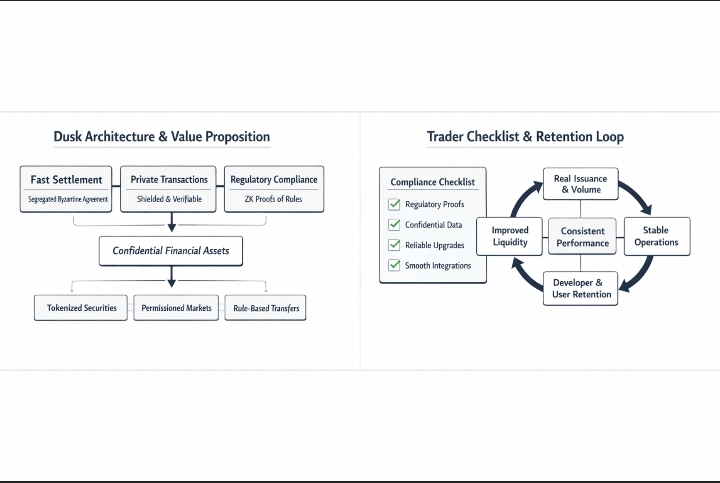
Dusk’s privacy model is also misunderstood. This isn’t “privacy for retail users hiding balances.” It’s selective disclosure built for environments where someone always has the right to audit just not everyone, all the time. That distinction matters. Traditional zero-knowledge narratives break down under regulation because regulators don’t accept black boxes. Dusk’s architecture assumes adversarial auditors exist and designs around that reality. The result is not maximal privacy, but defensible privacy, which is the only kind institutions can actually deploy.
From a systems perspective, Dusk’s modularity isn’t about flexibility it’s about isolating regulatory risk. Components can evolve without forcing a hard fork across the entire financial stack. That matters when legal frameworks shift faster than protocol upgrades. Chains optimized for composability often forget that compliance is a moving target. Dusk treats regulation like latency: something you architect around, not react to later.
Token behavior reinforces this positioning. You don’t see the classic “emissions up, usage follows” pattern because incentives aren’t the primary onboarding tool. That creates a weird optical illusion for traders: price action looks suppressed relative to development milestones. But that suppression is structural. If your users aren’t farming, they’re not reflexively dumping rewards either. Supply pressure is slower, quieter, and less visible which is why Dusk doesn’t trade like a hype-driven L1 even during favorable macro windows.
Liquidity on Dusk-related venues also behaves differently. It’s thinner, yes, but also stickier. When volatility spikes elsewhere, you don’t see the same cascading withdrawals. That suggests capital deployed here has longer time horizons and external mandates. In practice, that reduces reflexive downside but caps upside during speculative phases. Whether that’s attractive depends entirely on what cycle you think we’re in.
One underappreciated angle is how Dusk handles auditability under stress. In most chains, transparency collapses exactly when it’s needed most during hacks, insolvencies, or forced liquidations. Dusk’s selective disclosure flips that dynamic. The system becomes more legible to authorized parties during crises, not less. That’s not a feature retail users care about, but it’s a prerequisite for real-world asset settlement at scale.
From a capital rotation standpoint, Dusk doesn’t benefit from “rotation into infra” the way generic L1s do. It benefits from rotation out of regulatory ambiguity. As enforcement tightens and gray-zone protocols bleed liquidity, capital doesn’t necessarily flee crypto it reallocates to structures that can survive scrutiny. That’s the rotation Dusk is positioned for, and it’s slow, unsexy, and largely invisible on CT.
The risk, of course, is demand elasticity. Institutions move slowly, and if onboarding pipelines stall, Dusk doesn’t have a retail fallback. There’s no meme layer to bail out price, no DeFi casino to bootstrap volume. That makes execution risk higher but narrative risk lower. You’re betting on follow-through, not vibes.
The clearest tell is wallet concentration. Instead of thousands of ephemeral addresses, you see repeated interaction from a small, consistent set of actors. That’s not decentralization theater it’s workflow persistence. In markets, persistence beats noise over long horizons.
So does Dusk make sense right now? It does if you believe the next leg of crypto adoption won’t be led by anonymous leverage, but by boring, permissioned flows that quietly absorb value while everyone else argues on Twitter. It doesn’t if you’re trading momentum or farming narratives.
