STON: How Power, Incentives, and Control Actually Work on STON.fi
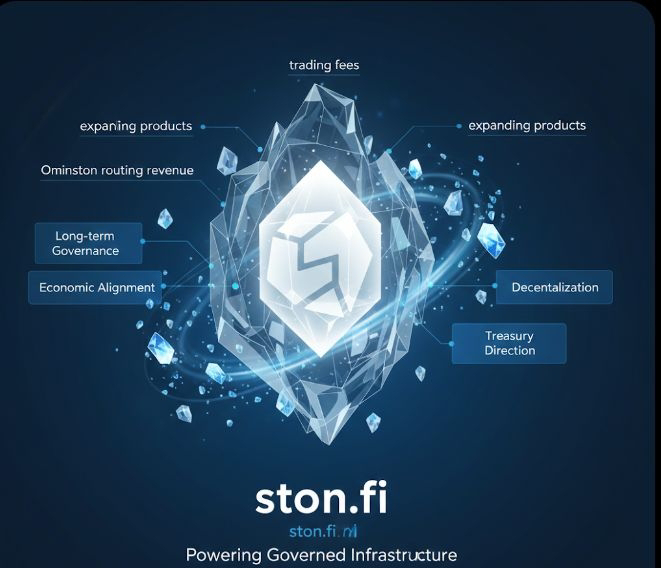
STON isn’t just another token — it’s the ownership layer for the STON.fi ecosystem. It’s the mechanism that ties together trading fees, Omniston routing revenue, and long-term governance into a single system that rewards commitment over speculation. That design turns the protocol from a simple marketplace into governed infrastructure: a place steered by people who put time and stake behind their beliefs.
The economics under the hood
The protocol creates real economic value in three main ways:
Swap fees from traders using the DEX.
Aggregation / routing revenue via Omniston, which finds best-execution across liquidity sources.
Product expansion — new features and integrations that create additional revenue streams.
That value is meant to flow back into the system: part into the treasury, part to long-term participants, and part used to grow the protocol. STON is the ledger that tracks and channels that economic alignment. But ownership alone doesn’t equal governance — influence requires commitment.
Locking: ARKENSTON as your governance identity
To convert token ownership into governance power, STON holders lock tokens and receive an ARKENSTON — a non-transferable NFT that represents a governance identity. ARKENSTON is not a tradeable badge: it’s a certificate of long-term alignment.
Why this matters:
Non-transferability prevents vote-selling. You can’t simply sell the NFT to cash out influence.
Identity by commitment. ARKENSTON ties a person’s governance identity to a time-bound economic commitment, which makes governance participation harder to game.
GEMSTON: influence earned over time
While ARKENSTON is your identity, GEMSTON is the currency of influence. The protocol awards GEMSTON to locked positions over time: the longer and larger your lock, the more GEMSTON you accumulate. In other words, voting weight is earned by sustained alignment, not by speed or trading volume.
Key properties:
Time-weighted influence. Short locks earn little; long locks accumulate significant GEMSTON.
Effortless signal of commitment. Participants who consistently lock STON demonstrate ongoing belief in the protocol’s future and therefore gain more say in its direction.
How decisions get shaped
With GEMSTON as voting power, governance becomes a function of sustained participation. Those who hold GEMSTON influence:
Proposal outcomes (which direction the protocol takes).
Parameter changes (fees, incentives, risk limits).
Treasury allocations (where to invest or how to support growth).
Protocol upgrades (technical or product-level evolutions).
This pushes governance toward people who are consistently invested in the protocol’s long-term health rather than opportunistic short-term actors.
Why the design reduces manipulation
Traditional token-vote models are vulnerable to rapid vote flipping and short-term capture: buy tokens, push a change, sell. STON’s multi-layer approach addresses this:
Locking requirement means governance power is not instantly liquid.
Non-transferable ARKENSTON prevents simple sale of influence.
GEMSTON accrual over time rewards patience and alignment.
Together, these features discourage short-term attacks and create a clear path toward decentralization — governance slowly shifts to those who demonstrate long-term commitment.
Practical implications for users and the protocol
For users:
If you want real governance influence, you must lock STON and commit for longer periods.
The system rewards patience: longer locks = more GEMSTON = more say.
For the protocol:
Treasury and revenue distribution can be guided by participants whose incentives align with long-term growth.
Governance becomes more resilient to flash takeovers and more focused on sustainability and product roadmap.
Potential risks and mitigations
No system is perfect. Potential risks include concentration of locked supply among a few large actors, or sophisticated coordination by aligned groups. The protocol’s design mitigations include:
Non-transferable governance identity, which makes influence non-fungible and harder to trade.
Time-weighted accrual that makes sudden capture expensive and slow.
Community norms and on-chain transparency that expose coordinated attempts to centralize power.
Designers and the community can further mitigate risk by adding graduated quorum/threshold rules, periodically updating lock mechanics, and keeping treasury actions transparent.
Conclusion
STON, ARKENSTON, and GEMSTON are more than tokenomics jargon — they form a coherent system that converts economic value into durable governance. By rewarding time and commitment rather than speed and speculation, STON.fi pushes its DAO toward stability, decentralization, and a culture of long-term stewardship. It’s not just a place to trade; it’s infrastructure built to be steered by people who are actually in it for the long haul.
This article explains STON’s governance design and incentives. It’s informational, not financial advice.