A few years from now, someone will probably trace Walrus back to a moment that looks ordinary on the surface: a small group of engineers staring at their screens late at night, annoyed that the internet the thing meant to be everywhere had quietly turned into a set of locked warehouses owned by a handful of corporations. But revolutions rarely announce themselves with trumpets. They begin with discomfort, with the slow realization that something essential has slipped out of collective hands.
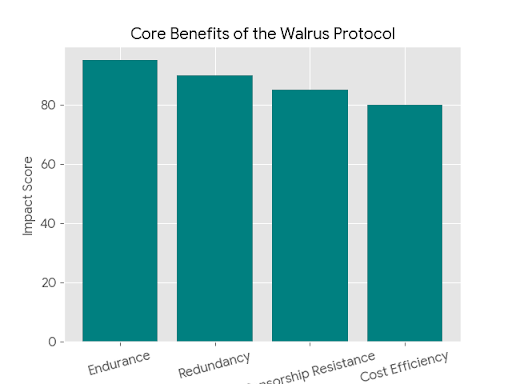
Walrus grew out of that unease. It was born from the feeling that data the photos, research papers, videos, archives, medical records, cultural memory, and the raw fuel for artificial intelligence had become too fragile, too controlled, too dependent on centralized gatekeepers. The world was producing information at a breathtaking pace, yet the infrastructure holding it together was brittle, expensive, and politically vulnerable. A server outage could erase access for millions; a policy change could wipe out entire digital communities; a government decree could force companies to remove records that once felt permanent. In response, the people behind Walrus imagined a quieter kind of infrastructure, one that didn’t shout about power but spread it so thinly that no single actor could bend it to their will.
They named it after an animal that moves slowly, carries great weight, and survives in harsh conditions. That choice was less playful than poetic. The idea was not speed for its own sake, but endurance a system that could hold vast amounts of data across time, weathering technical failures, political pressure, and economic turbulence. Instead of stacking copies of files in a few giant data centers, Walrus breaks information into encoded fragments and scatters them across many independent nodes run by people all over the world. Each piece is useless on its own, but together they can reconstruct the whole, like shards of a story that only make sense when reunited.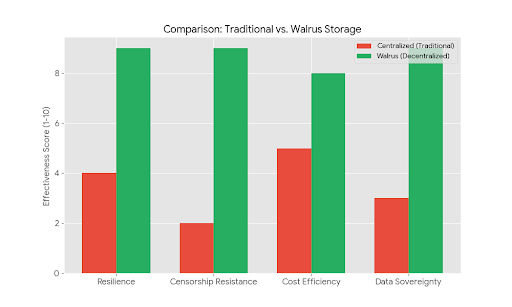
To an outsider, this might sound abstract. To someone watching it in motion, it feels almost intimate. A researcher uploads a dataset late at night, knowing it will be sliced, transformed, and sent drifting across a decentralized sea of machines. Somewhere, a student running a small server in their apartment becomes one of the caretakers of that data without ever seeing it directly. They stake WAL the network’s native token as a promise: I will host my piece reliably, I will stay online, I will play my part. In return, they earn rewards, not as charity, but as participation in a shared system that values their contribution.
WAL is more than just a digital coin. It is the heartbeat of the protocol. People use it to pay for storage, operators earn it for maintaining the network, and holders use it to shape the future of the system through governance. This intertwining of money, technology, and collective decision-making creates a delicate tension. On one hand, it aligns incentives beautifully: those who care about Walrus must invest in it. On the other, it risks concentrating power in the hands of those who can afford the most stake. The dream of decentralization is always shadowed by the fear of quiet centralization creeping back in through economic back doors.
What makes Walrus emotionally compelling is not its mathematics, but what that mathematics enables. Imagine a journalist storing sensitive archives beyond the reach of censorship, or an artist preserving their life’s work without trusting a single corporation. Picture communities in politically unstable regions safeguarding their history in a way no regime can easily erase. At the same time, imagine the darker possibilities: illegal content hiding in the network’s folds, or powerful players manipulating governance to serve their own interests. The same tools that protect freedom can also shelter wrongdoing. Walrus doesn’t pretend to resolve that moral paradox; it lives inside it.
Technically, the system is elegant. Erasure coding means the network doesn’t waste space by keeping full duplicates of everything. Instead, it keeps smart fragments that can survive failures and disappearances. If one node goes offline, the data remains alive elsewhere. If many fail, the system adapts. It feels almost biological a living organism with redundancy built into its bones.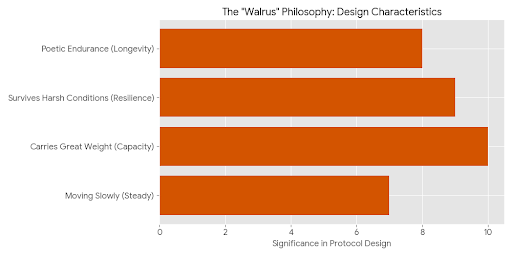
Yet for all its engineering brilliance, Walrus is ultimately a human experiment. It depends on trust between strangers who will never meet. It relies on people choosing cooperation over exploitation, long-term stability over short-term profit. Every slashed stake, every missed epoch, every small technical failure carries emotional weight. For a node operator, losing tokens because their internet cut out feels personal, not abstract. For a developer who saves thousands on storage, the protocol becomes not just infrastructure, but a partner in creativity.
In the broader landscape, Walrus sits at the intersection of two powerful currents: decentralized finance and artificial intelligence. AI systems are ravenous for data, and storing that data cheaply, securely, and ethically is becoming one of the defining challenges of our time. Walrus offers a vision where datasets are not locked behind corporate walls but treated as shared, programmable resources that can be accessed and licensed in new ways. Whether that vision will scale or crumble under real-world pressure remains uncertain.
What is clear is that Walrus is not just about technology; it is about who gets to own memory in a digital age. Will our collective knowledge live in centralized vaults guarded by private interests, or in a distributed commons shaped by many hands? The protocol does not guarantee the answer, but it pushes the question into the open.
For now, Walrus moves steadily forward, neither heroic nor humble, carrying its heavy cargo of data across a decentralized horizon. Some will call it a backbone of a new web. Others will see it as a bold experiment that may or may not endure. But in its quiet persistence, there is something undeniably human: a desire to build systems that outlast us, that remember what we create, and that keep that memory alive beyond the reach of any single power.