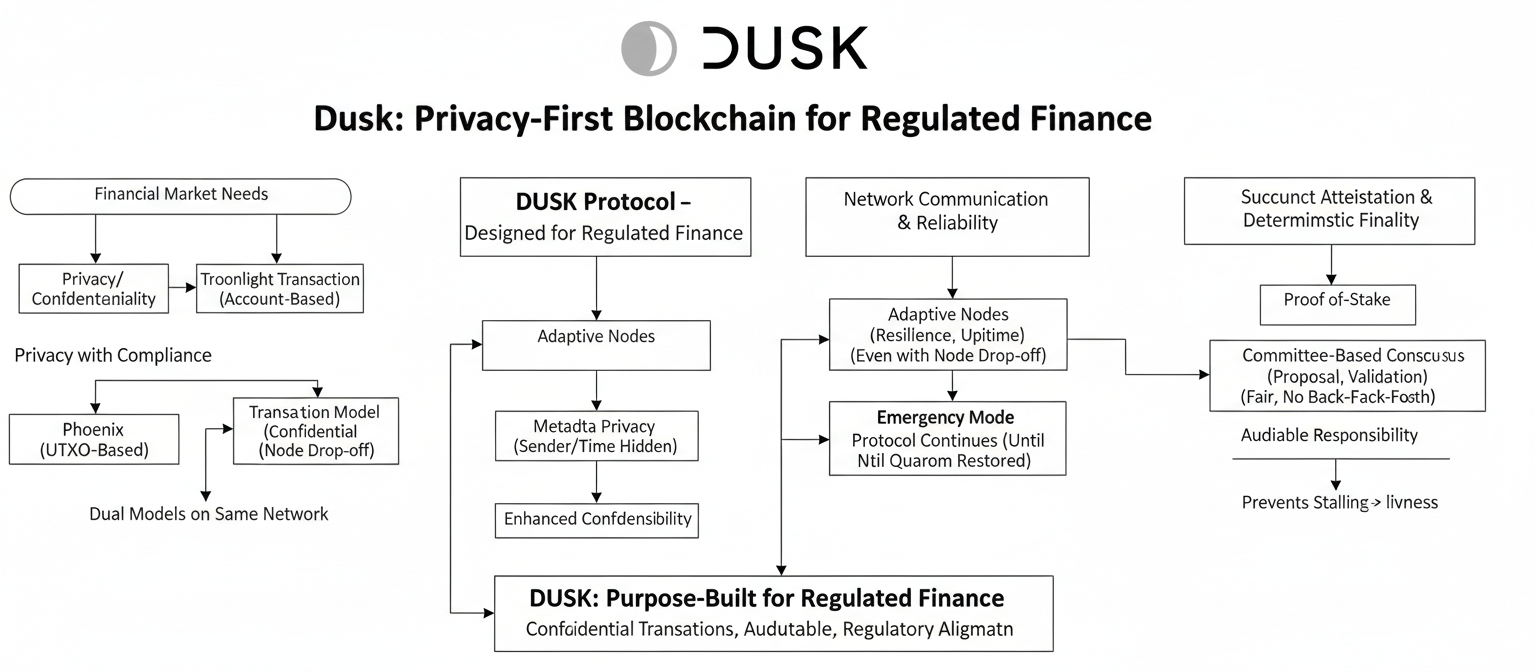
Let’s talk about Dusk.It’s not your typical blockchain While most networks chase after total transparency and open experimentation,Dusk goes the other way.It puts privacy,regulatory compatibility,and reliable finality front and center.Financial markets demand this.They can’t mess around with sensitive data being public,or settle for unpredictable settlement times.Dusk gets built for this world.It’s infrastructure,not a playground.
Most blockchains leave every transaction out in the open.Dusk doesn’t.It’s privacy first,but still lets regulators keep an eye on things. That balance keeping data confidential,but not hidden from those who need to see it runs through everything Dusk does.
Privacy with Compliance by Design
Here’s the big challenge:blockchains for finance usually end up stuck between privacy and compliance.Go fully transparent,and you risk exposing trades that should stay private. Hide everything,and auditors can’t do their job.Dusk doesn’t bolt on privacy as an afterthought.It bakes it into the design.
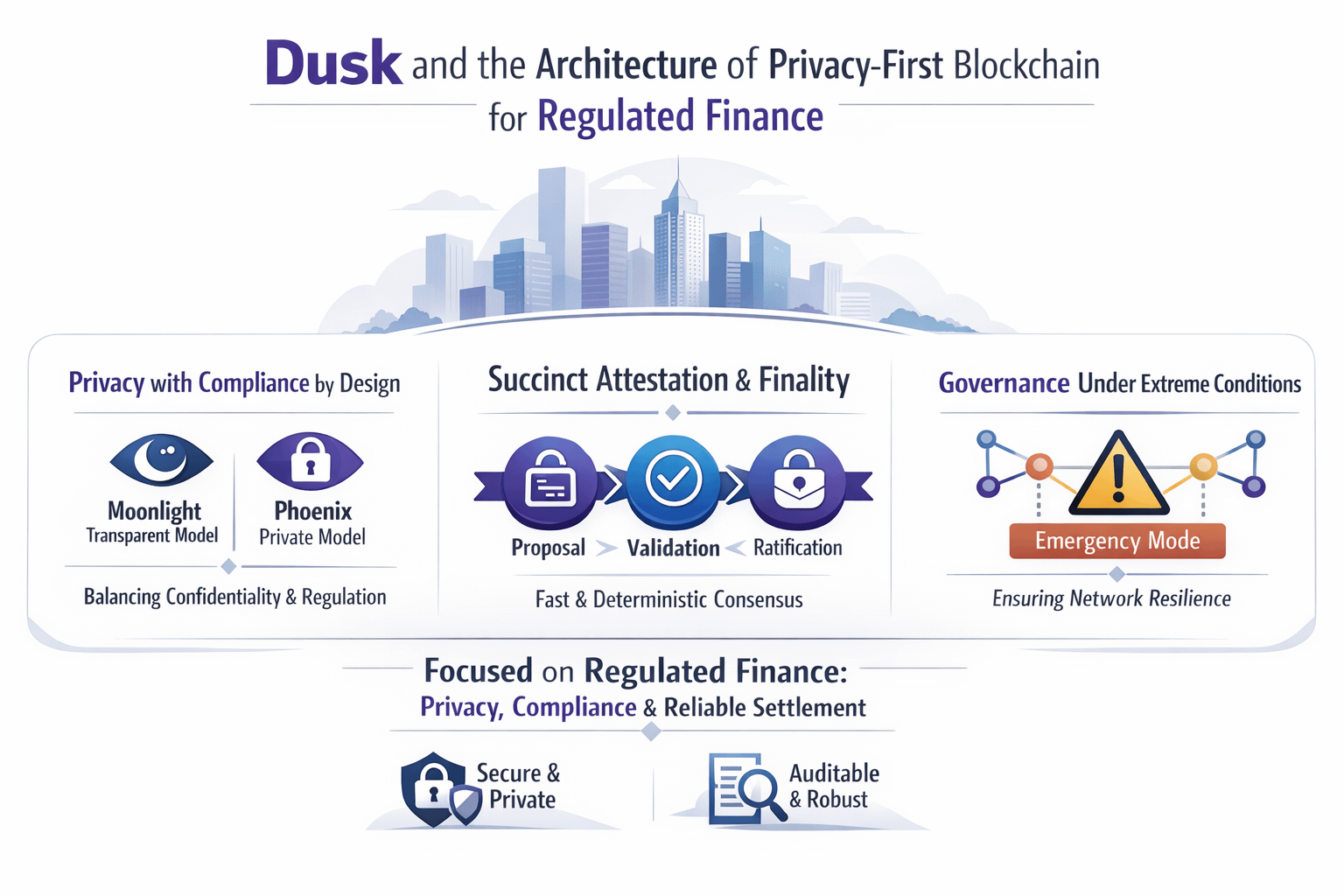
There are two transaction models.Moonlight is transparent and account based,built for situations where you need to show your cards.Phoenix uses a UTXO based setup,so transactions stay confidential.Both models run on the same network,which means financial institutions can pick what they need without having to compromise.
Honestly,I think this split is one of Dusk’s smartest moves.Instead of choosing privacy or transparency for everyone,it lets both live side by side.That’s how finance works in the real world rules change depending on the asset,the country,or even the kind of participant.
Network Communication and Reliability
Dusk’s network layer isn’t just about moving blocks around fast.It’s about making sure messages get where they need to go,even if some nodes drop off.That’s huge for finance, where delays raise real risks.
Nodes in Dusk adapt as the network shifts. They keep things running smoothly,even when some players go offline.Plus,the way messages move through the network hides who sent what and when so privacy covers not just the transaction,but the metadata too. That’s smart.Protecting privacy isn’t just about what gets sent;it’s also about who’s talking and when.
Succinct Attestation and Deterministic Finality
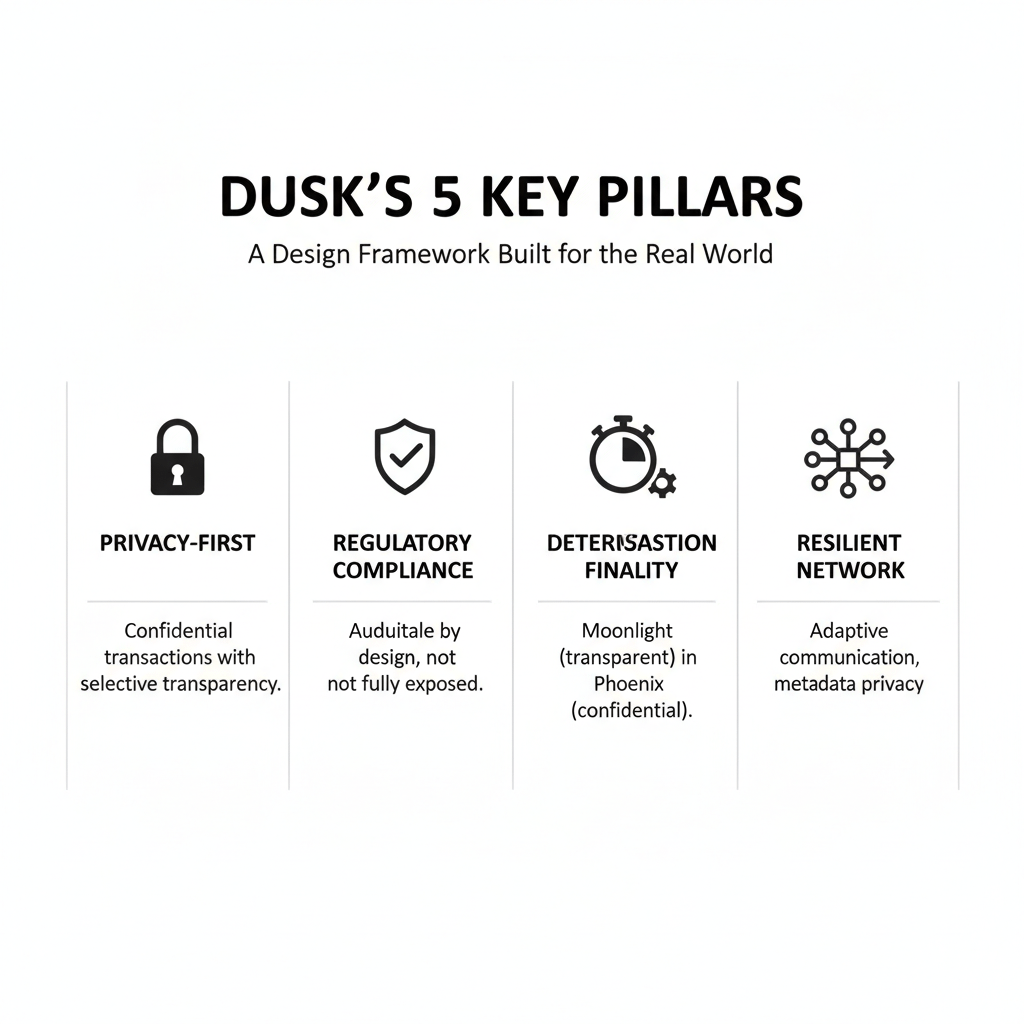
Consensus in Dusk comes from the Succinct Attestation protocol.It’s proof of stake,but with a focus on speed and certainty.No waiting around for endless confirmations; blocks get finalized in seconds.Committees handle this through a clear process proposal,validation,ratification.
Provisioners stake DUSK to join in. Committees get picked by deterministic sortition,so it’s fair and there’s no need for back and forth between nodes.Every step in the consensus process has people (well, nodes) responsible.If something fails,it’s obvious where the problem is.That’s what you want in finance no gray areas that can turn into headaches later.
Governance Under Extreme Conditions
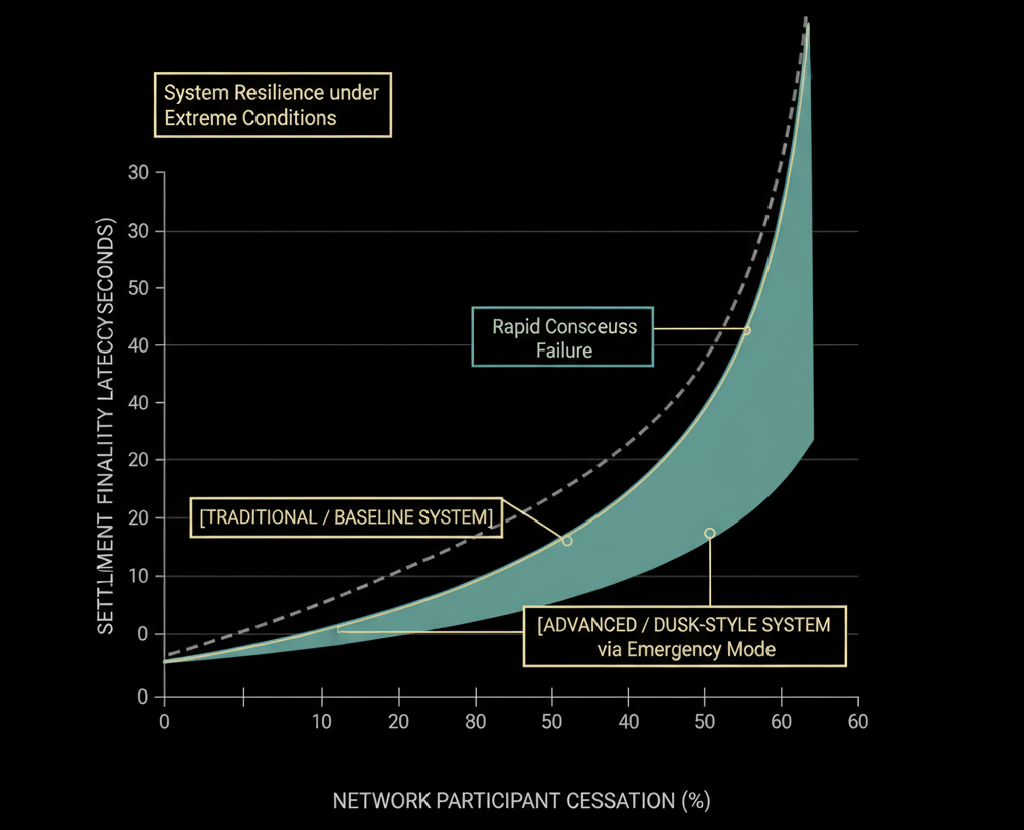
Sometimes things go wrong.Dusk has an emergency mode for that.When too many nodes disappear and consensus can’t move forward,the protocol lets things keep going until enough people come back to reach a quorum.
Yeah,it raises the risk of forks,but it keeps the network alive.That’s the priority.For settlement systems,stalling is just not an option.
Conclusion
Dusk isn’t trying to be a one size fits all solution.It’s built for regulated finance,plain and simple.Privacy,compliance,and deterministic finality are baked in from the start.Transactions stay confidential,the consensus is auditable,and the whole thing lines up with what actual financial markets need.
What impresses me most is Dusk’s restraint. Instead of chasing hype,it focuses on solving the real,structural problems that have stopped blockchains from fitting into regulated finance.That focus gives Dusk a sense of purpose you don’t see in most general networks.