
Executive Summary
Superform represents a technically sophisticated attempt to solve omnichain yield fragmentation through ERC-4626 standardization and intent-based routing. The protocol has demonstrated early product-market fit with $61.5M TVL and secured $13.9M from Tier-1 investors including Polychain Capital and VanEck. However, critical economic details remain opaque ahead of the February 10, 2026 $UP token launch, presenting both architectural promise and due diligence requirements for institutional consideration.
1. Project Overview
Superform is a mainnet-stage omnichain yield marketplace aggregating ERC-4626 vaults across EVM chains. The protocol enables single-transaction deposits into multiple vaults across different chains, abstracting cross-chain complexity through a non-custodial architecture.
Core Thesis: Superform positions itself as "the user-owned neobank" addressing yield fragmentation across EVM ecosystems by standardizing access through ERC-4626 and automating cross-chain execution.
Stage Assessment: Growth-phase deployment with $61.5M TVL concentrated on Ethereum ($54.7M) and Base ($5.6M), plus minimal deployments on Avalanche, BSC, Linea, and Fantom (~$40k combined). DefiLlama
Team & Funding: $13.9M total raised across:
Seed Round (Feb 2024): $6.5M led by Polychain Capital with Maven 11, Circle Ventures, and angel investors including Arthur Hayes
Strategic Round (Dec 2024): $3M led by VanEck with Polychain, CMT Digital, Amber Group
Public Sales (Sep 2025): $4.42M across multiple rounds
The team includes co-founders Blake Richardson, Vikram Arun, and Alex Cort with previous infrastructure experience, though specific backgrounds require deeper due diligence.
2. System Architecture and Omnichain Design
Superform's architecture consists of two main components: Superform Core (non-upgradeable base layer) and Superform Periphery (user-facing products).
Core Architectural Components
SuperRouter: Handles cross-chain deposit/withdrawal logic through Merkle-verified signature compression Docs
Forms: Vault adapters that wrap ERC-4626 vaults into standardized interfaces, permissionlessly creatable via SuperformFactory
SuperPositions: ERC-1155A tokens representing vault shares minted on the source chain regardless of destination chain vault location Mirror
Cross-Chain Execution: Uses "Dual-Merkle validation" with primary and secondary AMBs (Arbitrary Message Bridges) for message verification, though specific AMB partners remain undisclosed in public documentation
Architectural Comparison
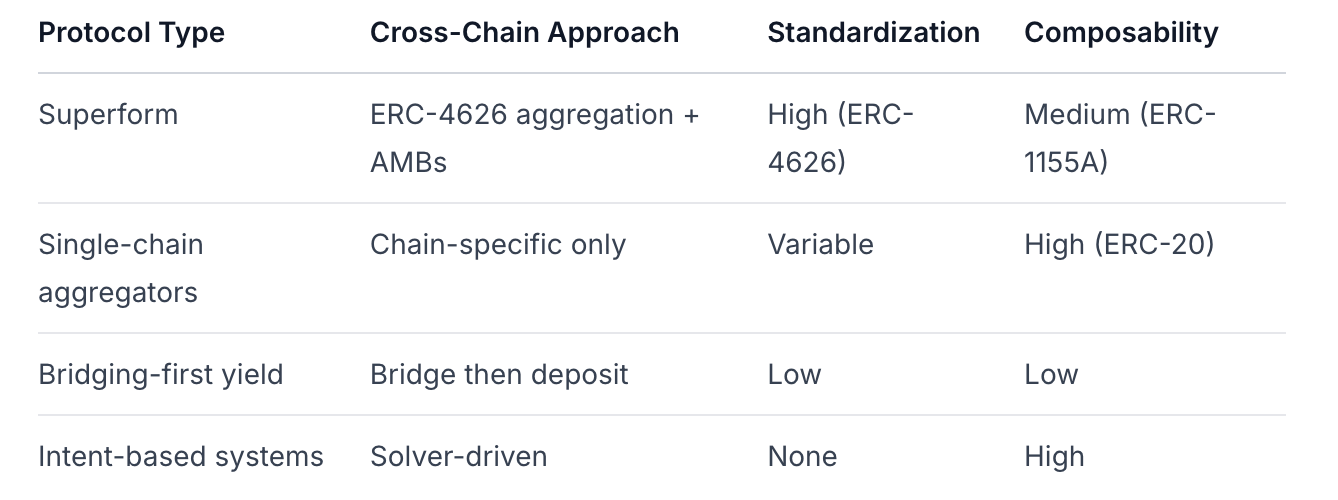
Key Differentiator: Superform's use of ERC-4626 as a foundational primitive provides stronger standardization than intent-based systems while maintaining more composability than bridge-centric approaches.
3. ERC-4626 Vault Integration and Asset Representation
Superform's vault integration follows rigorous criteria centered on ERC-4626 compliance:
Vault Requirements:
Must issue transferrable ERC-4626 shares
redeem() return value must exactly match assets received
Atomic execution of deposit()/redeem() (no async actions)
No msg.sender-based limitations to redemption Help Center
SuperPosition Mechanics:
ERC-1155A tokens (modified ERC-1155 with single ID approval)
1:1 representation of vault shares
Minted on source chain regardless of destination chain
Transmutable to ERC-20 format ("aERC20") for DeFi composability
Trust Assumptions: Superform introduces additional execution risk through cross-chain messaging but reduces vault integration risk through ERC-4626 standardization. The dual-Merkle validation system mitigates single-AMB failure risk.
4. Cross-chain Routing and Yield Logic
Superform's routing prioritizes user experience and capital efficiency through:
Single-Transaction Execution: Users can deposit into multiple vaults across chains with one signature, with bridging and swapping handled automatically
Routing Logic: Combination of on-chain verification (Merkle proofs) and off-chain computation for optimal route selection
Latency/Cost Trade-offs: The system batches transactions to minimize gas costs but introduces cross-chain latency (minutes to hours depending on AMBs)
The protocol currently emphasizes Ethereum-centric routing with 89% of TVL on Ethereum mainnet, suggesting either strategic focus or liquidity constraints on other chains.
5. Protocol Economics and Incentive Structure
Economic Model Gaps: Critical details remain undisclosed ahead of the February 10 token launch:
Fee Structure: SuperVaults support configurable management and performance fees set by strategists, but protocol-level fee percentages are not disclosed
$UP Token Utility (Inferred):
Governance: Staking $UP for voting rights on vault parameters and SuperAsset weights
Incentives: Rewarding user participation and ecosystem expansion
Protocol fees: Potential distribution to stakers Whales Market
Points System: Active Points program distributing 2.5M $UP per epoch pro-rata to users, creating initial demand dynamics X
Token Distribution: On-chain analysis shows:
~39.2% in foundation wallet (0x0027eea9e867845182c407d51adcae77fb906ce2)
15% in contract (0x722ff7c0665f4b1823c9c4cfcdf73a43de5865bd)
Multiple 0.7% allocations likely for team/ecosystem vesting
Sustainability Concerns: Heavy reliance on Points incentives pre-launch; long-term viability depends on actual fee generation versus yield compression.
6. Governance, Security, and Risk Analysis
Governance Structure
Current structure appears foundation-led pre-decentralization
$UP token intended for governance of vault parameters and economic configuration
Upgradeability: Core contracts are non-upgradeable, periphery may have upgrade paths
Risk Surface Analysis
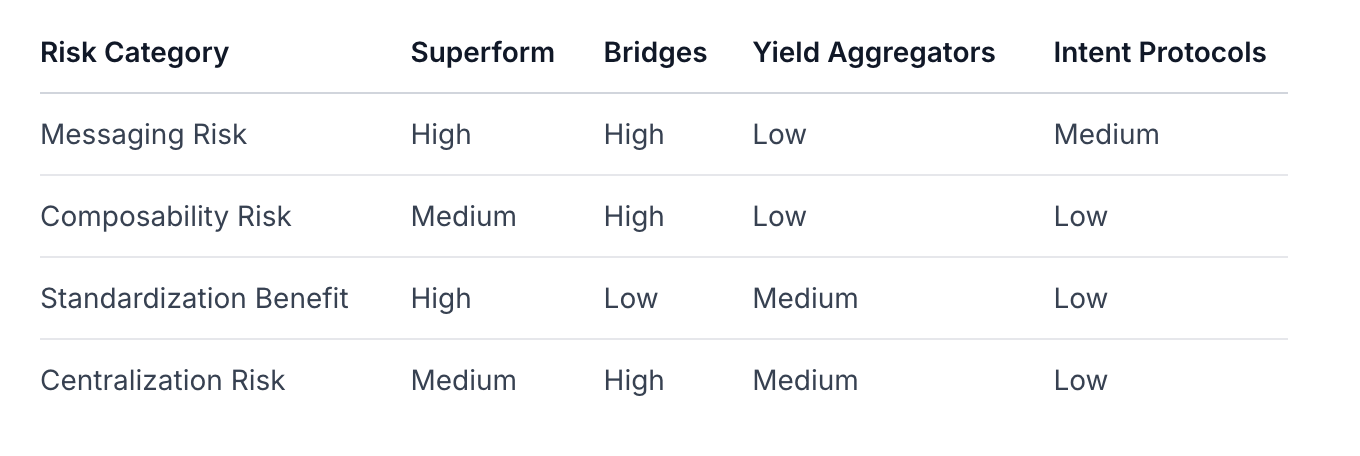
Cross-chain Messaging Risk: High - Despite dual-AMB validation, dependence on external messaging protocols creates systemic risk. Specific AMB partners not disclosed prevents proper risk assessment.
Vault Strategy Risk: Medium - ERC-4626 standardization reduces integration risk but underlying vault strategies vary in risk profile
ERC-4626 Adoption Risk: Low-Medium - Standard is widely adopted but protocol-specific implementations may have edge cases
Liquidity Fragmentation Risk: High - 89% TVL concentration on Ethereum contradicts omnichain narrative and creates centralization risk
Comparative Risk Assessment:
7. Adoption Signals and Ecosystem Potential
Current Adoption: $61.5M TVL with strong Ethereum dominance suggests early adopters are primarily Ethereum-native users seeking cross-chain yield opportunities
Developer Activity: Active GitHub repositories with recent commits to v2-core and v2-periphery (Jan 29, 2026) indicating ongoing development GitHub
Ecosystem Integration: Partnerships with Pendle Finance for yield tokenization and Morpho for lending strategies show DeFi integration focus X
Mobile App Launch: Recent iOS release in US/Canada suggests consumer-facing strategy X
Target User Segments: Likely to capture (1) Ethereum whales seeking cross-chain yield, (2) DeFi power users wanting simplified cross-chain execution, and (3) institutional users looking for standardized yield access
8. Strategic Trajectory and Market Fit
Problem Alignment: Superform addresses three structural problems effectively:
Fragmented yield opportunities across EVM chains
User friction in cross-chain capital deployment
Lack of standardization in yield-bearing assets
Key Milestones (12-24 month outlook):
Expansion beyond current 6 supported chains
Increased TVL diversification beyond Ethereum
Institutional product integrations (e.g., treasury management)
Decentralization of governance and validation
Strategic Vulnerabilities:
Competition from intent-based systems (e.g., Anoma, SUAVE)
Bridge-native yield solutions improving UX
ERC-4626 limitations in representing complex strategies
9. Final Investment Assessment
Scoring (1-5 scale):
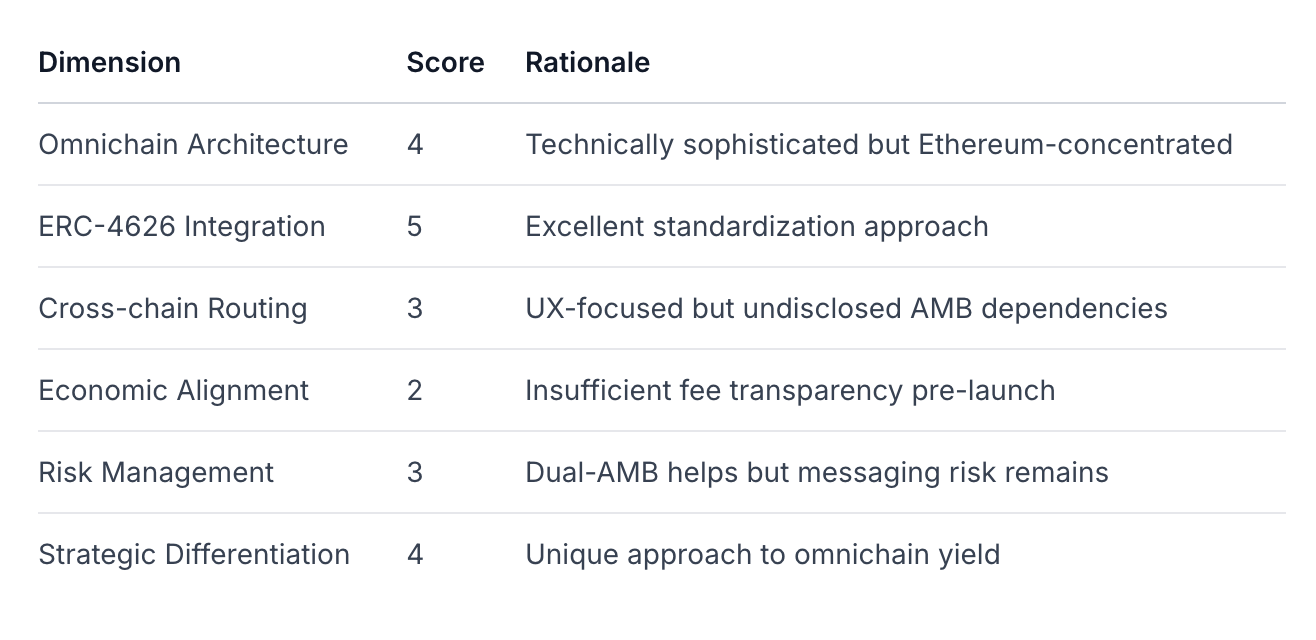
Overall Score: 3.5/5
Verdict: Monitor with Caution
Superform demonstrates technical sophistication in omnichain yield abstraction and has achieved notable early traction with $61.5M TVL. The ERC-4626-centric approach provides genuine standardization benefits, and Tier-1 investor backing validates the core thesis.
However, the protocol requires substantial due diligence before investment consideration:
Pre-launch Opacity: Critical economic details (fee structures, tokenomics, AMB partners) remain undisclosed days before token launch
Concentration Risk: 89% Ethereum TVL concentration contradicts omnichain narrative
Messaging Risk: Undisclosed AMB dependencies prevent proper risk assessment
Economic Sustainability: Points-driven growth may not translate to sustainable fee generation
Recommendation: Tier-1 funds should closely monitor the February 10 token launch and subsequent economic disclosures. The architectural foundation is promising, but investment readiness requires transparency on economic model, partnership disclosures, and evidence of multi-chain adoption beyond the current Ethereum concentration.
The protocol represents a credible attempt to solve omnichain yield fragmentation, but requires further de-risking before institutional allocation.
Report Limitations: This analysis is constrained by pre-launch information availability. Critical details regarding fee structures, exact tokenomics, AMB partnerships, and vesting schedules were not publicly disclosed as of February 8, 2026. Post-launch disclosures may significantly alter the risk assessment and investment recommendation.