

For a long time, Plasma lived in the category many infrastructure projects occupy before proof arrives. Interesting architecture. Thoughtful positioning. Clear intent. But still waiting for the moment when usage moves from theory to visible behavior.
This week, something shifted.
Not because of an announcement or a new narrative cycle, but because the network started to look like a place where money is actually moving.
When Plasmascan shows more than a hundred million transactions and block production hovering around the one-second range, you stop imagining future scale and start observing present flow. That distinction matters. Crypto has trained participants to treat metrics cautiously, and rightly so. Inflated activity and circular incentives are common patterns.
What stands out here is not spectacle. It is repetition.
Settlement happening again and again, at a pace that begins to resemble routine infrastructure rather than episodic demand.
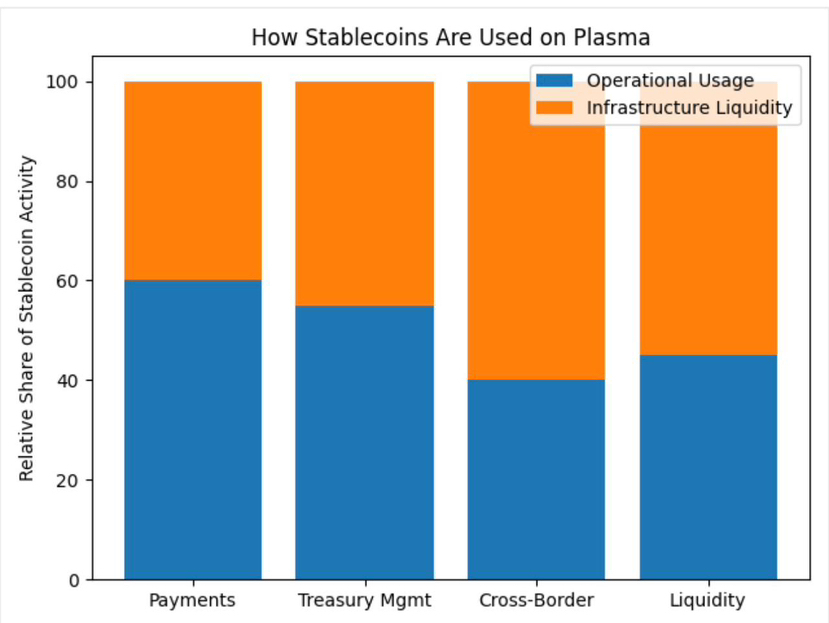
Stablecoin conversations often remain abstract. People debate adoption curves, regulatory pathways, or theoretical market share. Meanwhile, the practical requirement is simpler. Can value move consistently? Can applications rely on timing? Can operators assume continuity instead of preparing for irregularity?
This is where Plasma begins to feel different.
The emerging picture is not a chain chasing every use case. It is a network narrowing its attention toward becoming dependable rails for dollar-denominated movement.
And once you see it through that lens, recent developments line up.
Gasless transfers are not cosmetic upgrades. They are onboarding decisions.
If users must acquire the native asset before they can move a stablecoin, friction remains. Relayer-based flows remove that first negotiation. Participants can begin with the asset they already understand. For payment businesses and fintech integrations, that is enormously important. Operational models simplify. Support requirements shrink. Adoption discussions become easier.
The barrier between intention and execution shortens.
The introduction of stablecoin-first gas logic reinforces the same direction. Instead of asking people to translate value into another unit simply to access infrastructure, the system adapts around existing behavior.
Good design often looks obvious in hindsight.
Underneath the user experience layer, additional pieces contribute to the growing sense of maturity. Sub-second finality is not merely about speed. It is about confidence in outcome. Faster certainty allows surrounding services to act without hesitation. Treasury functions, exchanges, and merchants all benefit from reduced ambiguity.
When the wait disappears, integration accelerates.
Full compatibility with familiar development environments matters as well. Builders do not want to relearn foundations every cycle. If applications can port, extend, and maintain code without rebuilding mental models, ecosystems compound more efficiently.
Practical familiarity reduces risk.
Then there is the security framing. Anchoring assurances in a structure perceived as neutral strengthens the story for institutions that care about long-term durability. Whether every participant evaluates that mechanism deeply is secondary. What matters is that the option exists and can be communicated clearly.
Clarity supports trust.
Individually, none of these components guarantee success. Together, they begin to form a coherent operating profile. A network that wants stablecoin settlement to feel uneventful must combine throughput, accessibility, predictability, and credible security. Missing any of them weakens the proposition.
This week, Plasma started looking like a place where those pieces are aligning.
It is worth emphasizing how different this is from narrative-driven growth. Nothing here depends on sudden attention or speculative enthusiasm. Instead, the progress shows up in usability improvements and steady performance.
You notice it while interacting.
That is why the timing feels important. Last month, Plasma could still be discussed primarily as direction. Today, it is becoming easier to describe it as environment. The difference between intention and implementation is narrowing.
Confidence grows in that space.
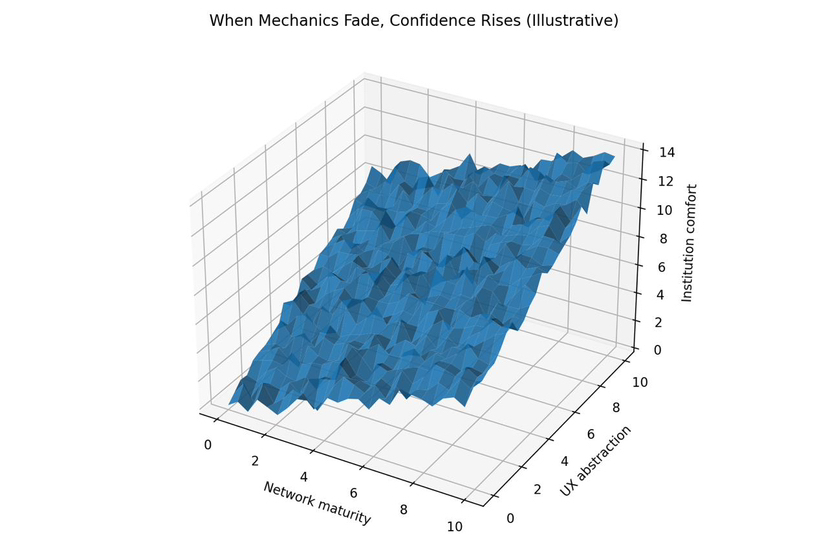
The most powerful infrastructure often reaches legitimacy quietly. One day people debate potential. The next they simply assume availability. Somewhere between those moments, perception flips.
Plasma may be approaching that transition.
There is still work ahead. Integration pipelines take time. Institutions move cautiously. Competitive pressures will remain intense. Skepticism remains healthy.
But when real flows begin to appear, conversations change tone. They become less about possibility and more about preparation.
From that perspective, this week matters. Evidence accumulated. The system felt less like a roadmap and more like machinery already in motion.
And once machinery runs reliably, participants build around it.
