

I noticed Plasma's approach to security does not rely solely on internal consensus assurances but extends outward by anchoring to Bitcoin, reinforcing its settlement model with an external reference point. This design choice is not shown as an extra feature; it is a part of the network's way of defining neutrality and censorship resistance within its stablecoin, focused infrastructure.
Plasma operates as a Layer 1 blockchain tailored specifically for stablecoin settlement. While execution compatibility through Reth and sub-second finality via PlasmaBFT define how transactions are processed and confirmed, Bitcoin anchoring influences how the network positions long-term settlement integrity. By referencing Bitcoin's established security properties, Plasma strengthens the credibility of its finalized state without altering its execution environment.
Bitcoin anchoring functions as an additional layer of assurance. Once transactions are processed and finalized through PlasmaBFT, anchoring mechanisms provide a form of external verification tied to Bitcoin’s chain. This approach extends neutrality beyond the boundaries of Plasma’s own validator set and embeds its settlement trace within a broader security context. The result is a layered structure where execution speed and final confirmation operate internally, while anchoring reinforces integrity externally.
For stablecoin settlement, neutrality is not theoretical. Payment flows, treasury movements, and cross-border transfers require predictable inclusion and consistent finality. By incorporating Bitcoin anchoring, Plasma reinforces the expectation that finalized transactions remain resistant to arbitrary alteration or selective exclusion. This strengthens confidence for participants who depend on deterministic outcomes when moving stable value.
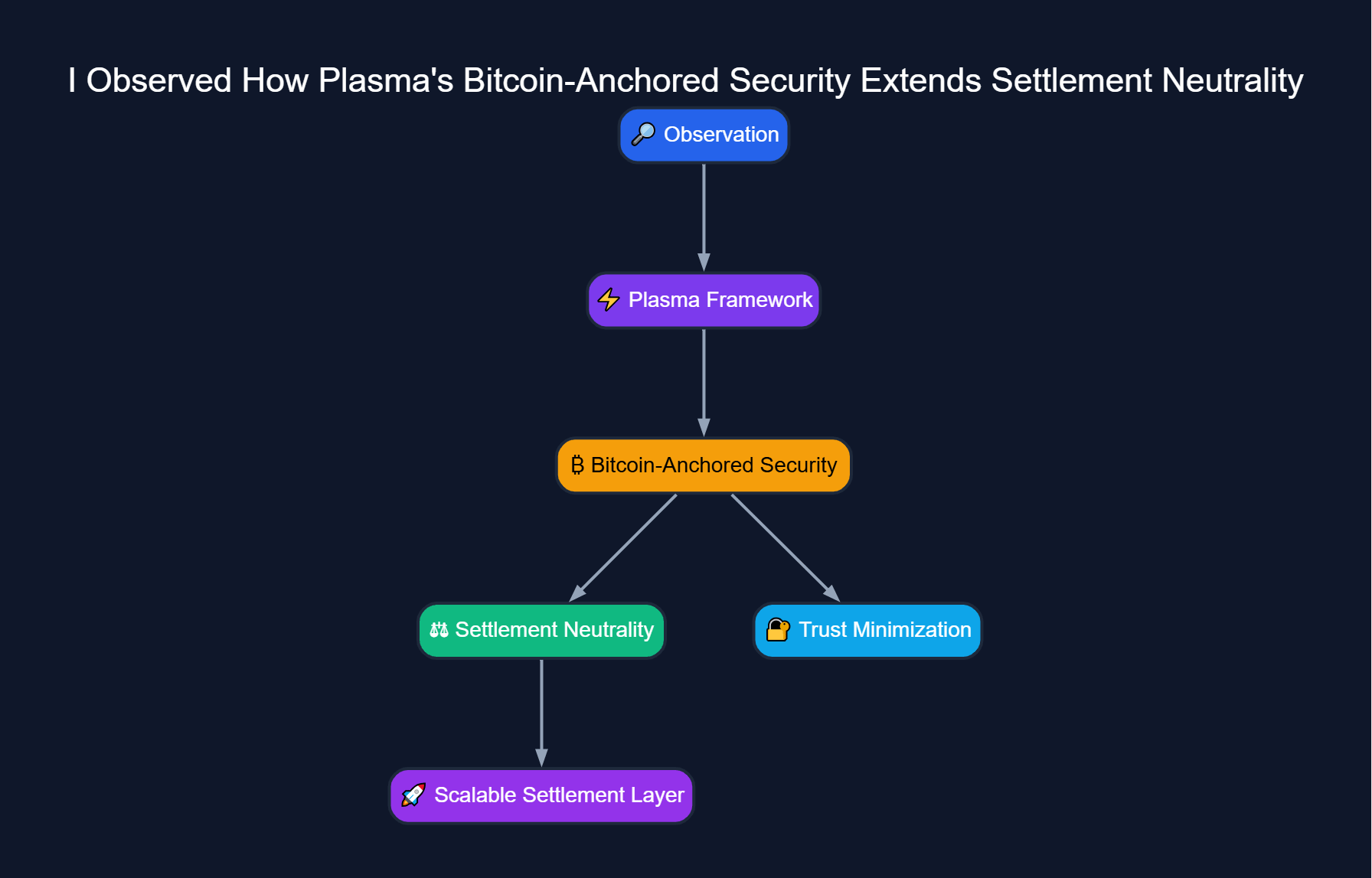
Importantly, anchoring does not modify how transactions are submitted or executed. Retail transfers and institutional payment operations continue to follow the same EVM-compatible logic under Reth and the same consensus confirmation path under PlasmaBFT. Bitcoin anchoring exists as a structural reinforcement rather than an alternative processing layer. The execution experience remains uniform while settlement assurance is extended.
This separation between execution performance and security reinforcement allows Plasma to maintain sub-second finality without compromising on long-term credibility. Fast confirmation is achieved through PlasmaBFT, while anchoring connects finalized state to Bitcoin’s security foundation. The two systems operate in complementary roles, one prioritizing speed and determinism, the other reinforcing neutrality and resistance characteristics.
In high-adoption markets where stablecoin usage is routine, neutrality has practical implications. Users expect transfers to finalize quickly and remain immutable once confirmed. For institutions operating in payments and finance, additional anchoring to Bitcoin enhances confidence in settlement traceability and long-term record integrity. Both participant groups benefit from the same structural design without requiring differentiated handling.
Plasma's Bitcoin-anchored approach also supports its positioning as infrastructure rather than a feature-heavy ecosystem chain. Instead of introducing segmented security tiers or optional guarantees, Plasma applies a unified security model to all finalized transactions. Every confirmed state inherits the same anchoring principle, reinforcing consistency across the network.
By combining EVM compatibility, PlasmaBFT finality, stablecoin-first transaction design, and Bitcoin anchoring, the network creates a layered settlement framework. Execution occurs quickly and predictably within Plasma, while anchoring extends trust boundaries outward. This coordination is centred on stablecoin settlement, which aims to deliver both high operational efficiency and structural assurance.
Conclusion
Plasma's Bitcoin-anchored security strengthens its stablecoin settlement model by extending neutrality and censorship resistance beyond internal consensus. Through sub-second finality with PlasmaBFT and external anchoring to Bitcoin, the network balances execution performance with reinforced settlement integrity. Rather than altering transaction flow, anchoring operates as a structural safeguard, supporting retail and institutional stablecoin activity within a consistent and externally reinforced Layer 1 framework.