

In a stunning and rapid market shock, nearly $4.5 trillion in global value vanished within minutes as gold and silver prices plunged sharply. This wasn’t just a routine correction — it was a warning signal that deeper macroeconomic risks are colliding all at once.
What makes this moment different is that the pressure isn’t coming from a single event. Instead, multiple global stress points are stacking simultaneously, creating a perfect storm that’s shaking confidence across metals, stocks, crypto, and even real estate.
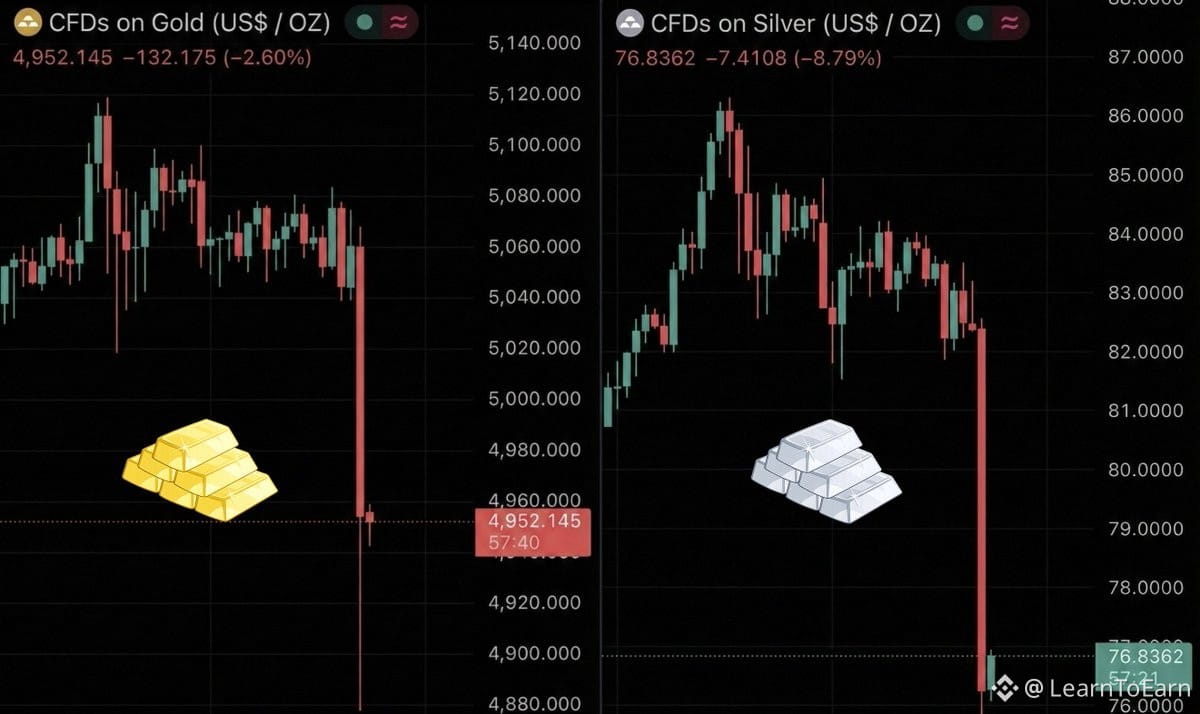
Let’s break down what’s really driving the chaos.
1. Government Shutdown Risk Is Rising Fast
One of the biggest triggers is the looming funding crisis in the United States Congress. Lawmakers remain deadlocked as critical deadlines approach, raising fears of a potential government shutdown.
If that happens, the consequences could be immediate:
• Federal spending freezes
• Economic data releases get delayed
• Growth expectations weaken
• Market uncertainty surges
For investors, uncertainty is often more dangerous than bad news itself. Markets hate not knowing what comes next.
2. Bond Market Stress Is Draining Liquidity
Another major pressure point lies in the bond market.
The U.S. Treasury is issuing massive amounts of debt, but demand isn’t keeping up. This imbalance is pushing bond yields higher, which has a ripple effect across every asset class.
Higher yields mean:
• Borrowing costs rise
• Liquidity tightens
• Investors shift toward safer fixed returns
This liquidity drain is one of the biggest reasons why even traditional safe-haven assets like gold and silver are falling.
3. The Federal Reserve’s Policy Fog
Markets also rely heavily on clarity from central banks — and right now, that clarity is missing.
Inflation remains stubborn, and expectations for rate cuts keep getting pushed further into the future. Investors are realizing that the safety net they once relied on may not be coming anytime soon.
Without clear support, markets are being forced to price in harsher economic conditions.
4. Stocks Are Overvalued for Reality
Equity markets have been priced for a “soft landing” scenario — a situation where inflation cools without major economic damage.
But current macro signals suggest something much tougher may lie ahead. That mismatch between optimistic valuations and harsh economic reality is now beginning to close rapidly.
When that gap adjusts, markets tend to move violently.
5. Global Liquidity Is Tightening Everywhere
One of the most powerful forces impacting markets right now is global liquidity contraction.
Quantitative tightening, rising real interest rates, and a strengthening U.S. dollar are all squeezing capital out of global markets at the same time.
This is critical because even safe assets struggle when liquidity disappears. Gold and silver don’t crash because they lose value — they fall because investors are forced to sell them to cover losses elsewhere.
Why Safe Havens Are Failing
Traditionally, gold and silver act as protection during crises. But they only function as safe havens when liquidity is stable.
When markets face a liquidity shock, investors sell everything — even defensive assets — simply to raise cash. That’s exactly what we’re witnessing right now.
The Geopolitical Wildcard: A Possible Dollar Shift
Adding another unexpected layer to the situation is a geopolitical development involving Russia.
Reports suggest Moscow may be considering a strategic pivot back toward the U.S. dollar to secure economic cooperation with Donald Trump if political conditions align.
Potential implications include:
• Stronger coordination over global energy markets
• Major investments in LNG infrastructure
• Joint control over critical mineral supply chains
• Preferential treatment for U.S. commercial interests
Most importantly, such a shift could weaken the long-standing de-dollarization narrative tied to groups like BRICS.
If true, it would mark a dramatic turning point in the global financial system.
What This Means for Investors
The current market environment isn’t just volatile — it’s transitional. We may be witnessing a structural shift in how global liquidity, geopolitics, and monetary policy interact.
In the short term, expect:
• Extreme volatility across all asset classes
• Sudden liquidity shocks
• Rapid sentiment swings
In the long term, however, these periods often reshape market leadership and create new opportunities.
Final Thoughts
Markets aren’t simply reacting to one event — they’re recalibrating to a new reality where liquidity is tighter, policy support is uncertain, and geopolitical dynamics are shifting quickly.
Gold and silver crashing is not the story itself.
It’s the signal.
A signal that global markets may be entering one of the most important turning points in years.
And when such transitions happen, the biggest moves — both up and down — are usually still ahead.#Gold #Silver