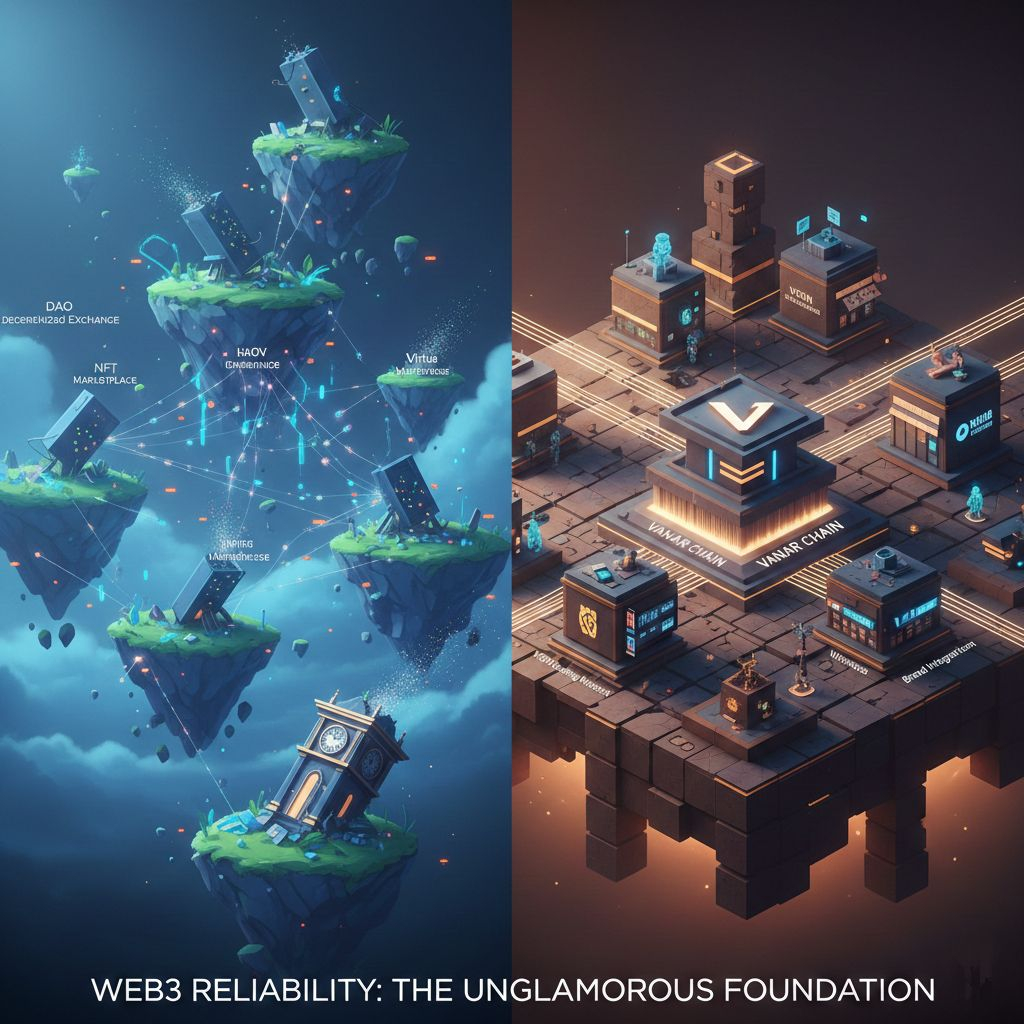
Here’s the uncomfortable part.
Web3 doesn’t struggle because people don’t understand decentralization. It struggles because too many things simply don’t work when they’re supposed to.
We talk about ownership. We talk about sovereignty. We talk about scalability, throughput, and the next billion users. But if we’re honest, most of the friction isn’t philosophical. It’s practical. Transactions fail. Wallets confuse people. Games freeze. NFTs disappear when a hosting service shuts down. Bridges get exploited. DAOs vote on proposals that no one implements properly.
The industry likes to frame its challenges as “education gaps” or “adoption curves.” But a lot of it is more basic than that. The infrastructure isn’t reliable enough for normal people. And sometimes, not even for us.
We built impressive systems. But we didn’t always build dependable ones.
Decentralization became a headline. Scalability became a benchmark. Real-world usability became an afterthought.
If you’ve been here long enough, you’ve felt this. You mint something and the metadata takes hours to resolve. You join a DAO and realize most contributors are volunteers juggling three other projects. You play a Web3 game and notice that the gameplay feels secondary to the token mechanics. Things don’t collapse dramatically. They just quietly stall.
That quiet failure is more damaging than any exploit.
Because it erodes trust slowly.
We like to believe the solution is more decentralization. Or more modularity. Or another layer stacked on top of the previous layer. But many “solutions” feel incomplete. They assume that if something is technically decentralized, it’s automatically durable. They assume incentives will magically align. They assume that removing central authority removes the need for accountability.
It doesn’t.
In the real world, systems survive because someone is responsible when things break. In Web3, responsibility is often diffused. Governance tokens vote. Contributors rotate. Roadmaps shift. And when a product fades away, there is rarely a clear consequence.
That’s the part we don’t talk about enough.
Infrastructure is not just code. It’s incentives, maintenance, long-term commitment, and the boring mechanics of keeping things alive when attention moves elsewhere.
This is where projects like Vanar Chain start to feel less like “another L1” and more like a necessary correction.
Not a hero. Not a revolution. Just a serious attempt to deal with the practical layer of Web3.
Vanar positions itself as an L1 built from the ground up for real-world adoption. That phrase usually triggers skepticism. We’ve heard it before. But what makes this conversation different is the context: the team behind Vanar has experience working with games, entertainment platforms, and brands. That matters. Those industries don’t tolerate infrastructure that randomly fails or feels experimental.
Games break when latency is inconsistent. Brands walk away when user experience is confusing. Entertainment platforms cannot rely on communities to “figure it out.”
Vanar’s approach leans into this reality. Instead of chasing abstract benchmarks, it focuses on verticals where usability isn’t optional: gaming networks like VGN, metaverse environments like Virtua, integrations across AI, eco, and brand ecosystems. These aren’t whiteboard ideas. They are environments where users expect things to function consistently.
And consistency is the unglamorous foundation Web3 needs.
If NFTs are going to matter long term, they need to exist in systems where ownership is stable and accessible. Not just technically secured, but reliably usable. If DAOs are going to coordinate real capital and communities, they need infrastructure that doesn’t require members to troubleshoot every other week. If Web3 games are going to compete with traditional gaming, the blockchain layer cannot be the weakest link.
This is where incentives and accountability become more important than marketing.
An L1 like Vanar isn’t interesting because it claims decentralization. Most chains do. It’s interesting if it can create economic and technical incentives that keep validators engaged, developers supported, and applications stable over time. If the VANRY token functions not just as a speculative asset but as a structural part of maintaining the network’s health, then it becomes part of that accountability layer.
We don’t need more theoretical innovation. We need systems that don’t quietly degrade.
One of the recurring problems in Web3 infrastructure is fragmentation. Too many chains launch without a clear path to real users. They depend on liquidity mining or short-term incentives. When those incentives fade, activity disappears. The chain technically survives, but its ecosystem thins out.
Vanar’s bet seems different. Instead of hoping developers will show up, it ties infrastructure to actual consumer-facing products. Gaming networks. Metaverse experiences. Brand collaborations. These environments bring their own users. That creates pressure. And pressure is good. It forces the infrastructure to mature.
Real-world adoption is not about onboarding billions overnight. It’s about surviving the expectations of people who don’t care about block times or consensus models. They care if their asset loads. If their game runs. If their account works.
That kind of pressure reshapes priorities.
We’ve spent years chasing decentralization as a philosophical goal. Maybe it’s time to treat reliability as a cultural one.
Because decentralization without usability feels abstract. Scalability without durability feels temporary. Ownership without accountability feels hollow.
Web3 doesn’t need louder narratives. It needs quieter competence.
It needs chains that think about maintenance, not just launches. It needs token models that reward long-term participation, not just early speculation. It needs infrastructure teams that understand what happens after the announcement thread fades.
Vanar Chain and the VANRY ecosystem are not the final answer to Web3’s infrastructure issues. No single chain will be. But the fact that it centers real-world verticals and product integration over theoretical dominance feels like the right direction.
It feels grounded.
And maybe that’s what growing up looks like for this space.
Less obsession with being revolutionary. More focus on being dependable.
If Web3 wants to move beyond cycles of excitement and quiet decay, it has to prioritize the boring mechanics. Accountability. Incentives. Consequences. Maintenance. Real users with real expectations.
Not slogans.
The future of this industry won’t be decided by who promises the most decentralization. It will be decided by who can keep systems running when no one is cheering anymore.
That’s not exciting.
But it might finally be sustainable.