


I keep coming back to the same impression when I look at @Vanarchain : they are not trying to convince crypto people to tolerate complexity, they are trying to make complexity irrelevant for everyone else.
That sounds small, but it changes everything.
Most Layer 1 discussions orbit around throughput, architecture, benchmarks, validator counts, or technical purity. These are important conversations for builders and researchers, yet they are not the language of mass participation. The average player, fan, or customer does not wake up hoping to understand a chain. They want an experience that works, costs what it should, and behaves the same way tomorrow.
Vanar appears to start from that expectation.
When infrastructure succeeds, it fades into the background. Electricity is not impressive when it works. Internet routing is invisible until it fails. Payments are memorable only when they break. Mature systems become quiet precisely because they are dependable.
If Vanar is positioning itself correctly, it is moving toward that silence.
Once you adopt this frame, many of their decisions begin to read differently. A focus on entertainment platforms, interactive worlds, consumer applications, and brand integrations is not just a marketing direction. It is a clue about who they believe the primary participant will be.
Not traders.
Users.
Users behave differently from traders. Traders chase opportunity and rotate quickly. Users repeat habits. They come back because the experience invites them to return. Their activity is smaller in size, yet more regular in frequency. They create continuity.
Continuity is what builds economies.
This is why consumer environments are powerful even when individual actions appear trivial. A single purchase, claim, transfer, or interaction might look insignificant in isolation. But multiply that motion by millions of participants repeating it daily, and you begin to see something that looks less like volatility and more like infrastructure throughput.
Repetition creates gravity.
Vanar’s approach seems built around encouraging that gravity to form. Instead of asking how to attract capital temporarily, the question becomes how to design environments people naturally revisit. Games, collectibles, social mechanics, live campaigns these are structures optimised for return visits, not one-time speculation.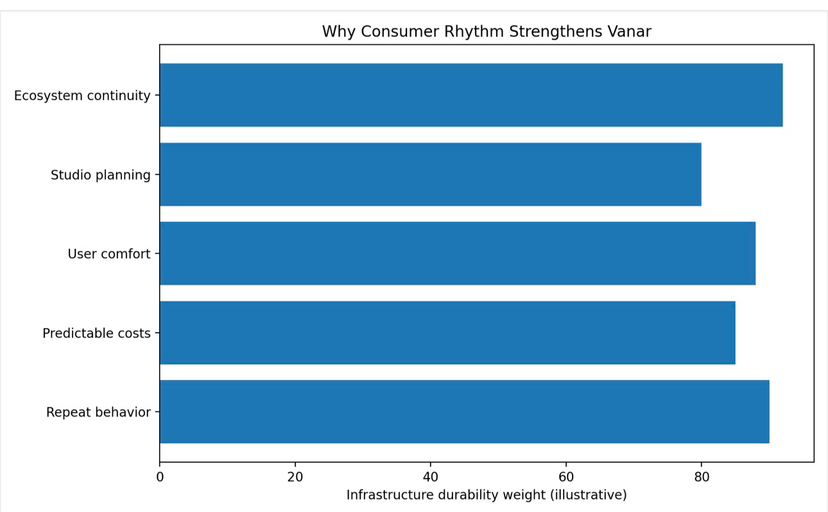
Return visits create rhythm. Rhythm creates predictability.
Predictability, in turn, changes how businesses evaluate participation. Studios can forecast costs. Brands can measure engagement. Platforms can model revenue. Once those variables stabilize, planning becomes possible.
Planning invites investment.
Something important happens here. The blockchain stops being a novelty and starts behaving like a utility provider. It delivers settlement, coordination, and ownership quietly while the front-end experience captures attention.
The more invisible the chain becomes, the more indispensable it may be.
This perspective also reshapes how token demand should be understood. If the ecosystem is functioning correctly, the average participant may never consciously interact with VANRY. They are busy enjoying a product. Meanwhile, behind the scenes, infrastructure providers, studios, marketplaces, and partners are the ones ensuring fuel is available so that experiences remain uninterrupted.
Demand migrates from the edge to the core.
When you watch mature consumer systems in traditional markets, you see similar dynamics. End users tap a screen; operators handle liquidity, infrastructure, and compliance. The user benefits from simplicity while the platform manages complexity.
Vanar seems to be steering toward that division.
What makes this powerful is scalability. Consumer behavior is not limited by financial literacy. It grows with accessibility. If onboarding becomes easier and interfaces become familiar, participation widens far beyond crypto-native communities.
Wider participation means more actions. More actions mean more structural load.
Structural load is healthy for a network. It means the chain is being used for reasons independent of narrative cycles. People transact because the product requires it, not because the market suggests it.
Utility replaces excitement.
Now think about what that implies for sustainability. When usage emerges from entertainment loops or branded experiences, it does not vanish the moment incentives end. Habits persist. Communities return. Assets circulate.
Economic life continues.
In that environment, validators and security providers operate under clearer conditions. Throughput is measurable. Growth patterns are observable. The incentive structure becomes anchored to real participation rather than speculative timing.
Alignment improves.
I also notice how this orientation reduces fragility. Systems dependent on large, irregular events can struggle between peaks. Systems supported by everyday interaction develop resilience. They can absorb shocks because their foundation is distributed across countless small behaviors.
Many small streams create a river.
For VANRY, the implications are straightforward but often misunderstood. The token does not need constant spotlight if it is embedded in operational necessity. As products scale, so does the requirement for consistent settlement. As ecosystems widen, so does the need for secure coordination.
The asset becomes a component of continuity.
And continuity is powerful because it compounds quietly. More products attract more participants. Participants generate more interactions. Interactions reinforce infrastructure relevance. Over time, replacement becomes difficult not because alternatives are inferior, but because migration disrupts established patterns.
Habit protects networks.
This is why I pay attention to signals beyond price. I watch whether applications retain users. I watch whether studios remain active. I watch whether new experiences appear. These are indicators that the environment is livable, not merely attractive.
Livable ecosystems endure.
The stress moments will be revealing. Viral adoption is never polite. Surges arrive suddenly. If Vanar can maintain performance while absorbing those waves, confidence will deepen rapidly. If it cannot, the narrative will falter.
Execution will decide.
Yet the direction is visible. Vanar is not shouting about future possibilities as much as it is constructing present readiness. It is designing a place where everyday participation feels normal and where infrastructure supports that normality without demanding attention.
That is a very different ambition from running an experiment.
In the long run, experiments are remembered. Infrastructure is relied upon. If Vanar succeeds in making itself reliable, people may stop noticing it entirely and paradoxically, that may be the clearest sign of victory.
Because when the chain disappears, the economy remains.