
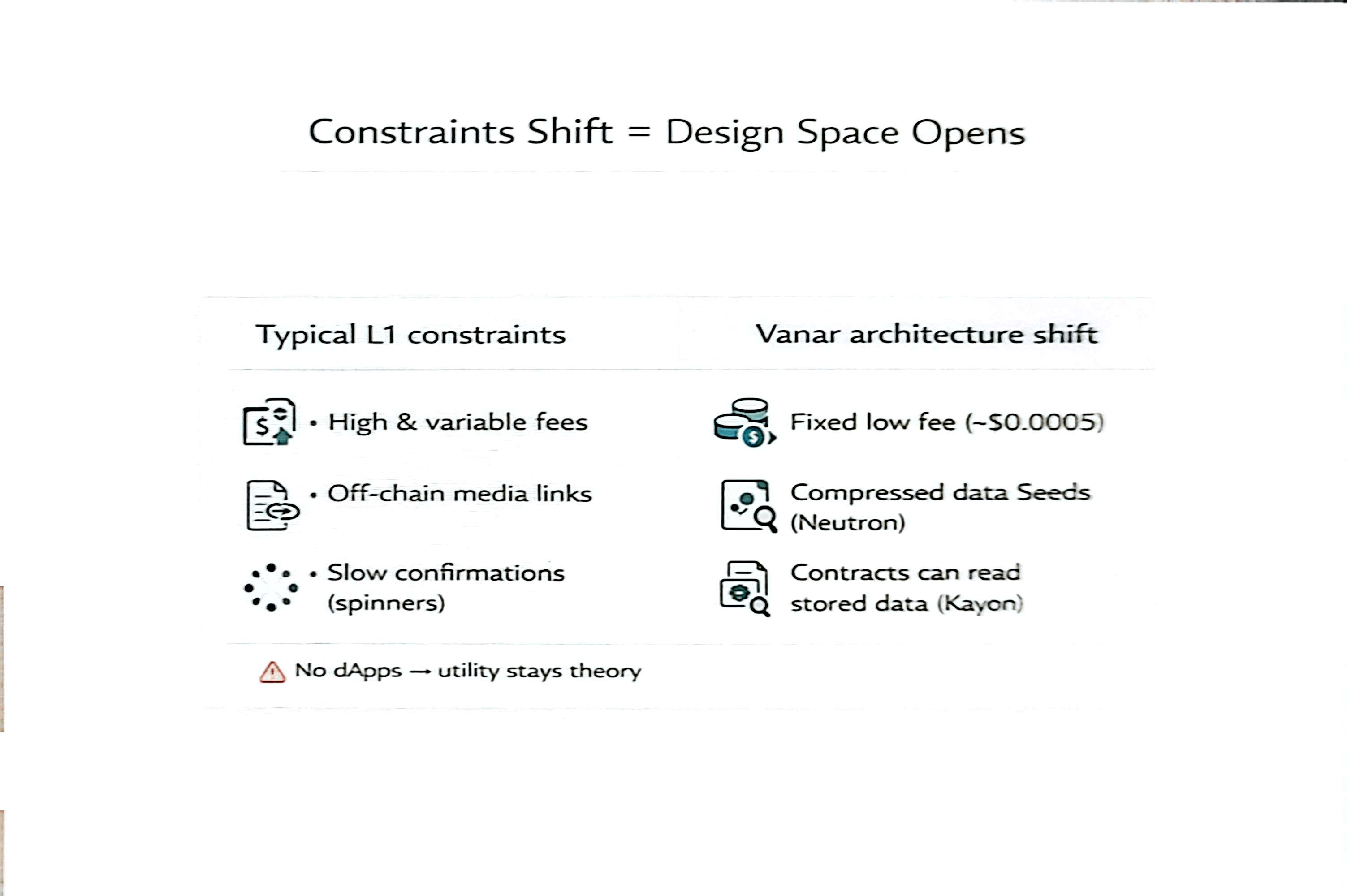
Invisible compromises have been internalized by most web3 product designers. The cost of gas charges skyrockets, and you co-locate actions. Storage is stored off-chain and thus you construct around links in IPFS that may not work. The time of confirmation differs, and therefore you put spinners everywhere to load. And these are not engineering peculiarities but they determine what is constructed.
What is the effect of changes in those constraints? It is worth going into with @Vanarchain , since its architecture alters a number of variables which builders usually express in terms of.
What Actually Changed
#Vanar Chain does not charge low and variable transaction fees, but fixed transaction fees of approximately 0.0005. It saves files on-chain with the compression layer of the Neutron rather than referencing to external hosts. And Kayon, the reasoning engine, allows smart contracts to read the data stored and not the blind logic.
Both of them open up to a different design space.
Micro-Actions Become Viable
You would never develop an application on Ethereum mainnet in which users are making dozens of little on-chain calls in a single session. The gas math kills it. That is inverted with fixed sub-cent fees. Not only final scores but also each move by the player could be recorded on-chain to be verified on-chain. A social platform would ensure that all of the followers and posts are made a real transaction and no one would think of the cost.
The research question becomes "How can we reduce on-chain interactions? to what they can do when they are almost free?
Data That Lives Where It's Used
At the time when CloneX NFTs disappeared due to a Cloudflare incident, the main issue was obvious: on-chain tokens and off-chain media. Neutron Seeds Up to one compressed Neutron Seed could be embedded in a builder on Vanar, without external dependencies. An example of actual-world asset tokenization is the deed and compliance documents being permanently etched into the property, which can be read by smart contracts using Kayon.
That is as compared to the conventional stack: token on-chain, documents on IPFS, compliance through off-chain oracle. Every handoff is an opportunity of failure. The architecture of Vanar brings those down to one on-chain object.
Quick Fit Check for Builders
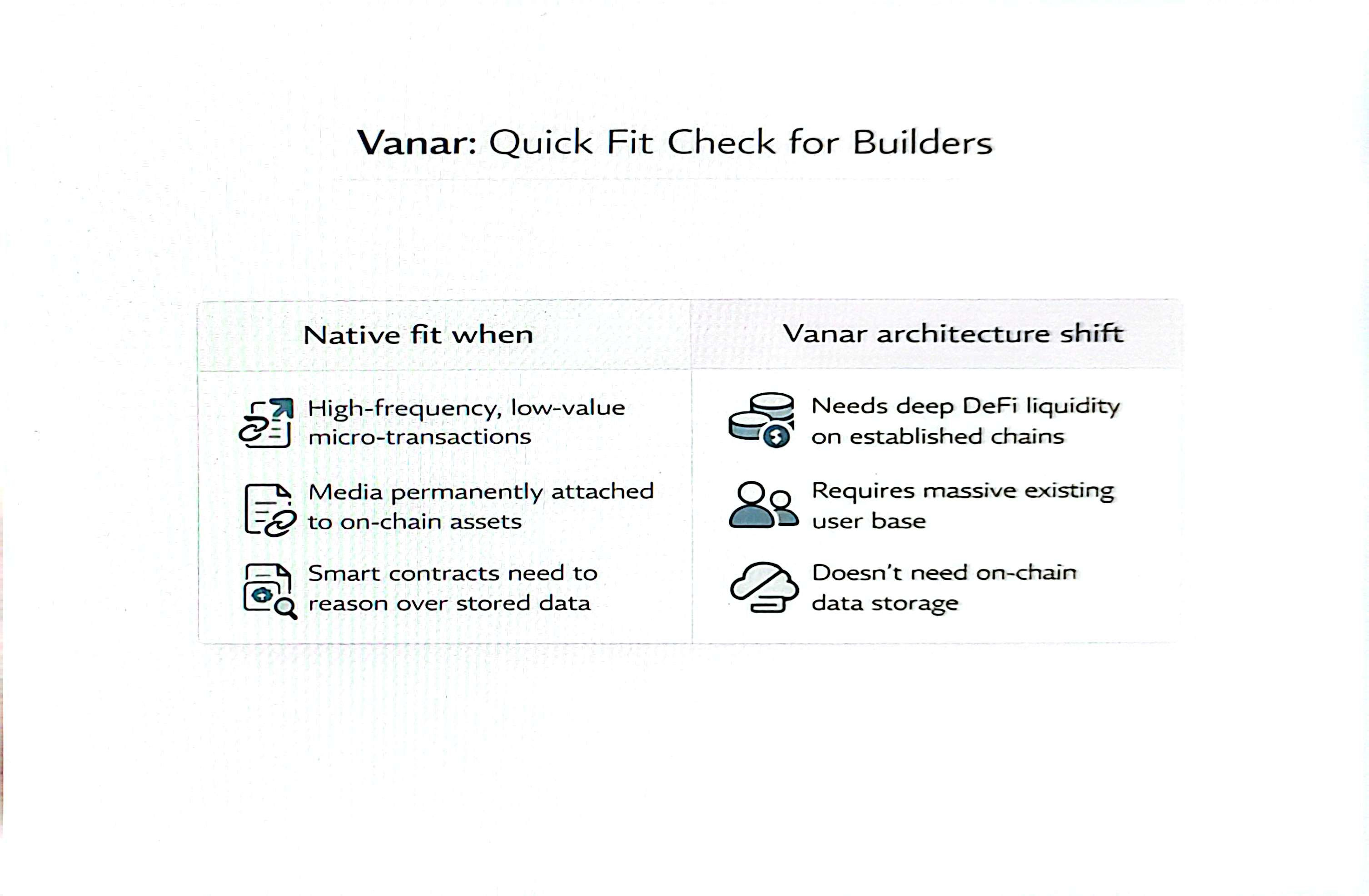
Native fit when: your app produces high-frequency, value low transactions; requires media inextricably attached to on-chain assets; or can make use of smart contracts reasoning about data in stores.
Forced fit if: it mainly requires rich DeFi liquidity on pre-existing chains; requires a huge user base to rely upon; does not need on-chain data storage.
It is important to be truthful about fit than enthusiastic about infrastructure.
The Tradeoff You Can't Ignore
Other tradeoffs of decentralization are associated with fixed fees and on-chain storage. Smaller validator set. Younger and less battle-tested network. Lighter environment of composable protocols. Their users have an easier time with some operations, at the cost of less mature composability. Vanar will not have a PayFi app integrated into it by default with Aave. Whether to grow integrations, Supra oracles, AuriSwap, cross-chain bridges, or not to bridge gaps is fast enough is a matter of execution that nobody can promise.
Risks for Builders
Ecosystem thinness. A smaller number of composable protocols implies creating additional infrastructure.
Compression dependency. The 500:1 ratio of Neutron has been proven though not audited on its own at full scale in various file types.
Developer community gap. The compatibility of EVM is helpful, but the community debugging materials and Stack Overflow answers do not exist in the same quantity as in Ethereum and Solana.
User onboarding friction. Minor lack of familiarity with the $VANRY wallets will introduce an additional conversion phase that can silently seal adoption.
This Week's Checklist
Create a test project on Vanar testnet and stress test the creation and the retrieval of Neutron Seeds.
Compare the needs of your product in terms of frequency of transactions and storage costs with the fixed-charge model. Unless it alters your design, the chain is not likely to suit you.
Make an honest comparison of the developer ecosystem of VANAR and your second choice chain. Describes what is there, what is not there and what would you create on your own.