Speed can be mentioned as a marketing measure in blockchain. The numbers of transactions per second, finality time, and throughput are used as evidence of excellence. However, beyond all these surface measurements is a sub lying question that not many networks are directly challenged with. What does really hold performance down in a globally distributed system?
Fogo is a high performance Layer 1 which operates on Solana Virtual Machine. Its main concept is not pursuing marginal benefits. It starts with a plain, simple fact: physics is the veritable choke point of blockchains. This paper is about re-thinking performance, aligning network incentives, and why Fogo is designed to attract short-term speculation.
Real Constraint Understanding Distance and Tail Latency
The efficiency of consensus is increased in most of the modern blockchains. The concepts of leader rotation, vote aggregation and optimized runtimes are no longer an experimental concept. However, the Fogo Protocol Lite paper v2 describes that the performance of the end-to-end performance is dominated by network distance and tail latency.
Signals are not transmitted immediately. It may take over a hundred milliseconds to send a message across the continents. These delays are multiplied in consensus systems which require multiple communication rounds among a majority of validators. Settlement speed is typically determined by the slowest quorum nodes.
The first principle of Fogo is straightforward: a blockchain, which takes into consideration physical geography, can be better than one, which does not consider it.
Compatibility but not Reinvention
One of the most realistic design decisions is that Fogo is compatible with the Solana Virtual Machine. It is based on the SVM ecosystem, as opposed to developing a new execution environment. Solana program developers can easily migrate programs with low friction.
This compatibility includes block propagation, Proof of History and Tower BFT style consensus. Fogo optimizes around real-world constraints, and does not introduce a replacement of existing systems but instead remains familiar to the developers.
In the case of builders, it reduces switching costs. The logic of tools, infrastructure and programs developed in Solana can be reused in Fogo architecture. It is not idealistic it is realistic.
Validator Zones: Organizing Consent based on Geography
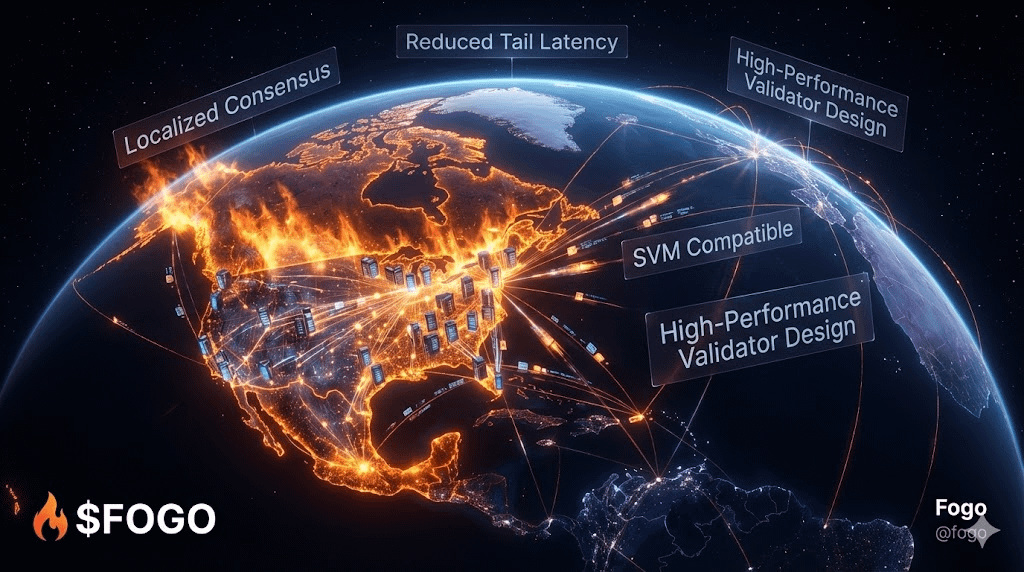
One of the key properties of Fogo is its system of validator zones. Instead of involving all the validators in consensus at every instance, Fogo zones validators. There is only one zone at any given epoch. Validators in the active environment suggest blocks and vote. The remaining remain in sync yet remain in disagreement at that time.
Such a configuration will minimize the geographic dispersion of the quorum on the critical path. Reduced long distance communication hops reduce block-confirmation latency.
Fogo introduces structured rotation models epoch rotation and follow the sun scheduling. A consensus in a follow the sun architecture migrates between regions to coincide with peak activity intervals, which might reduce the latency of the users in the active region.
The security guards are in built and there are minimum stake requirements to be in place before activation. The consensus remains stake based, and the majority requirements are present. It is an easy idea that is very strong, the closer the consensus participants, the sooner an agreement is made.
Due to fire dancer architecture, performance is enforced
The other important consideration in Fogo design is standardization of performance. Decentralized networks are resilient to large validator hardware and structure. This is inclusive hence unpredictable. Tail latency comes about when the quorum formation of nodes is not optimized.
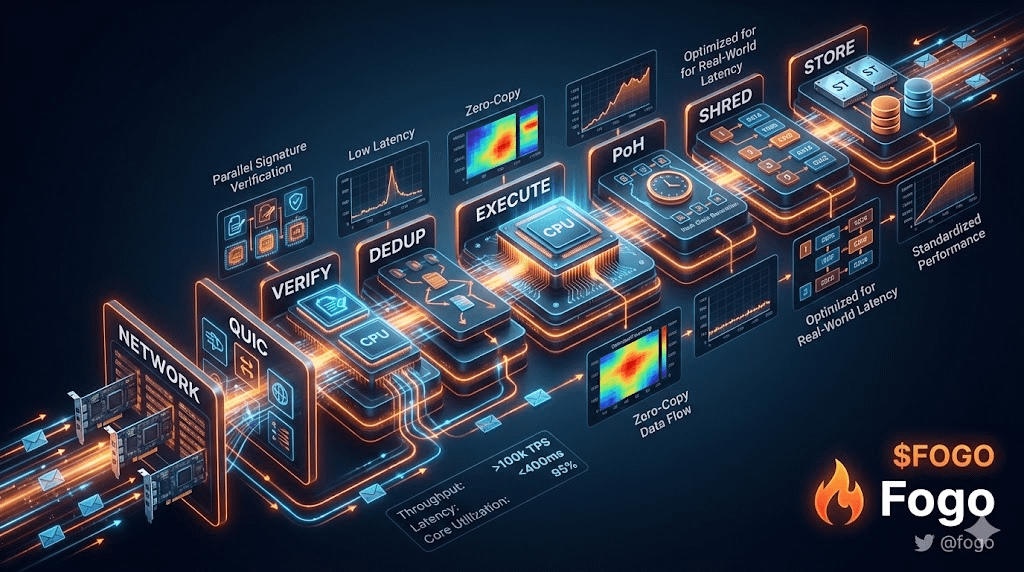
Fogo addresses this by standardization on a high performance validator client, over Fire dancer technology. The architecture has special processing units known as tiles, and all of them are connected to a particular set of CPU cores. Activities networking, signature checking, transaction processing are executed in loops which are highly optimized.
The overhead is decreased by zero-copy data manipulation, bypassing the kernel and parallel verification. The outcome is a resultant validator pipeline that reduces jitter and optimizes load throughput.
The rule is simple enough distributed systems are constrained by the slowest part. The minimization of variance increases the predictability of the performance of the network.
Economic Design of $FOGO
In addition to performance engineering, the economic layer is used to align incentives to maintain the network healthy. The transaction fees are based on the common Solana model. The minimum fee is divided into the burning and validator rewards; the priority fees are given to the block producer. The arrangement has a deflationary effect by burning fees and yet rewarding validators.
The storage rent defers unwarranted growth of the state. Balances that are large remain rent-exempt, allowing the regular users of the system to go without repeating charges yet motivate them to use their resources efficiently.
The fixed inflation rate of Fogo is 2 percent per year. Newly minted $FOGO is given to validators and stokers who get their money through a delegate. The rewards system is based on the points system associated with vote credits and, thus, those validators who actively and properly participate obtain better returns to delegators.
Such a structure helps to reinforce uptime, correctness, and long-term participation. FOGO does not sit well within a transactional unit, but rather integrates into consensus, zone governance, and security model of the network.
Session: Improving User Interaction
The Sessions standard is one of the most progressive elements of Fogo. Web3 applications can be problematic in terms of signature fatigue and transaction friction. The users will be forced to verify their actions again and again, make payments, and handle intricate wallet transactions.
Fogo Sessions presents a time limited authorization model. Users generate a session key containing scoped permissions and expiration boundaries so that apps can make several actions within the boundaries and avoid the use of repeated signatures.
Optional fee sponsoring allows apps or third parties to have costs to cover transactions within a prescribed limit. The choice of their willingness to pay fees is made by developers either in the form of native tokens, stable assets, and other assets supported.
This is particularly applicable with the gaming, mobile, and high frequency DeFi that is concerned with the user experience. Fogo brings together Web2 usability and Web3 security by implementing session-based authorization on the token layer and the program layer.
Constructed to Build Builders and Real Use Cases
The general message of Fogo is not about competing with the headline. It is concerning the optimization of blockchain infrastructure, physical and economic.
The design constraints of recognizing the speed of light and mitigating the variation in validator performance, and arranging consensus geographically, make Fogo achieve finality in quantifiable ways.
To developers, compatibility with the SVM reduces experimentation barriers. Clear expectations have been made by predictable standards of performance to the validators. Sessions and optimized settlement make it less frictional to users.
The thesis of @Fogo Official is conceptually founded in an oversaturated market with incremental changes. Hyper-optimize the physical stack, reduce distance on the critical path, and standardize the performance where it is most needed.
Joining this architecture is known as $FOGO. It is the one that achieves consensus, harmonizes economic incentives as well as forms the integrity of the network mechanism.
The bigger question is on whether blockchains can be theoretically faster or can be designed with practical constraints in mind. The strategy of Fogo demonstrates that significant changes can be achieved when the design of the protocols faces the real world. It is the point at which the long term builders and investigators can start with the longest lasting innovation.