

There is a big difference between claiming high throughput and structuring an entire chain around achieving it under real conditions.
Many networks advertise theoretical capacity. Benchmarks appear in ideal environments, under selective workloads, with limited adversarial behavior. Those numbers travel well on social media, yet they often collapse when exposed to sustained usage or unpredictable traffic.
What makes @Fogo Official interesting is that it approaches performance from a different direction. Instead of treating speed as a bragging right, it treats it as infrastructure responsibility.
Fogo is built on the Solana Virtual Machine, which already signals something important: compatibility with a high-performance execution environment that developers understand. But compatibility alone does not guarantee reliability. What matters is how consensus, networking, and validator behavior are engineered around it.
That is where Firedancer enters the picture.
The validator client matters more than many people realize. It determines how transactions propagate, how blocks are built, and how the system behaves under stress. If the client cannot keep up, theoretical throughput becomes irrelevant. You end up with congestion, inconsistent latency, and unpredictable execution.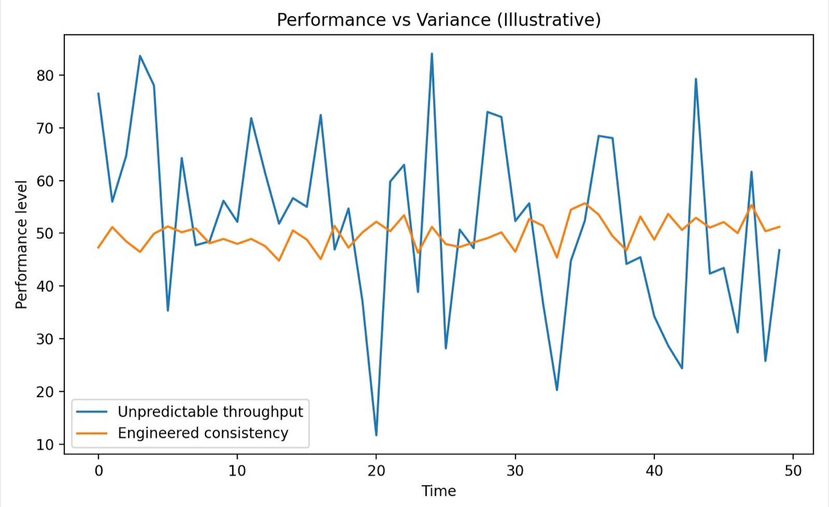
Fogo choosing a Firedancer-based path is therefore less about branding and more about mechanical confidence. It aligns the chain with a software stack specifically designed to push performance boundaries while maintaining determinism.
The reported numbers are striking: close to one hundred thousand transactions per second in observed windows, tens of milliseconds block times, and finality measured in little more than a second. But raw figures are not the only point.
The point is consistency.
For applications that care about user experience, variance is often worse than delay. If confirmations arrive in 200 milliseconds sometimes and five seconds at other times, integration becomes difficult. Businesses cannot plan around uncertainty. Systems break at the edges.
Fogo’s orientation toward predictable latency suggests it understands this.
Then there is the idea of sovereignty.
By operating as its own chain with independent consensus and security, Fogo is not inheriting congestion or governance trade-offs from a broader ecosystem. It can tune parameters specifically for the types of workloads it wants to attract.
Optimization becomes targeted.
This is especially relevant for latency-sensitive applications. Real-time trading environments, interactive consumer systems, machine-driven execution — these require infrastructure that behaves closer to traditional computing networks than experimental ledgers.
Multi-local consensus is a fascinating response to that need. By allowing geographically aware coordination, the network reduces unnecessary communication overhead while preserving agreement. Distance still matters in distributed systems; pretending otherwise only hides the problem.
Fogo is trying to manage it directly.
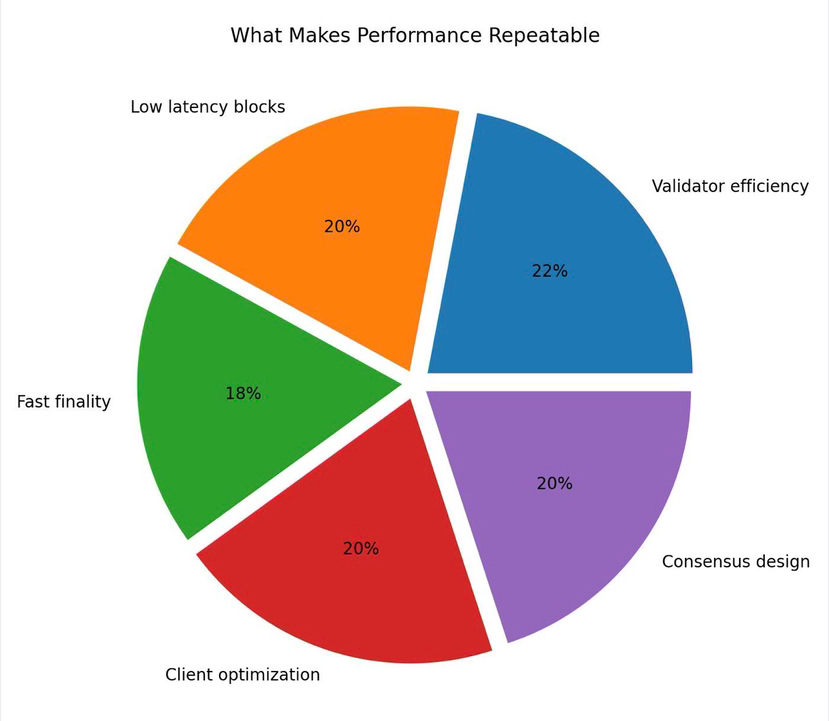 Another subtle but powerful decision is avoiding a fragmented client environment. Diversity can enhance resilience, but it can also introduce uneven performance profiles. If some validators run slower implementations, the network’s effective speed declines toward the lowest common denominator.
A Firedancer-aligned approach narrows that variability.
This does not make the system immune to challenges. High-performance chains must constantly defend against spam, maintain fairness, and ensure hardware requirements do not become exclusionary. These are real trade-offs, and they deserve scrutiny.
But at least the trade-offs are visible.
What excites me most is how this architecture reframes the conversation. Instead of debating narratives, we can discuss service levels. Instead of asking whether throughput might be possible someday, we can evaluate how the network behaves right now.
Maturity begins when promises turn into measurements.
If Fogo succeeds, developers will treat it less like a speculative environment and more like a predictable computing substrate. They will design products assuming performance will hold. They will build user journeys that depend on speed. They will create experiences that would be impossible on slower systems.
Expectations rise.
Rising expectations are a sign of trust. People only depend on infrastructure when they believe it will continue to function. That belief is built through repetition, not announcements.
The network must prove itself daily.
The broader market sometimes underestimates how transformative reliability can be. Once participants internalize that transactions clear quickly and consistently, creativity expands. Entire categories of application logic open up. Integration friction declines.
Possibility multiplies.
At the same time, independence gives Fogo flexibility in governance and upgrades. It can iterate without waiting for multi-layer coordination. That agility may prove critical as demand patterns evolve.
Performance is never finished.
Of course, numbers alone will not determine success. Ecosystems require community, tooling, support, and economic alignment. But those layers grow more easily on foundations that already function well.
Strong ground invites construction.
The real test will come during sustained activity. Short bursts demonstrate capability; continuous operation demonstrates endurance. If Fogo maintains low latency and high throughput as adoption expands, it will distinguish itself from many predecessors.
Endurance separates engineering from experimentation.
Ultimately, what I see is a network attempting to narrow the gap between blockchain and traditional high-speed systems. Not by mimicking them superficially, but by rethinking validator design, communication paths, and operational targets.
It is a serious undertaking.
Whether Fogo becomes dominant is impossible to predict. Markets are complex and adoption rarely follows linear logic. Yet the emphasis on measurable performance, controlled variability, and architectural clarity feels like a move toward adulthood for the industry.
And adulthood tends to reward those who can deliver consistently.
If crypto is going to support global-scale applications, it will require chains that behave less like prototypes and more like infrastructure. Fogo is positioning itself within that conversation.
Now it must keep running.