
I still remember the moment I seriously considered getting into crypto.
It was sometime between late 2020 and early 2021. You know how time blurs when markets get loud. Everywhere I looked, people were talking about Bitcoin again. Headlines. Group chats. Even that one friend who never talks about money suddenly had “conviction.”
NFT conversations hadn’t completely disappeared either, and meme coins were multiplying at a speed that honestly made no sense.
And me?
I felt the FOMO creeping in.
But before I sent a single dollar anywhere, one question kept replaying in my head:
Is this actually safe?
If you’re asking that right now, you’re in very good company.
Crypto is exciting, yes. But it can also feel a little like stepping into unfamiliar territory without a map. You hear the success stories, then five minutes later you hear about someone losing everything after clicking one bad link.
That contrast stays with you.
Back then, stories about hacks, phishing attacks, and social engineering were everywhere. Billions lost. Accounts drained overnight. It made the whole space feel powerful but unforgiving.
And I’ll be honest, that fear followed me into the night sometimes.
I worried about simple mistakes.
Sending funds to the wrong address.
Falling for a fake support message.
Opening my app one morning and seeing zero.
So I moved slowly. Almost painfully slowly.
Tiny amounts. Endless reading. Probably too many YouTube videos at 1 a.m.
Looking back now, I don’t regret that pace at all.
My Early Fears And What Turned Out to Be True
Volatility is not gentle.
Watching an investment drop 30 to 50 percent in hours is an experience. No simulator prepares you for that emotional punch. But over time, you realize it’s part of the landscape.
Scams really are everywhere.
Fake giveaways. Impersonated accounts. Messages that look just legitimate enough to trick you when your guard is down. I almost fell for one once, and that was enough to permanently sharpen my instincts.
There is no undo button.
Traditional banking spoils us a little. Crypto does not. If you make the wrong move with your keys or approve something malicious, recovery is unlikely.
Exchanges help, but they are not vaults.
Even strong platforms can face disruptions. Keeping large holdings on an exchange long term started to feel less like convenience and more like unnecessary trust.
But here’s the part many beginners don’t hear often enough:
The blockchain itself is remarkably secure. Most disasters don’t happen because the technology fails. They happen because someone was rushed, distracted, or manipulated.
Human moments. Not technical ones.
What Helped Me Sleep Better
I began treating safety less like a tip and more like a lifestyle.
I learned before I invested.
Not everything, of course. You never learn everything. But I understood wallets, private keys, and why self-custody matters. That foundation changes how you move.
I started ridiculously small.
My first purchase was about $20 worth of Bitcoin. Not impressive, but it let me practice. I tested transfers. Checked addresses three times. That tiny rehearsal prevented expensive mistakes later.
I stayed close to reputable platforms.
The flashy promises never tempted me much. Security history started to matter more than bonuses.
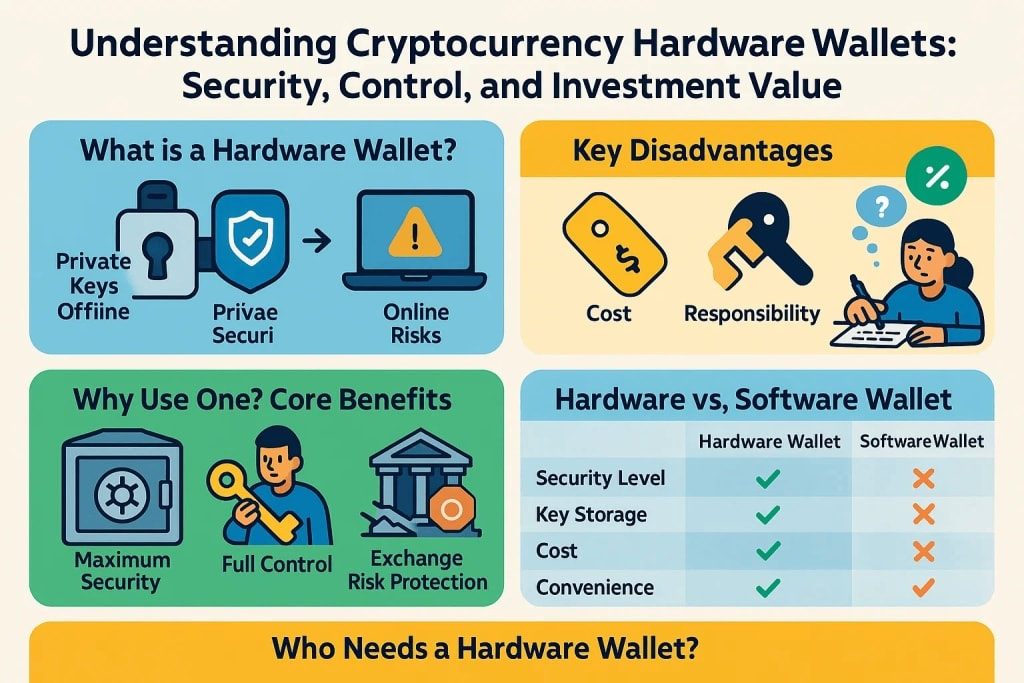
Getting a hardware wallet changed my mindset.
When I finally bought a device from Ledger, it felt less like buying tech and more like installing a lock on my financial front door.
Offline keys bring a very quiet kind of peace.
And honestly, that principle alone eliminates a huge portion of beginner risk.
Small Habits That Made a Big Difference
Some of these sound obvious. Yet they save people every single day.
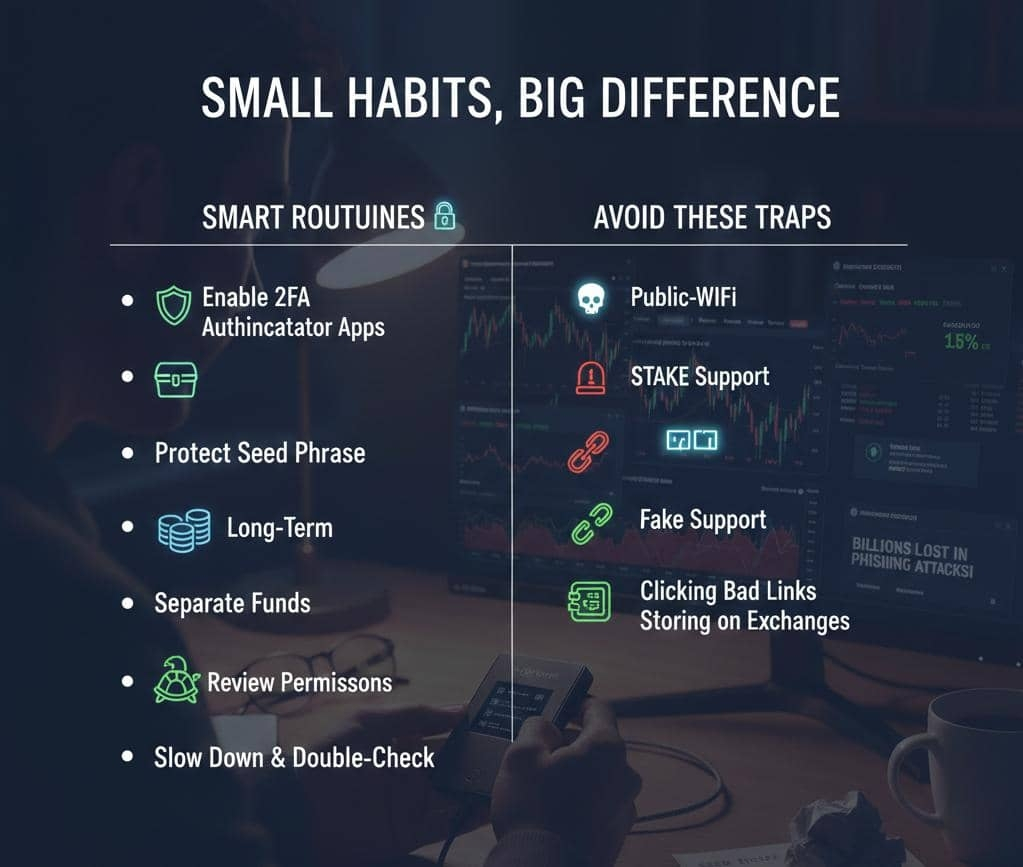
• Enable two-factor authentication everywhere. Prefer authenticator apps over SMS when possible.
• Treat your seed phrase like something irreplaceable, because it is.
• Separate long-term holdings from trading funds.
• Review wallet permissions occasionally using tools like Revoke.cash.
• Avoid making transactions on public Wi-Fi.
• Slow down and double-check addresses. Every time.
No shortcuts here. Just consistency.
The Mindset Shift That Reduced My Stress
One quiet rule helped more than anything:
Only risk what you can emotionally afford to lose.
Not just financially. Emotionally.
When your entire stability isn’t tied to market swings, you think clearer. You panic less. You make better decisions.
Crypto stopped feeling like a threat the moment I stopped treating it like a lottery ticket.
Looking Back Now
Was the fear worth it?
I think so.
Fear, when listened to, becomes awareness. Awareness becomes habit. And good habits compound faster than hype ever will.
Over time, the anxiety softened. Crypto started to feel less intimidating and more like a space full of calculated opportunity.
If safety is the question circling your mind right now, that’s not hesitation. That’s intelligence.
Move slowly. Stay curious. Secure everything.
And remember the phrase people repeat for a reason:
Not your keys, not your crypto.
The early stage is always the hardest. But the investors who build careful habits early usually thank themselves.
When you first thought about entering crypto, what scared you the most?