

A lot of chains say they’re compatible with something popular. Most of the time, that word “compatible” hides a catch. You still rewrite half your code. You still retrain your team. You still debug for weeks. So when I first heard that Fogo is SVM compatible, I didn’t get excited. I got suspicious.
It’s a bit like switching banks. If your debit card, app, and account number all stay the same, the move feels easy. If everything changes, you hesitate. Developers feel the same way about virtual machines.
SVM stands for Solana Virtual Machine. In plain language, it’s the engine that runs programs on Solana. It decides how smart contracts execute, how transactions are ordered, and how accounts interact. If you’ve built on Solana, you’ve already internalized how SVM “thinks.” The way accounts are structured. The way instructions are processed. The way parallel execution works in the background.
So when Fogo says it supports SVM, what it’s really saying is this: your mental model still works here.
That matters more than marketing ever will. I’ve seen teams spend months just adapting to a new execution model. Not because the new system was bad, but because it was unfamiliar. Developers are creatures of habit. Once they understand a runtime deeply, they don’t want to throw that knowledge away.
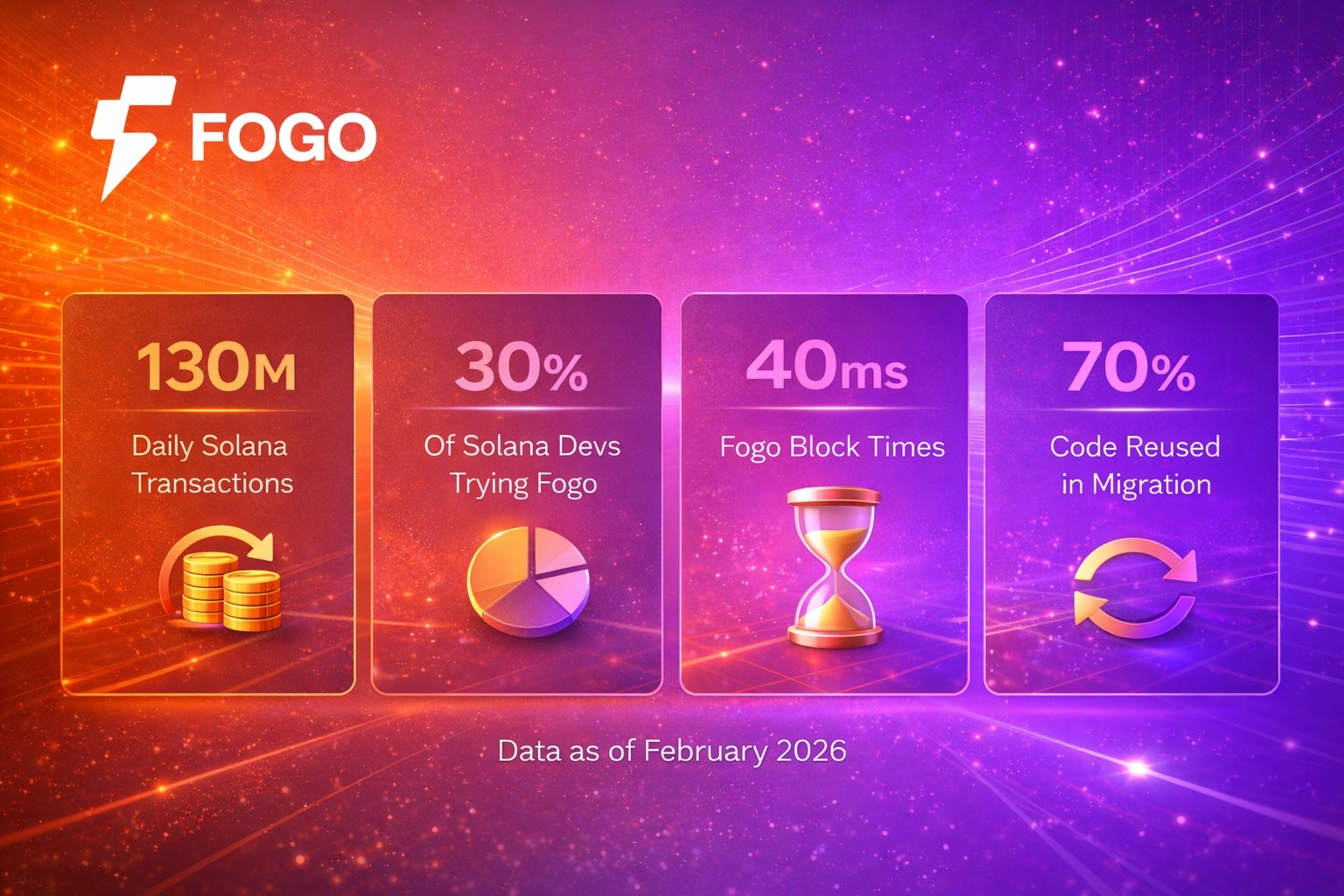
SVM itself was designed with parallel execution in mind. Transactions can run at the same time if they don’t touch the same accounts. That’s why Solana became known for high throughput. As of February 2026, Solana continues to process tens of millions of transactions per day across its ecosystem. That scale means thousands of developers have already learned how SVM behaves under pressure.
Fogo stepping into that world isn’t random. It’s practical. Instead of inventing a new virtual machine, it builds on one that already has real-world battle testing behind it.
What makes this interesting now is timing. Over the past year, developers have become more cautious. The experimental phase of building on entirely new stacks feels less attractive. Teams want speed, yes, but they also want familiarity. Early 2026 feels more conservative than 2021 ever did. That shift in mood is quiet, but you can feel it.
Fogo positions itself as trading-focused, with block times reportedly around 40 milliseconds and sub-second finality as of February 2026. That means transactions are considered confirmed in under a second. For high-frequency financial applications, that’s meaningful. But speed numbers only matter if developers can actually deploy without friction.
Here’s where SVM compatibility plays out in real life.
Imagine a Solana-based decentralized exchange built using Rust and the Anchor framework. The core program logic – order matching, margin checks, liquidation rules – relies on SVM’s account model. On Fogo, that same structure can often be reused with minimal changes. The instruction handlers don’t suddenly become obsolete. The account layout doesn’t need to be redesigned from scratch.
That’s not magic. It’s engineering alignment.
But I’ll be honest – compatibility doesn’t erase complexity. Even if the execution engine behaves the same, the surrounding ecosystem may not. Solana has years of tooling behind it: indexers, wallet integrations, analytics dashboards. Fogo is newer. Some of that infrastructure may still be maturing. Early builders often become unofficial beta testers whether they planned to or not.
There’s also the performance question. Running SVM in a different network environment isn’t identical to running it on Solana. Validator design, fee markets, and network topology all affect real-world behavior. A 40 millisecond block time sounds impressive, and it is, but maintaining that under heavy load is harder than demonstrating it in controlled conditions. If serious trading volume migrates, that’s when stress shows up.
Another subtle challenge is evolution. Solana’s SVM continues to develop. If Fogo wants to remain truly compatible, it has to track those changes closely. Otherwise, “SVM compatible” slowly becomes “SVM inspired.” That drift can happen quietly.
Still, there’s something steady about this approach. It doesn’t scream novelty. It doesn’t demand a leap of faith. It builds on a known foundation and tries to optimize around it.
And that may be the unique angle here. Instead of competing on abstract technical theory, Fogo competes on developer continuity. It says: keep your skills, keep your language, keep your structure. Just run it in an environment tuned for speed.
I’ve noticed something underneath all this. Virtual machines are starting to matter more than the chains themselves. We used to talk about networks like separate planets. Now it feels more like shared operating systems across different hardware. The execution layer becomes the constant. The chain becomes the variable.
If that pattern holds, SVM compatibility isn’t just a feature. It’s a strategy.
But there are risks. If Fogo fails to build enough ecosystem depth, developers may test it and then drift back. Familiarity helps you get attention. It doesn’t guarantee long-term retention. Liquidity, community, tooling – those still need to be earned over time.
At the same time, early signs suggest genuine curiosity. Builders who already understand Solana don’t need to relearn fundamentals to experiment here. That lowers the emotional cost of trying something new. And emotional cost is real, even if we rarely admit it in technical discussions.
So why is this trending now? Because developers are tired of starting from zero. Because reuse feels smarter than reinvention. Because performance combined with familiarity is a more grounded pitch than flashy architectural overhauls.
Whether Fogo becomes a major hub remains to be seen. Speed claims must survive real demand. Ecosystem gaps must close. Compatibility must stay aligned as SVM evolves.
But one thing feels clear. In a market that once chased novelty at any cost, a chain that respects existing knowledge might quietly have the advantage. Not because it is louder. Because it asks less of the people building on it.
