
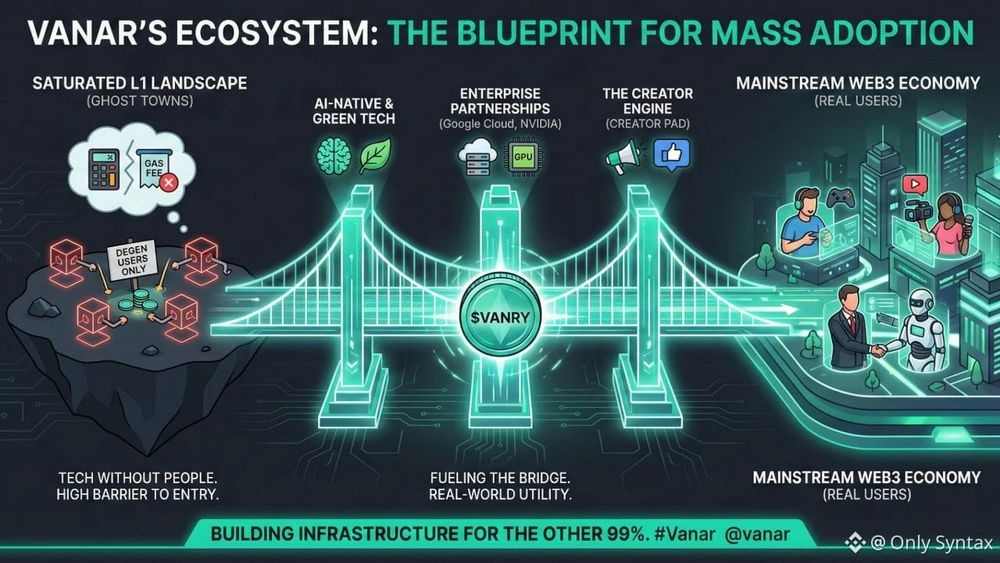
Vanar’s ecosystem, which lays out a blueprint for mass adoptionbringing ordinary people into the Web3 world on a large scale. It teaches us that blockchain technology shouldn’t be limited to technical experts but should be made accessible to everyday users, businesses, and industries.
In this image, it shows how Vanar acts as a bridge. On one side, it moves beyond the existing L1 blockchains that have high fees and limited users, and on the other side, it connects AI, green tech, major enterprise partnerships (like Google Cloud, NVIDIA), and creators to a real Web3 economy.
This benefits people by showing that blockchain is not just a complicated technology, but a practical platform for daily life, businesses, digital content, and everyday users. Vanar is essentially laying a foundation where people can benefit from blockchain in real-world applications, teaching us how technology can be molded for public benefit.
In the early days of blockchain, the technology felt like a private language spoken by a small circle of believers. It promised transparency, ownership, and a new financial order, yet for most people it remained distant and technical. Wallet keys, network fees, and complicated interfaces created a gap between vision and reality. Over time, that gap became one of the biggest obstacles to mass adoption. Vanar enters this landscape not as another experiment in speed or complexity, but as an effort to close that distance and bring blockchain closer to everyday life.
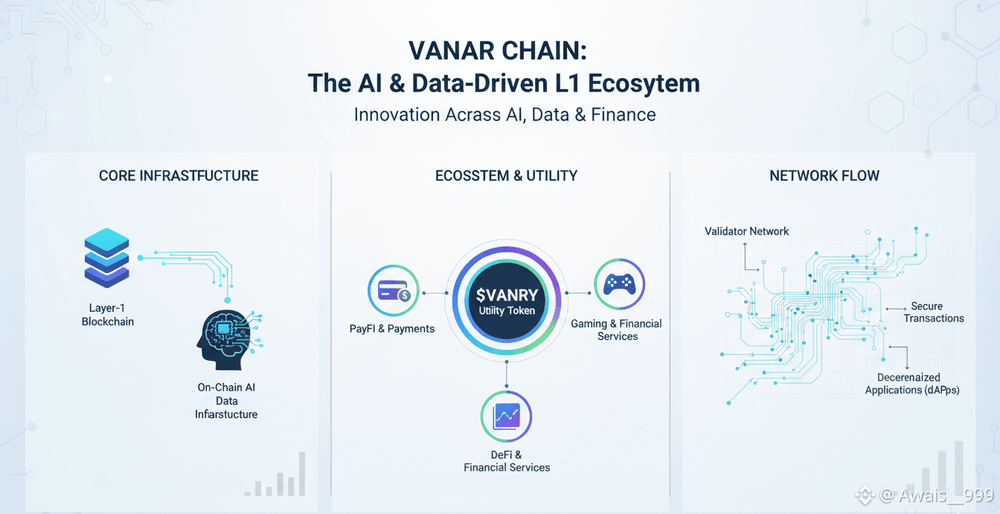
Vanar Chain is a Layer-1 blockchain that is building an ecosystem based on AI and data. It aims to offer innovation across AI, data, and finance in the future.
It primarily focuses on three aspects: a strong blockchain infrastructure where AI data is handled on-chain, then an ecosystem using the VANRY utility token, which can be used in payments, gaming, and financial services, and a network flow that includes validators, secure transactions, and decentralized apps.
From this, people can learn that the role of data and AI in the digital economy is expanding. The benefits could include new opportunities like easier payments, transparent financial systems, and new business models. The downside could be that if the technology becomes too complex or is misused, there could be challenges related to security or privacy.
One of the most important aspects of Vanar’s strategy is its focus on integration rather than isolation. Many blockchain networks develop advanced technical systems but struggle to connect them with mainstream industries. Vanar takes the opposite path. It builds infrastructure designed to support applications across gaming, digital worlds, artificial intelligence, sustainability initiatives, and brand collaborations. This cross-industry approach positions the network as more than a standalone blockchain. It becomes a foundation capable of supporting diverse digital economies.
The gaming sector plays a central role in this vision. Gaming has long been considered one of the strongest pathways toward blockchain adoption because players already understand digital assets, online communities, and virtual economies. However, early attempts at blockchain gaming often prioritized token mechanics over gameplay quality, creating friction for users. Vanar’s approach seeks balance. Through its VGN games network, it provides a scalable environment where players, developers, and digital assets can coexist within a secure blockchain framework without overwhelming the experience. The focus remains on gameplay and user interaction, while the underlying blockchain handles ownership and transaction security.
Beyond gaming, Vanar supports immersive digital environments through the Virtua metaverse. Virtual spaces are not new, but their connection with blockchain technology introduces a new layer of digital ownership and interaction. In these environments, users can explore branded spaces, attend events, collect digital items, and engage with communities. The blockchain element works quietly in the background, ensuring transparency and asset security without requiring users to understand complex technical processes. The result is an ecosystem that blends entertainment with decentralized infrastructure in a natural way.
Artificial intelligence integration represents another dimension of Vanar’s ecosystem. As AI tools become more integrated into digital life, the intersection between AI and blockchain offers opportunities for data management, verification, and decentralized applications. While many projects discuss AI in theoretical terms, Vanar positions its infrastructure as capable of supporting AI-driven applications within a secure and scalable network. This reflects the broader ambition of the project: remain adaptable to technological shifts while maintaining a strong core foundation.
Sustainability initiatives also form part of Vanar’s broader narrative. Blockchain technology has often faced criticism regarding environmental impact. As the industry evolves, efficiency and responsible development have become more important. By focusing on practical infrastructure and scalable architecture, Vanar aligns itself with a more mature phase of blockchain development where efficiency and long-term planning take priority over rapid expansion without consideration.
At the center of the Vanar ecosystem lies its native token, VANRY. The token serves as the operational engine of the network. It powers transactions, supports ecosystem participation, and enables access to services built on the blockchain. Unlike tokens designed solely for speculation, VANRY is integrated directly into the functionality of applications within the ecosystem. Whether facilitating transactions in gaming environments or supporting interactions within digital spaces, the token’s utility is tied to real activity.
As adoption grows, the relevance of VANRY is connected to ecosystem expansion. Increased application development, user engagement, and cross-industry collaboration strengthen the demand for network participation. This relationship between usage and token utility reflects a broader shift within blockchain projects toward sustainable growth models rather than short-term token cycles.
Vanar’s infrastructure is designed to prioritize scalability and user experience. One of the challenges facing many blockchain networks is balancing performance with accessibility. High transaction speeds mean little if users struggle to interact with the network. Vanar addresses this by focusing on streamlined integration for developers and intuitive interfaces for users. The blockchain should feel invisible to the average participant. When someone joins a digital world or engages in a game, the experience should feel seamless rather than technical.
This user-centered design philosophy is central to the project’s long-term outlook. Mass adoption will not occur because people suddenly become interested in decentralized protocols. It will happen when blockchain becomes embedded in applications they already value. By positioning itself within entertainment, gaming, and digital brand ecosystems, Vanar places blockchain in contexts that feel familiar and engaging.
Partnerships also play an important role in the network’s strategy. Experience in global brand collaboration allows Vanar to connect blockchain infrastructure with established audiences. Instead of expecting users to migrate toward purely crypto-native environments, the project integrates decentralized elements into spaces where communities already exist. This reduces the learning curve and encourages gradual onboarding rather than abrupt transition.
The broader Web3 landscape is evolving rapidly. Initial enthusiasm was driven by decentralized finance and token trading, but long-term growth depends on practical applications. Infrastructure projects like Vanar represent the industry’s shift toward maturity. The conversation is no longer only about speed or technical complexity. It is about real-world relevance, usability, and sustainable ecosystems.
Vanar’s narrative reflects patience and strategic positioning. It does not rely on dramatic claims or exaggerated forecasts. Instead, it emphasizes consistent development and cross-sector integration. In a market often driven by volatility, this measured approach stands out. Building a foundation capable of supporting billions of users requires more than innovation; it requires stability and long-term planning.
The ambition to onboard the next three billion users into decentralized ecosystems may sound bold, but it aligns with global digital trends. Internet access continues to expand, gaming communities grow across continents, and digital entertainment becomes more immersive each year. Blockchain adoption will likely follow these patterns rather than replace them. By embedding itself within growing industries, Vanar increases the probability of organic expansion.
Another key element of Vanar’s strategy is flexibility. Technology evolves quickly, and networks must adapt to remain relevant. By designing infrastructure that supports multiple sectors, the project reduces dependence on any single trend. If gaming accelerates, the network supports it. If AI-driven applications expand, the foundation can integrate them. This adaptability strengthens resilience in a competitive environment.
Security remains a fundamental requirement for any Layer 1 blockchain. While user experience and industry integration are essential, the underlying architecture must maintain reliability and trust. Vanar’s focus on scalable design aims to ensure that as adoption increases, performance remains stable. This balance between innovation and reliability is critical for attracting developers and enterprise partnerships.
As blockchain technology moves into its next phase, the distinction between experimental networks and real-world infrastructure becomes clearer. Projects that survive long-term are those that align technical capability with practical application. Vanar positions itself within that category by focusing on integration, usability, and cross-industry collaboration.
The journey toward mainstream Web3 adoption will not be defined by a single breakthrough. It will be shaped by gradual integration into everyday digital experiences. People may not even realize they are interacting with blockchain technology, and that may be the point. When infrastructure works smoothly, it fades into the background. Vanar’s approach suggests an understanding of this principle.
Ultimately, the significance of Vanar lies in its attempt to humanize blockchain. It treats decentralized technology not as an abstract financial revolution but as a tool that can enhance entertainment, digital ownership, and global interaction. By connecting blockchain with gaming networks, immersive digital worlds, artificial intelligence applications, and brand ecosystems, it builds a bridge between technical infrastructure and mainstream culture.
In a space often characterized by extremes, Vanar represents a steady, grounded effort to make Web3 practical. It acknowledges the complexity of blockchain while striving to simplify its impact. As the digital economy continues to expand, platforms capable of blending innovation with accessibility will shape the future. Vanar’s mission reflects that belief, positioning it as a foundational layer for the next stage of decentralized growth.
