
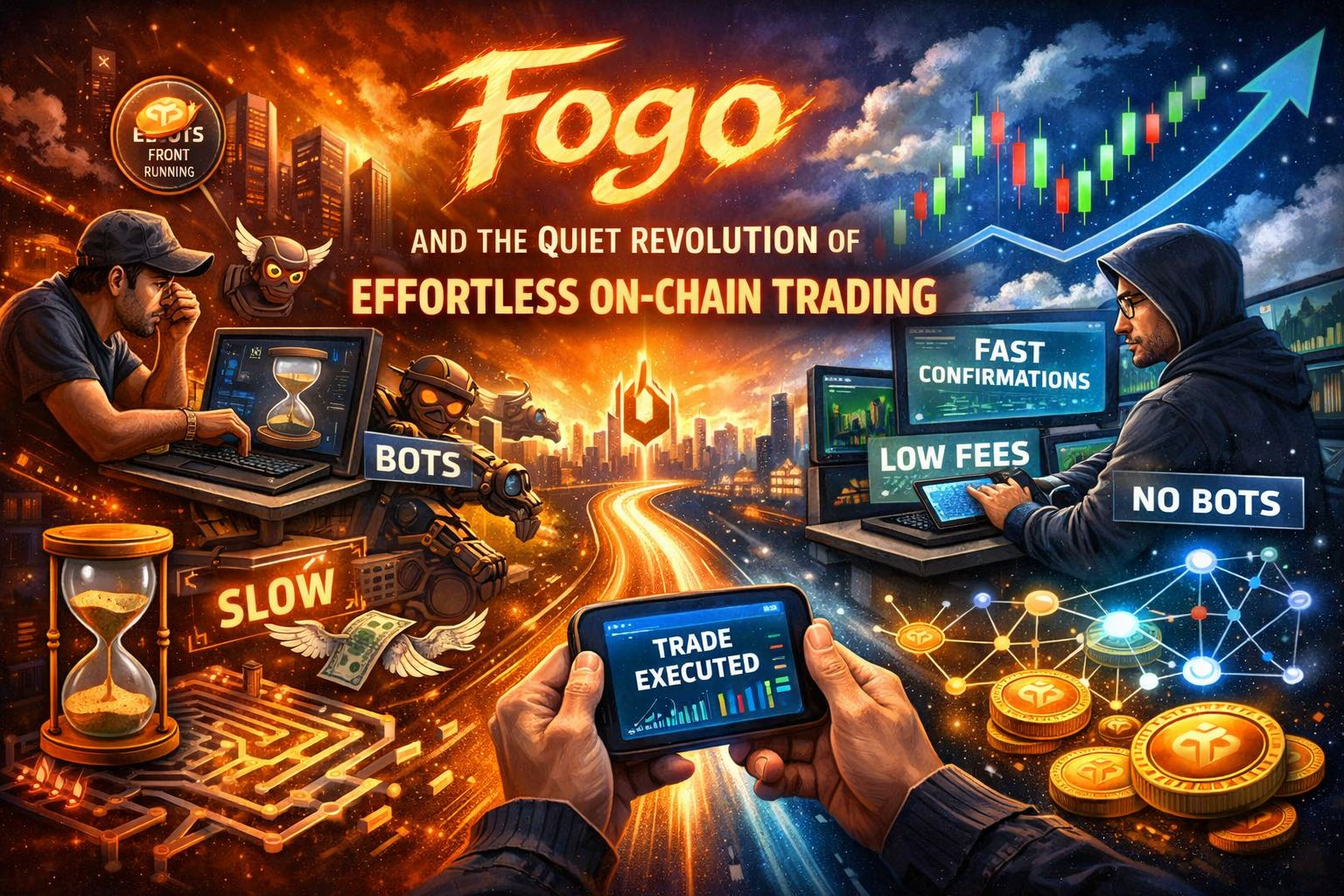
There was a time when using blockchain for trading felt like stepping into the future while carrying the weight of the past. The idea was powerful. You control your assets. You trade without middlemen. You participate in an open financial system. But the reality often felt different. Transactions were slow when markets were moving fast. Gas fees would suddenly rise without warning. Bots would jump ahead of regular users and capture opportunities before a human even realized what happened. It became clear that decentralization alone was not enough. The experience had to improve. Fogo was created in that exact space of frustration, with one simple intention that feels deeply human. Make on chain trading feel effortless.
Fogo is a high performance Layer 1 blockchain built specifically to remove the hidden taxes of on chain activity. When we talk about hidden taxes, we are not just speaking about money. We are talking about time, stress, uncertainty, and missed opportunity. If you have ever tried to execute a trade during a volatile market, you know how important speed and reliability are. Even a few seconds can change the outcome. Fogo addresses this by designing its entire architecture around low latency and high throughput. Instead of treating performance as a feature, it treats performance as a foundation.
One of the core technical choices behind Fogo is its use of the Solana Virtual Machine. This decision is important because it allows developers familiar with the Solana ecosystem to build on Fogo without learning everything from scratch. It creates compatibility and lowers the barrier for innovation. But Fogo does not stop at compatibility. It introduces its own optimizations aimed at delivering extremely fast block production and quick finality. Blocks can be produced in around forty milliseconds, and transaction confirmations often happen in roughly one and a half seconds. When you compare that to older blockchains where confirmations could take much longer, the difference becomes something you feel in real time.
Speed alone, however, does not solve every issue. Fogo also focuses on fairness. In many blockchain environments, sophisticated bots exploit network delays and transaction ordering to gain an advantage over regular users. This creates a sense that the system favors those with advanced automation and technical resources. Fogo’s design aims to reduce these structural advantages by minimizing latency and improving transaction processing efficiency. When execution is fast and predictable, it becomes harder for opportunistic actors to exploit delays. The experience starts to feel more balanced and transparent.
The infrastructure supporting Fogo reflects this same philosophy. Validators operate with high performance software clients designed to maximize throughput and reliability. The network architecture is tuned to reduce communication delays between nodes. This is not about marketing numbers. It is about ensuring that when activity increases, the network remains stable and responsive. If demand surges during a major market event, users should not feel panic because of congestion or unexpected costs. Stability builds trust, and trust encourages participation.
The FOGO token plays a central role within this ecosystem. It is used to pay transaction fees, to stake and secure the network, and to participate in governance decisions that shape the future of the chain. Early funding rounds and a public token sale helped bring attention to the project. Binance became important at one stage when it supported the token sale process, introducing Fogo to a broader audience of traders and investors. That exposure mattered, but long term value depends not on listings but on adoption and usage. A token gains meaning when it powers real economic activity on a network that people rely on.
Developers are an essential part of this story. Fogo provides them with a familiar environment while offering improved performance. This combination reduces friction for builders who want to deploy decentralized exchanges, lending platforms, staking solutions, or other trading related applications. If the infrastructure is fast and reliable, developers can focus on creating better user interfaces and financial products rather than constantly optimizing around network limitations. It becomes easier to experiment and innovate when the base layer is strong.
Traders also experience this difference directly. On centralized exchanges, execution is usually fast and predictable, but users give up custody of their assets. On many traditional blockchains, users keep custody but sacrifice speed. Fogo attempts to bridge that gap by delivering near centralized levels of responsiveness while maintaining the principles of decentralization. If that balance holds, it changes how people think about on chain trading. It stops feeling like a compromise and starts feeling competitive with traditional systems.
What makes Fogo stand out is not only its technical approach but its emotional awareness. The team behind it understands the psychological side of trading. When markets move quickly, hesitation and uncertainty increase stress. If a network adds delays or unpredictable fees, it amplifies that stress. By removing these hidden obstacles, Fogo reduces friction not just technically but mentally. The smoother the experience, the more confident users become. Confidence leads to participation, and participation fuels ecosystem growth.
We are seeing decentralized finance mature beyond its experimental phase. Early blockchains proved that trustless systems could exist. Now the focus shifts toward usability and performance. Real world adoption requires infrastructure that feels intuitive and responsive. Fogo positions itself within this transition. It is not trying to reinvent the concept of blockchain. It is refining how blockchain feels in practice.
Of course, no project is without risk. The blockchain space is competitive and constantly evolving. New technologies emerge quickly. User attention shifts rapidly. For Fogo to succeed long term, it must continue to attract developers, maintain security, and deliver consistent performance even under pressure. Trust is not built in a single release. It is built over time through reliability and transparency.
Still, there is something compelling about a project that chooses focus over hype. Instead of promising to change the world in abstract ways, Fogo concentrates on a specific pain point and works to solve it deeply. If you have ever been frustrated by slow confirmations, rising gas costs, or bots cutting ahead of your transaction, you understand why this mission matters. Effortless trading is not about luxury. It is about fairness and accessibility.
When I reflect on what Fogo represents, I see more than just another Layer 1 blockchain. I see a shift toward user centered design in decentralized finance. If blockchain technology is meant to empower individuals, then it must respect their time and energy. It must feel smooth rather than complicated. It must remove hidden taxes rather than introduce new ones. Fogo moves in that direction with clarity and intention.
If the network continues to deliver on its promise, it could help redefine expectations for on chain trading. Instead of accepting delays and unpredictability as normal, users may begin to demand seamless performance as a standard. That cultural shift would be powerful. It would signal that decentralization and usability no longer stand in opposition. They can coexist. And when they do, the future of finance becomes not just decentralized but genuinely human.
