
Designing Deterministic Exit Windows: How I Learned That Liquidity in Games Is a Governance Problem, Not a Speed Problem
I still remember the exact moment it clicked. I was sitting in my hostel room after midnight, phone on 4% battery, trying to exit a profitable in-game asset position before a seasonal patch dropped. The marketplace was moving fast, prices were shifting every few seconds, and every time I tried to confirm the transaction, the final execution price slipped. Not by accident. By design. 😐
What bothered me wasn’t the volatility. I trade. I understand risk. What bothered me was the invisible layer between my click and my outcome. Some actors were consistently getting better fills than others. My liquidity wasn’t just competing with other players — it was competing with a structural advantage baked into the system.
That night didn’t feel like losing to market forces. It felt like losing to timing asymmetry. And that’s when I realized: in adaptive game economies, exit isn’t a feature — it’s a battleground.
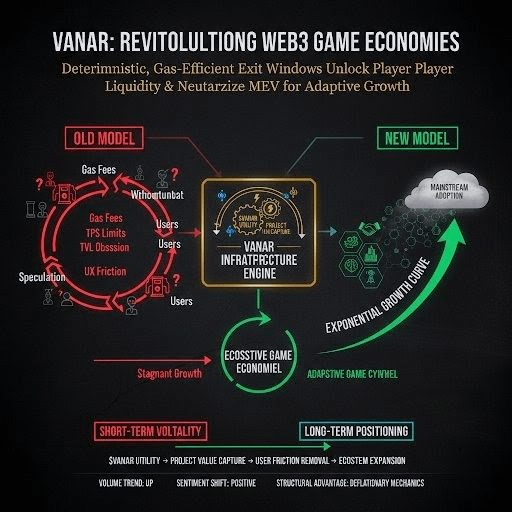
When we talk about “liquidity” in games, most people think about speed. Faster confirmations. Faster matching. Faster settlement. But speed is the wrong lens. Speed without fairness simply amplifies the advantage of whoever sees the board first. ⚖️
A better analogy is airport security. Everyone wants to leave, but if some travelers can see the screening algorithm before they approach the line, they will always move more efficiently. The issue isn’t how fast the line moves. It’s whether the rules of the line are deterministic and visible to all participants at the same time.
In adaptive digital economies, especially those embedded in games, the problem is not volatility. It is predictable extraction. When exit windows are open continuously and execution is reactive, sophisticated actors can observe intent, reorder transactions, and capture value before ordinary players even realize what happened.
This is not uniquely a gaming problem. Traditional finance has struggled with similar asymmetries. High-frequency trading firms built entire infrastructures around microsecond advantages, prompting regulatory debates at institutions like the SEC about fairness versus efficiency. Markets became fast, but not necessarily equitable.
On networks like Ethereum, execution order can be influenced by transaction bidding dynamics. On Solana, high throughput reduces congestion but doesn’t eliminate ordering games. Both systems demonstrate that performance improvements do not automatically solve extraction incentives. They often magnify them.
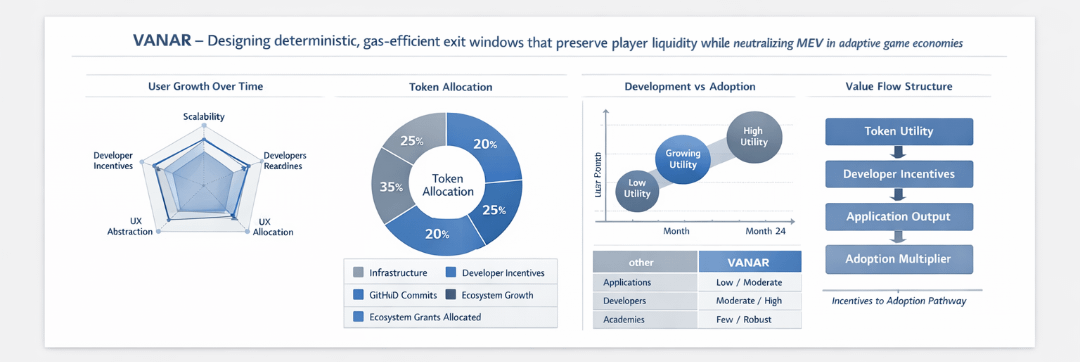
The structural cause is simple: when exits are continuous and non-deterministic, the earliest observer captures the surplus. That observer may not be the creator of value — only the fastest intermediary.
In adaptive game economies, this becomes more fragile. Prices are influenced by gameplay events, AI-driven adjustments, reward recalibrations, and narrative shifts. When economic parameters change dynamically, players need predictable liquidity windows to rebalance. If exits remain permanently open and reactive, the system effectively taxes information delay. 🎮
Here is the core tension: players need liquidity flexibility, but continuous liquidity invites MEV-style extraction.
Deterministic, gas-efficient exit windows attempt to resolve this. Instead of allowing exits at any microsecond, the system defines structured windows with transparent rules for entry, exit, and settlement. All participants know when execution occurs, and ordering within that window follows a fixed, pre-declared logic.
Imagine a framework table titled: “Continuous Exit vs Deterministic Window.” The columns compare execution timing, ordering predictability, gas variability, extraction risk, and player outcome dispersion. The visual would show how continuous exits correlate with high variance and high extraction risk, while deterministic windows reduce variance and compress unfair arbitrage opportunities. This matters because it reframes fairness as an architectural parameter, not a moral preference.
Within VANAR’s architecture, this idea becomes technically feasible because of its game-centric design philosophy. VANAR is not merely optimizing throughput; it is optimizing experience-layer predictability. Gas efficiency plays a key role here. If exit windows are expensive to access, smaller players are excluded. If they are cheap and deterministic, coordination improves. 💡
The token mechanics also matter. When fees, staking incentives, and validator participation are aligned toward predictable execution rather than reactive bidding wars, the incentive to exploit micro-ordering reduces. This does not eliminate extraction entirely — no system can — but it compresses the opportunity surface.
Consider this scenario:
A seasonal in-game event increases demand for a rare asset. Under continuous execution, bots detect early price movement and front-run exit attempts, widening spreads and raising effective costs for average players. Under a deterministic exit window, all exit requests during a defined interval are aggregated and cleared under a fixed algorithm, reducing the advantage of microsecond reaction time.
The second model does not eliminate competition. It eliminates timing privilege.
However, deterministic windows introduce trade-offs. Liquidity becomes periodic rather than continuous. Players must plan around windows. There is governance complexity in defining interval frequency. Too short, and extraction creeps back in. Too long, and liquidity feels constrained. ⏳
There is also the philosophical tension: are we designing for maximum freedom, or maximum fairness? Continuous exits feel liberating. Structured windows feel restrictive. Yet in practice, unlimited freedom often benefits the most technologically equipped minority.
A second visual could illustrate a timeline model: “Adaptive Event → Liquidity Window → Settlement → Price Stabilization.” This diagram would demonstrate how structured exit windows can absorb volatility spikes by batching exits, reducing panic-driven micro-manipulation. The importance of this visual lies in showing that exit design is part of macro-stability, not just micro-user convenience.
VANAR’s positioning in this discussion is not heroic. It is experimental. Designing deterministic windows requires deep coordination between validators, developers, and economic designers. If governance fails or incentives misalign, windows could become chokepoints rather than safeguards.
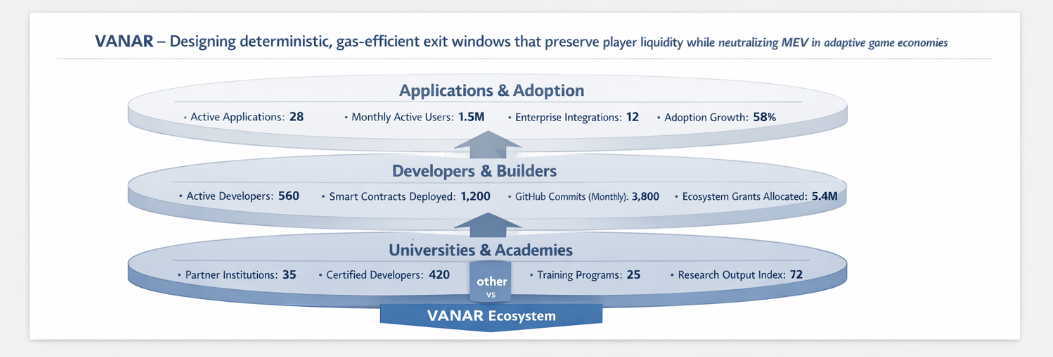
There is also a risk of reduced composability. External integrations that expect continuous liquidity might struggle with window-based execution. Market makers may resist structures that compress arbitrage margins.
Yet the alternative — leaving exit logic permanently reactive — effectively guarantees extraction pressure as game economies scale. The more adaptive the system becomes, especially with AI-driven parameter shifts, the more exploitable continuous liquidity becomes. 🤖
My hostel room moment was small. Just a failed exit attempt and a few hundred rupees in slippage. But structurally, it revealed something bigger: liquidity design determines who absorbs volatility and who monetizes it.