


Anyone who’s used a blockchain has felt the classic tradeoff: fast chains feel centralized, decentralized ones feel slow, and secure ones often lag on both. That tension isn’t just a developer headache, it shapes how we trade, build, and trust decentralized systems. For years, the space has treated speed, decentralization, and security as a zero sum game. Fogo’s consensus mechanism doesn’t just tweak the rules; it rethinks how consensus runs, where it runs, and who runs it, turning that trilemma into a balanced equilibrium.
At its core, Fogo builds on Solana’s SVM and TowerBFT consensus but adds three tightly integrated layers: a Firedancer-optimized validator client, multi-local zone based consensus, and a curated yet stake weighted validator set. Unlike monolithic global consensus, Fogo groups validators into geographically co-located zones during normal operation. These zones deliver ~40ms block times and near-instant finality by cutting cross-continental latency something no fully dispersed network can match at scale. Validators use zone-specific sub-keys for fast consensus, while root global keys stay offline for security. If zone consensus fails or can’t reach quorum, the network automatically falls back to global consensus with conservative 400ms block times, prioritizing liveness over raw speed.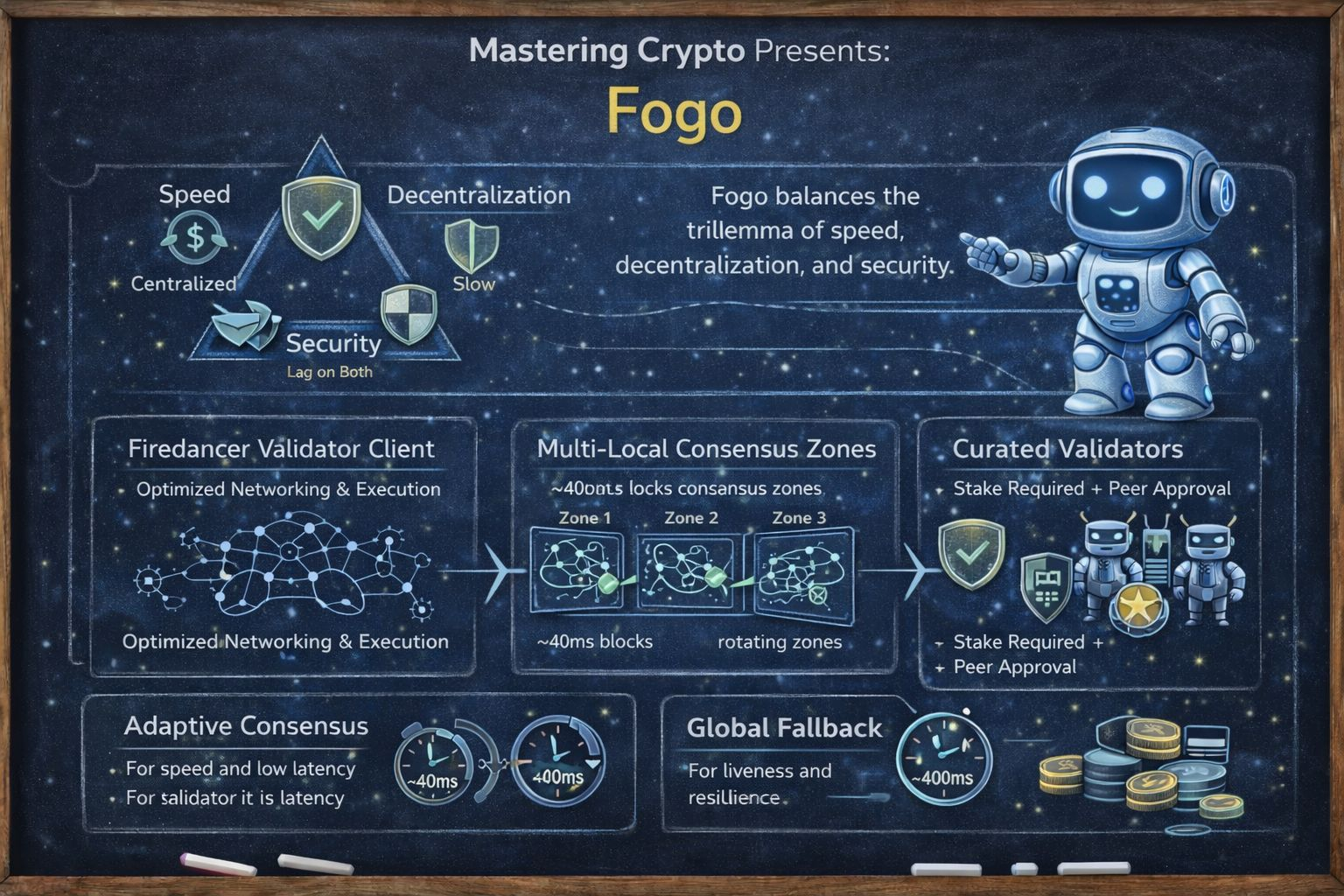
This isn’t about cutting corners to go fast. The zone system rotates across epochs, preventing jurisdictional capture and single-data-center reliance. The curated validator set requires stake plus peer approval, with supermajority voting for membership changes—blocking underprovisioned or malicious nodes without central control. Firedancer’s C-level networking, parallel execution, and zero-copy data flow remove client bottlenecks, so the network isn’t slowed by legacy software. Every choice ties speed to structure, not sacrifice.
Across the industry, we’re moving past “decentralization at all costs” to pragmatic decentralization systems that stay trustless but usable. High DeFi, real-time gaming, and institutional onchain trading demand latency that once only centralized platforms could deliver. Fogo fits this shift: it preserves cryptographic security and stake-weighted governance, just like mature PoS networks, but delivers performance for production apps. It’s not an outlier; it’s the next step for blockchains that want to serve users, not just testnets.
From my perspective, this balance feels long overdue. I’ve watched projects pick one pillar at the expense of the others—fast but fragile, decentralized but unusable, secure but stagnant. Fogo’s genius is that it doesn’t ask validators or users to choose. It uses co-location for speed, rotation and fallback for decentralization, and stake + curation for security. It’s human centered engineering: it works for the people running nodes and the people sending transactions, not just for whitepaper metrics.
What matters most is that Fogo doesn’t declare the trilemma solved, it builds a system that adapts. As hardware improves, zones can expand; as the network matures, validator curation can relax. Speed doesn’t have to kill decentralization, and security doesn’t have to kill speed. Fogo proves that with the right consensus design, we can have all three fast enough for real life, decentralized enough to stay trustless, secure enough to last. For builders and users alike, that’s not just a technical win; it’s the future of usable blockchain.