
Most blockchain projects still fight over the same narrative: faster blocks, lower fees, higher TPS. Vanar is moving in a different direction — one that feels more product-first than chain-first.
Instead of positioning itself as “just another L1,” Vanar Chain is slowly shaping an ecosystem of usable products aimed at real industries. Gaming and immersive digital environments were the initial focus, but the roadmap has clearly expanded. Recently, Vanar has been aligning itself as infrastructure for AI-driven applications as well.
What stands out is the way they talk about data. Products like Neutron aren’t marketed as hype features — they’re framed as practical layers that make blockchain data cleaner, more accessible, and easier for applications and autonomous agents to consume. That shift matters, especially as AI systems increasingly rely on structured, verifiable data sources.
But the more interesting part isn’t just the tech — it’s how value flows.
Vanar isn’t relying purely on transaction fees to justify its token. The ecosystem is designed so that revenue can come from actual product usage: subscriptions, services, and paid infrastructure. That revenue, according to their framework, can be converted into VANRY and redirected into mechanisms like buy pressure, burns, or community-controlled treasuries.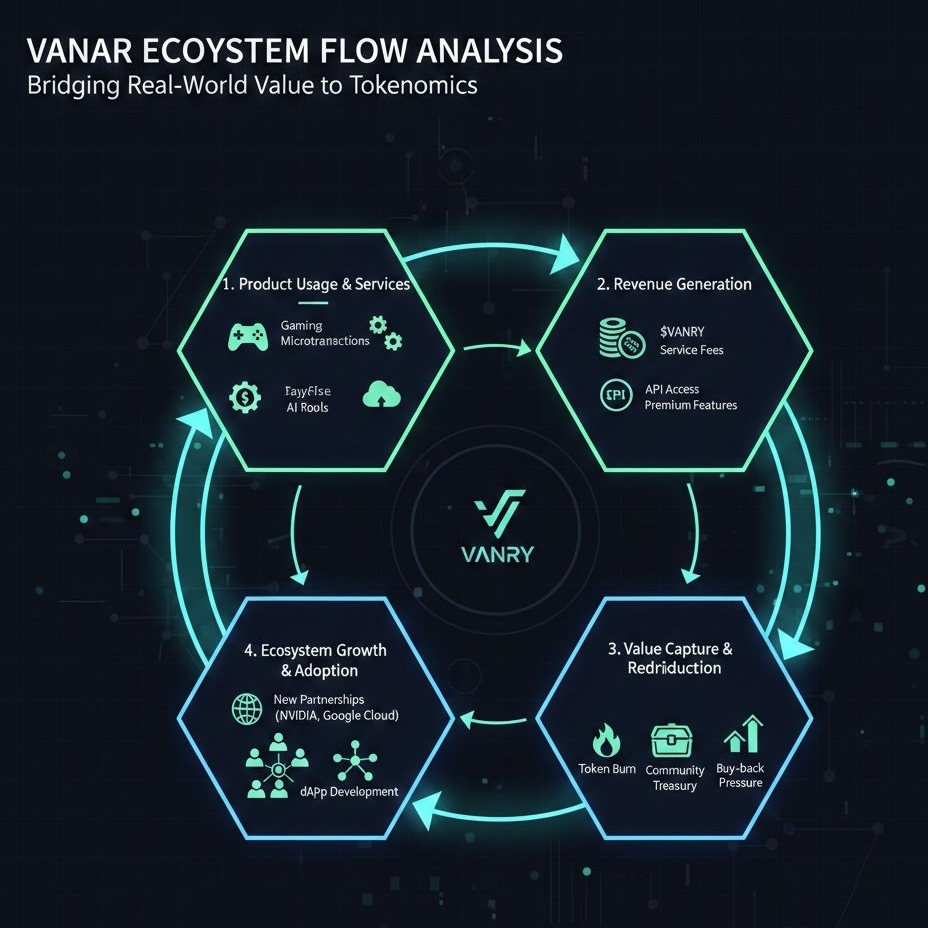
In simple terms, they’re trying to answer one of crypto’s toughest questions:
How does real economic activity translate into token value?
Rather than hoping speculation does the work, Vanar’s approach suggests a tighter loop between users, products, revenue, and the token itself. If adoption grows, the value capture doesn’t stay abstract — it feeds back into the ecosystem.
This doesn’t guarantee success. Execution still matters, and markets are unforgiving. But strategically, Vanar is thinking beyond surface-level metrics. They’re building with the assumption that blockchains need sustainable business models — not just faster pipes.
If the next phase of crypto is about usable infrastructure instead of empty scalability claims, Vanar is positioning itself early in that shift.Vanar isn't trying to be everything to everyone. They are doubling down on high-concurrency industries:
Gaming: Partnering with studios like Viva Games (700M+ users) to handle microtransactions at a fixed, predictable cost (roughly $0.0005).
PayFi & RWAs: Using AI to automate real-time compliance and settlement for tokenized assets.
Enterprise: Collaborating with giants like NVIDIA (Inception Program) and Google Cloud to provide the compute power needed for AI-driven metaverses.@Vanarchain #vanar $VANRY #RAW #MariaAsim
