

High performance Layer 1 blockchains tend to present themselves as inevitable. Faster throughput, lower latency, more parallelization, cleaner execution environments. The implicit message is always the same: dominance will follow performance. I’ve become increasingly skeptical of that assumption. If anything, the last few market cycles have shown me that specialization, not dominance, is the more realistic strategic path.
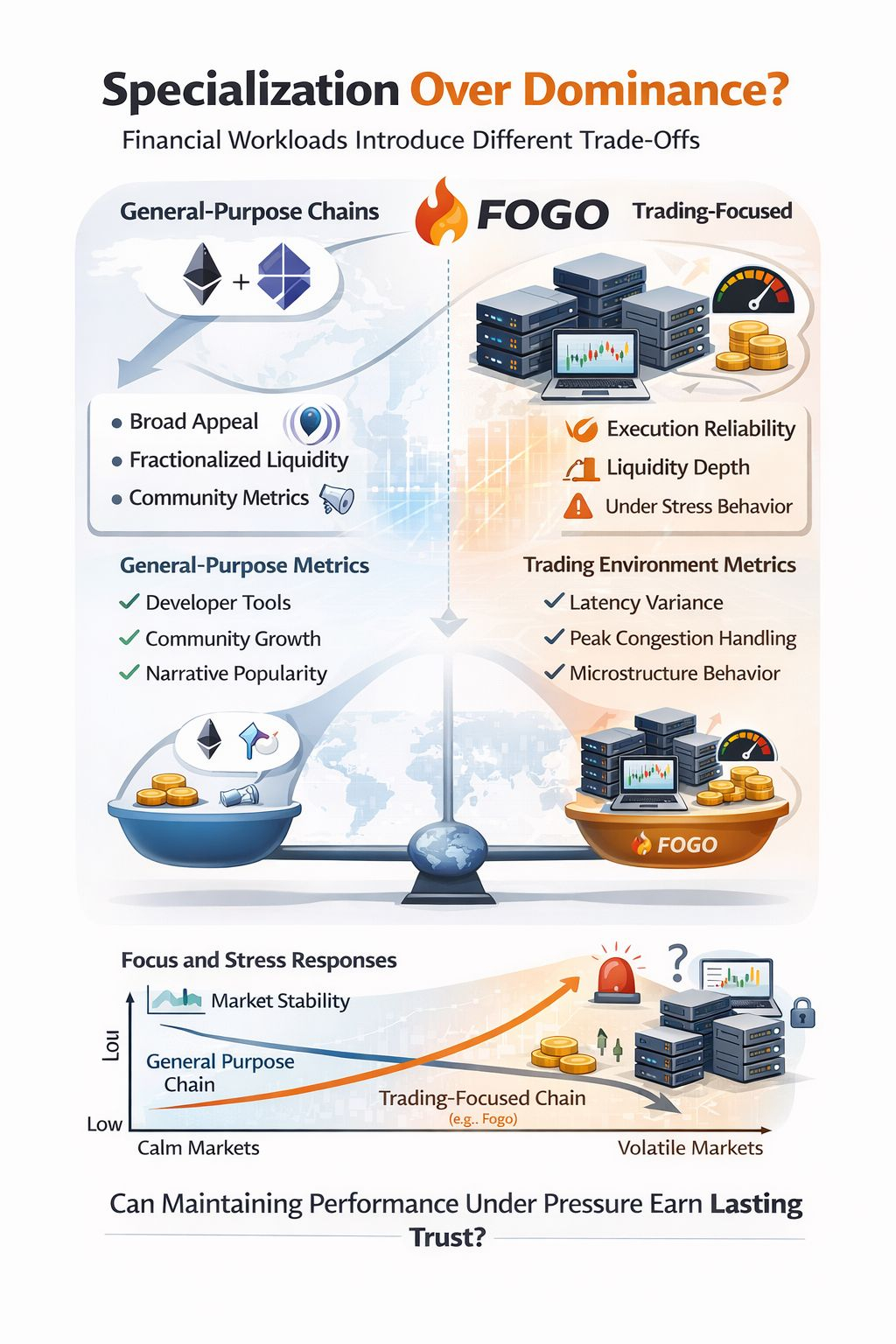
Fogo is an interesting case study in that respect. It does not attempt to be everything to everyone. It positions itself around performance, particularly for financial workloads. Trading infrastructure, order flow, high-frequency interactions, dense transaction environments. That focus is deliberate. And in a fragmented market where general purpose chains compete on narrative breadth, specialization can be an advantage if it is executed with discipline.
High performance chains, especially those that orbit around trading use cases, operate in a different risk category than general smart contract platforms. They are not judged primarily on developer tooling or NFT communities or social engagement metrics. They are judged on behavior under stress. Liquidity does not care about brand positioning. It cares about execution guarantees. It cares about whether orders clear when volatility spikes. It cares about whether RPC endpoints remain responsive when everyone is trying to exit at once.
That is why specialization is powerful but dangerous. If you position yourself as infrastructure for global financial scale, you are inviting the market to test you at global financial intensity.
In observing Fogo’s development and early ecosystem behavior, what stands out to me is the intentional narrowing of scope. It builds around performance primitives that align with trading workloads. It leans into architectural decisions that prioritize throughput and latency. It signals to professional participants rather than retail narrative cycles. Strategically, that makes sense. Competing for generalized dominance against chains with entrenched network effects is a losing game. Competing on precision, on microstructure alignment, on execution reliability that is at least a differentiated battlefield.
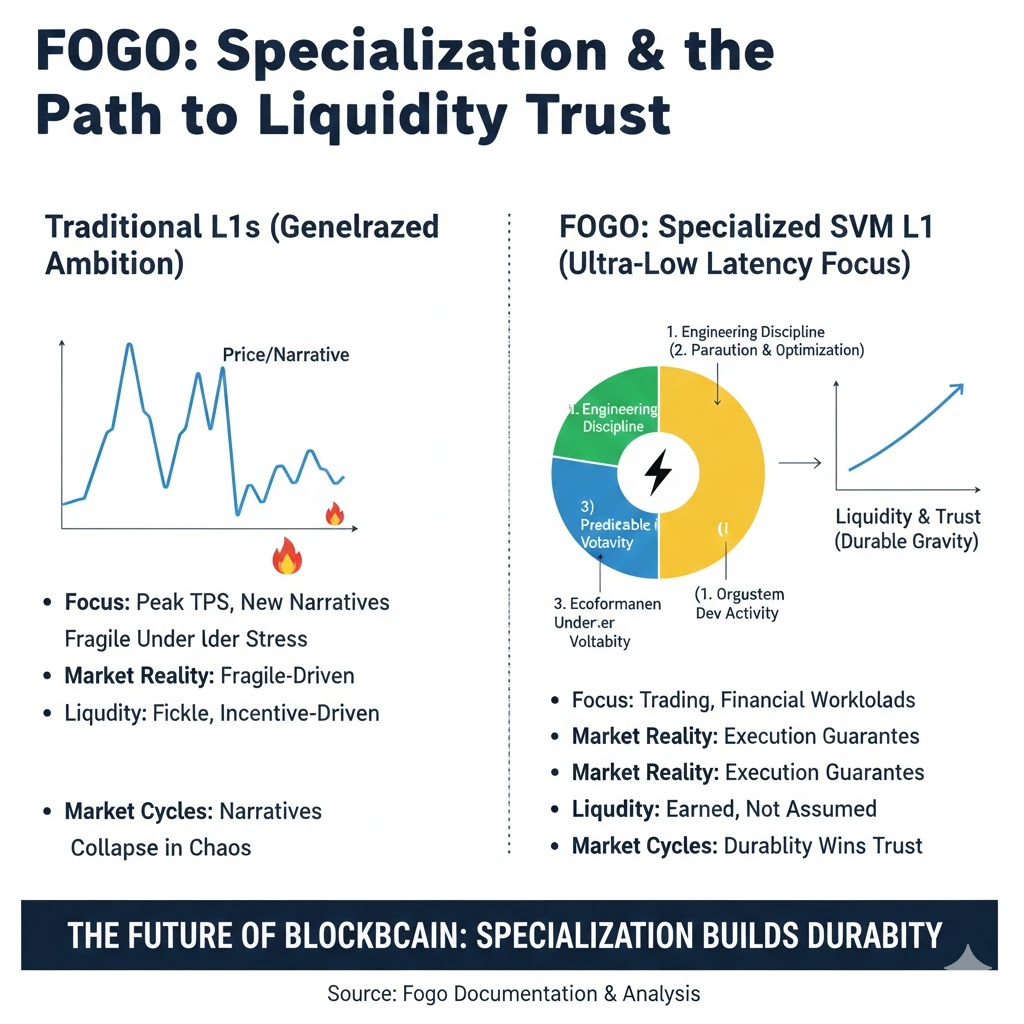
But specialization does not automatically translate into liquidity. Liquidity must be earned. And more importantly, it must be retained during drawdowns.
Trading centric chains often benefit early from incentive driven liquidity programs. Total value locked rises. Dashboards look impressive. Yet the true test is not during incentive rich expansion phases. The true test comes when volatility compresses or when macro conditions reverse. When volatility expands violently, the question changes from “How fast is this chain?” to “Does it behave predictably when the order book becomes hostile?”
Narratives are fragile during those moments. I have seen this repeatedly across ecosystems. A chain may be celebrated for speed during calm conditions, but when network load surges due to liquidations, arbitrage cascades, or panic withdrawals, even minor latency inconsistencies amplify into systemic distrust. Social media shifts tone within hours. Performance claims are replayed with screenshots of stalled transactions. What looked like a technical edge becomes a reputational liability.
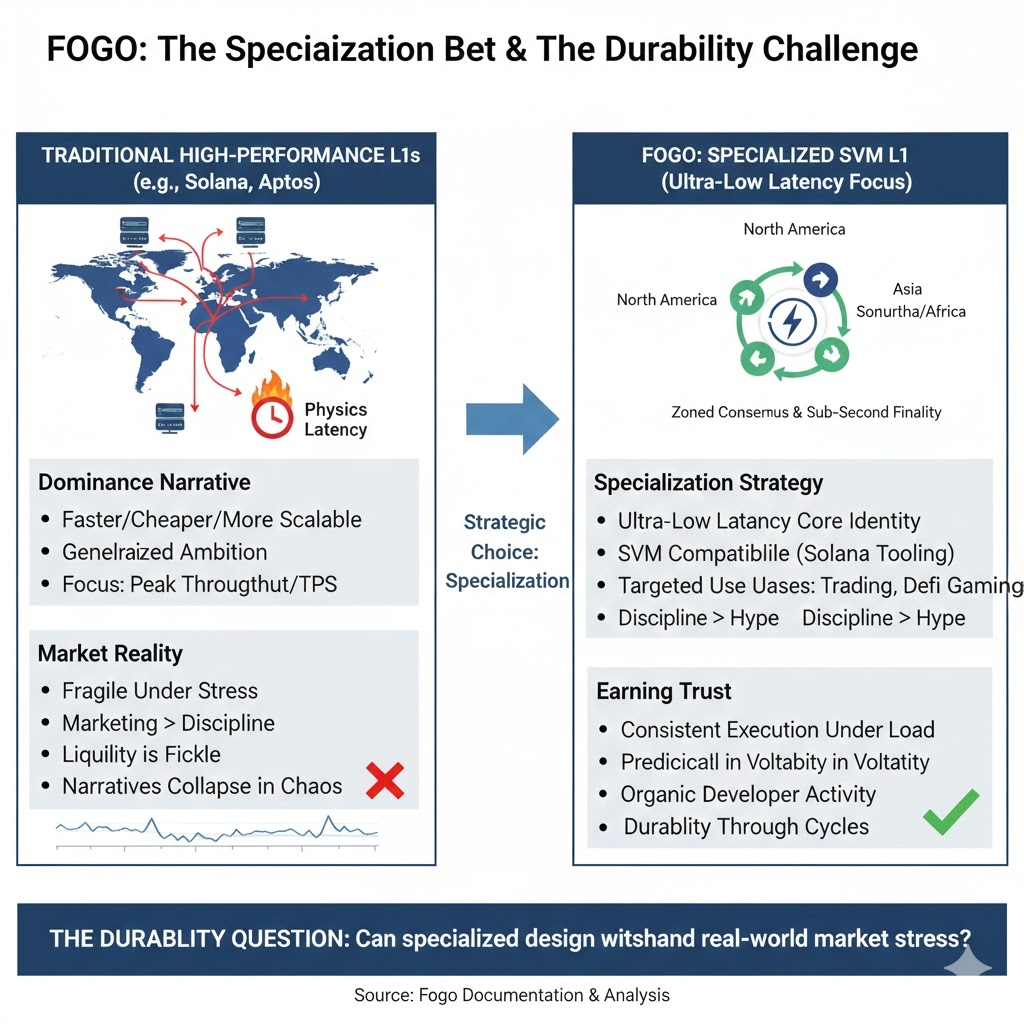
Fogo’s strategic advantage, if it is to have one, will not come from being the loudest high performance chain. It will come from surviving its first serious stress event without narrative collapse. That is a very different bar.
One pattern I pay close attention to is the difference between developer experimentation and public migration announcements. Announcements are abundant in this industry. Protocol X is deploying on Chain Y. A major trading venue is exploring integration. Liquidity programs are scheduled. Incentives are teased. These statements create temporary gravity. But real gravity emerges when developers begin deploying tools quietly, when teams begin running nodes without press releases, when institutional desks test settlement behavior in private before speaking publicly.
In early stage ecosystems like Fogo’s, experimentation matters more than migration headlines. Are serious developers probing performance boundaries? Are trading teams testing edge cases? Are infrastructure providers observing node behavior under simulated stress? Those signals are often invisible in marketing channels but highly visible in code repositories and infrastructure telemetry.
I find that the most credible ecosystems are the ones where infrastructure operators speak cautiously. Where engineers document behavior rather than promise transformation. Where RPC stability metrics are discussed openly. Where block propagation times are measured, not implied.
The emphasis on real behavior rather than marketing claims is especially critical for high performance chains. In low throughput environments, inefficiencies are tolerable. In high performance environments, inefficiencies compound quickly. A small inconsistency in validator coordination becomes magnified when transaction volume accelerates. A minor RPC bottleneck becomes a systemic access issue when traders attempt synchronized execution.
Volatile conditions are the true audit.
It is easy to build a performant system under controlled traffic. It is much harder to maintain determinism under adversarial flow. Trading centric chains face not only organic usage spikes but also adversarial behavior. Arbitrage bots, MEV searchers, latency optimized actors, these participants push systems to the edge intentionally. They are not passive users. They probe. They exploit.
In that sense, the specialization strategy cuts both ways. If Fogo optimizes for financial microstructure, it will attract financial microstructure participants. That means high competition, aggressive order flow, and relentless stress testing. The architecture must be resilient not just to high throughput but to strategic behavior.
Another dimension often overlooked in performance discussions is trust. High throughput alone does not produce trust. Predictability does. Institutions and serious liquidity providers care less about peak TPS and more about worst-case latency bounds. They want to know how the system behaves when 95 percent of capacity is consumed. They want to know whether consensus stalls propagate quickly cascade.
Trust builds slowly.
Market cycles accelerate this dynamic. During expansion phases, chains are judged on innovation. During contraction phases, they are judged on survival. Many high performance narratives are born in expansion phases. Few are tested until contraction arrives.
I view market cycles as a filtering mechanism. In euphoric conditions, capital spreads across experiments. In tightening conditions, liquidity consolidates around perceived durability. For Fogo to translate its design into lasting gravity, it must not only perform well technically but also demonstrate composure during liquidity contractions.
There is also the question of ecosystem depth versus replication. Early ecosystems often populate themselves with familiar primitives—forked AMMs, cloned lending protocols, standard token launchpads. This is not inherently negative; it provides functional scaffolding. But depth emerges when protocols adapt to the chain’s specific strengths. A performance-focused chain should eventually produce performance native applications, not simply replicas optimized for a different environment.
If Fogo’s ecosystem begins to exhibit applications that genuinely leverage its architectural profile order books that assume low-latency finality, risk engines that assume parallel execution, then specialization becomes structural. Otherwise, it remains cosmetic.
Liquidity and trust are interdependent. Liquidity flows toward trust, and trust emerges from repeated reliability. Incentives can attract liquidity temporarily, but only behavior retains it. In that sense, performance-focused chains are always on probation. Every volatility spike becomes an examination.
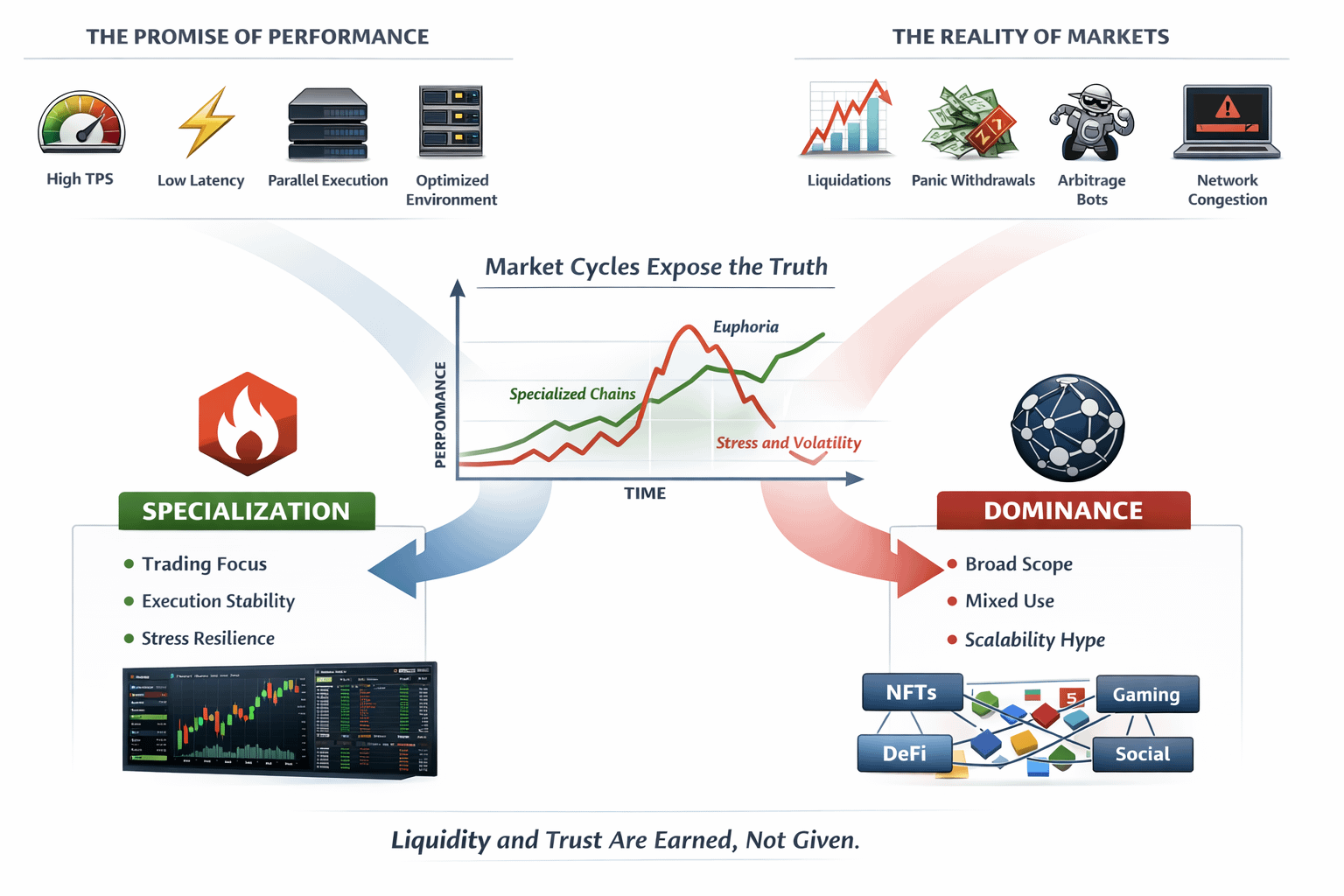
I do not dismiss Fogo’s approach. On the contrary, I find specialization strategically coherent. Attempting to be a universal base layer in today’s environment is unrealistic. Focusing on financial performance, on execution quality, on throughput discipline that is a credible niche. But niches are unforgiving. You are judged by the standards of your chosen arena.
And financial markets are not patient.
They do not reward theoretical scalability. They reward uptime. They reward consistency. They reward systems that remain boring when chaos erupts elsewhere. A performance chain that falters during peak volatility suffers disproportionately because its core identity is performance.
I am also cautious about the timing of public enthusiasm. Migration announcements often precede actual usage by months. Incentive programs create temporary distortions. Real adoption lags publicity. Observing developer commit frequency, RPC provider expansion, validator distribution, and wallet stability tells a more grounded story than promotional dashboards.
When I evaluate chains like Fogo, I look less at partnership graphics and more at infrastructure maturity. Are there multiple independent RPC providers? Is there geographic diversity in validator hosting? Are explorers stable under high query load? Are node operators transparent about hardware requirements? These questions determine whether specialization can scale without centralizing excessively.
There is always a tension between performance and decentralization. High throughput often demands higher hardware baselines. That narrows participation. Specialization intensifies that tension because the system is optimized for a specific workload rather than general inclusivity. The challenge is not eliminating that tradeoff but managing it transparently.
In my experience, the chains that endure are the ones that communicate constraints clearly. Overstated capabilities create future disappointment. Understated capabilities that quietly overdeliver build credibility.
Fogo’s trajectory will likely depend less on how loudly it asserts global financial readiness and more on how it behaves when the first real liquidity event collides with technical limits. When order flow spikes. When volatility compresses margins. When bots exploit edge conditions. Those are the moments when infrastructure reveals its character.
Specialization can be a strategic moat. It can also be a narrow bridge. If Fogo’s design truly aligns with financial workloads, then repeated cycles of stable behavior could create durable ecosystem gravity. Developers will build where execution is predictable. Liquidity will settle where settlement is reliable. Trust will accumulate slowly.
As market conditions evolve, as cycles expand and contract, the question will remain open. Can intentional design, focused, disciplined, performance-oriented, translate into lasting ecosystem pull under real pressure? Or will the gravitational center remain with incumbents whose durability has already been tested across multiple crises?
That answer will not emerge from announcements. It will emerge from behavior. And behavior, especially in financial systems, is revealed only when the pressure rises.
