In traditional high-frequency trading, there’s a saying:
“The fastest way to lose money is to be a millisecond late.”
Crypto traders know this pain in a different way. On-chain, being “late” isn’t the exception — it’s the norm. Slippage, failed transactions, MEV bots jumping the queue, and gas fees that suddenly make small trades pointless have been baked into the DeFi experience for years.
We’ve accepted it as the cost of decentralization. Until FOGO.
If you’ve seen people call FOGO “Solana on steroids,” it’s easy to assume it’s just marketing. But the real reason institutions are paying attention isn’t hype — it’s physics.
FOGO isn’t just another fast Layer 1. It’s built specifically to remove the latency and friction that have quietly drained value from on-chain trading.
Let’s look at why.
A 40 Millisecond Chain Changes Everything
Most blockchains move in visible pulses.
Ethereum updates in seconds.
Solana improved that to around 400 milliseconds.
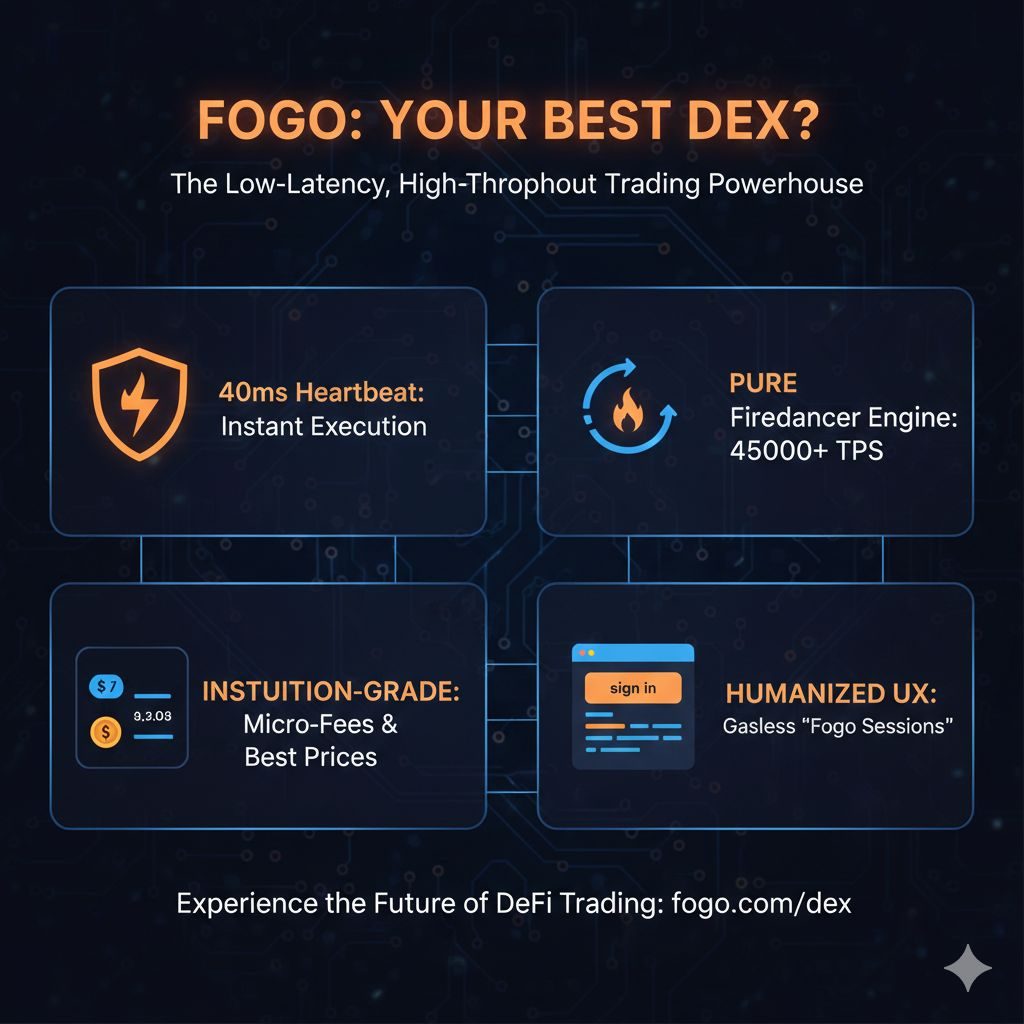
FOGO runs at 40 milliseconds per block.
That’s faster than a human blink.
For traders, this changes the entire experience. On most chains, when you submit a trade, you are effectively guessing what price you’ll get by the time it lands on-chain. That gap — the delay between intent and execution — is where slippage and MEV thrive.
FOGO shrinks that gap so much that the price you see is much closer to the price you actually get.
Instead of feeling like you’re throwing a dart in the dark, trading starts to feel precise again.
Firedancer, Without the Baggage
FOGO uses the Solana Virtual Machine (SVM), but it doesn’t run it on legacy infrastructure. It runs it on Firedancer, a high-performance validator client written in C++ and designed for extreme throughput.
Rather than retrofitting Firedancer into an older chain, FOGO was built around it from day one.
The result is consistent performance:
45,000+ transactions per second
No network collapse during volatile moments
Predictable execution for large trades
This is where institutional interest makes sense. A serious trading firm doesn’t care about memes or narratives — it cares about whether a $10 million order will go through when the market is moving fast.
FOGO’s architecture is designed to keep that execution reliable, even when the rest of the market is chaotic.
A DEX That Lives Inside the Blockchain
Most decentralized exchanges are smart contracts competing with every other application for block space.
FOGO’s DEX is different.
It uses an Enshrined Limit Order Book (LOB) — meaning the matching engine is part of the blockchain itself, not just another app on top of it.
That gives it several advantages:
FeatureFOGO DEXTypical DEXFees~$0.00001 (fixed)Variable gasLatency~40ms400ms–12sSlippageLow (deep liquidity)Often highUXSingle session signSign every trade
Because FOGO also uses multi-local consensus — placing validators close to major trading hubs like New York and Tokyo — the experience feels closer to a centralized exchange in speed, while keeping custody in the user’s wallet.
It’s a rare mix: CEX-like execution with DeFi-level control.
Sessions: Fixing the Most Annoying Part of DeFi
Ask most traders what they hate about DEXs, and you’ll hear the same thing:
“Why do I have to sign every trade?”
FOGO solves this with Sessions.
You approve once.
For the next hour, you can trade freely.
No wallet pop-ups.
No repeated gas approvals.
No mental friction.
It feels less like using a blockchain and more like using a real trading terminal. For active traders, this matters just as much as speed.
Why This Actually Matters
FOGO doesn’t feel like a chain built for hype cycles. It feels like a chain built by people who have traded professionally and got tired of slow systems.
It takes ideas from:
Wall Street infrastructure
Solana’s performance model
DeFi’s self-custody principles
And combines them into something that treats trading as a serious activity, not a casino game.
If you’ve ever felt like you were just exit liquidity for faster bots…
If you’ve ever missed a trade because the chain lagged…
If you’ve ever watched gas fees eat your edge…
FOGO isn’t promising miracles.It’s just refusing to be slow.