

The dominant narrative in crypto says interoperability is about expansion, more chains, more liquidity venues, more surface area. Bridges are marketed as growth engines. But if you’ve operated production infrastructure, you know that every bridge is also a liability surface.
Interoperability is not an expansion problem. It is a risk management problem.
Bridging VANRY across EVM chains is not primarily about reach. It is about containment, how to extend utility without multiplying fragility. When you treat blockchains as critical infrastructure rather than speculative networks, the question changes from How many integrations can we announce? to What breaks first under stress?
Real adoption does not depend on excitement. It depends on predictability.
Payment rails, DNS, and clearing systems do not earn trust by adding endpoints. They earn trust by ensuring that when packets drop or liquidity tightens, the system degrades gracefully rather than catastrophically. A bridge that works during ideal conditions but fractures during congestion is not infrastructure. It is a demo.
An interoperability strategy grounded in operational discipline begins with execution compatibility. VANRY’s alignment with EVM semantics reduces one axis of uncertainty. But execution compatibility alone does not guarantee safety. The consensus and coordination layer beneath it must be equally disciplined.
Bridges introduce cross domain finality assumptions. If one chain considers a transaction final while another experiences a reorg or validator instability, the bridge becomes the weakest link. Therefore, consensus design matters more than throughput. Predictable finality boundaries, validator quality controls, and liveness guarantees under network partitions become foundational to any interoperability plan.
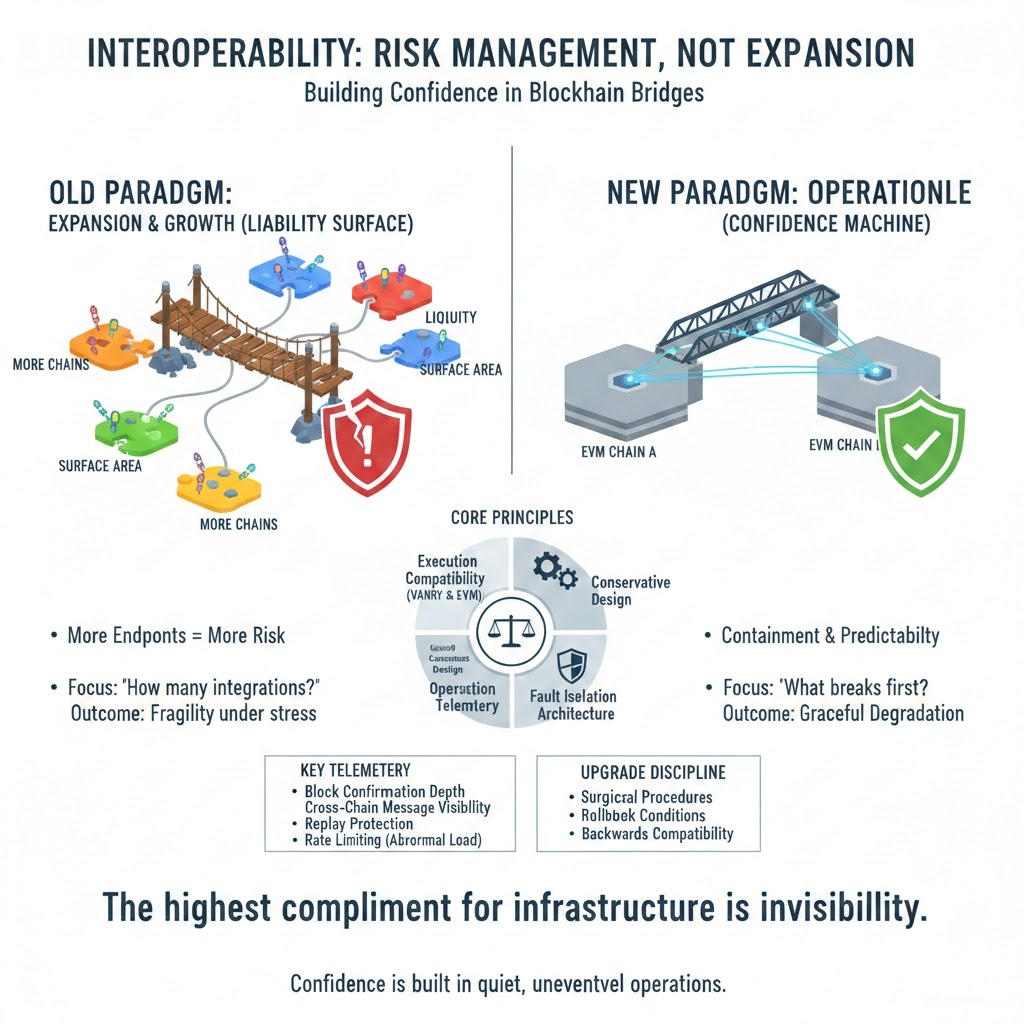
A well designed bridge treats both sides as independent failure domains. It assumes that one side may stall, reorder, or temporarily partition. The architecture must isolate faults rather than propagate them. This is less glamorous than promising seamless multichain liquidity, but it is what prevents cascading trust erosion.
Node quality and operational hygiene are equally critical. Bridges depend on monitoring infrastructure: relayers, validators, event listeners, indexing services. If node configurations drift, latency spikes, or observability is thin, the system becomes opaque. Opaque systems do not inspire confidence.
Healthy interoperability requires clear telemetry:
Block confirmation depth thresholds
Cross chain message queue visibility
Replay protection mechanisms
Rate limiting under abnormal load
These are not marketing features. They are hygiene controls.
Upgrade discipline is another underappreciated factor. In crypto culture, upgrades are often treated as feature releases. In infrastructure, they resemble surgical procedures. You simulate failure modes. You stage deployments. You define rollback conditions before pushing code.
Because a bridge connects two different systems, it increases the level of potential risk associated with upgrading each system. For example, if a consensus based tweak or gas accounting change is made on one side of the bridge, the interoperability layer on the other side must have already prepared for what is digitally compatible with the two sides. A mature infrastructure has assumed backwards compatibility as a default and will deprecate any backwards compatibility slowly. Abrupt changes in the meaning of a given term can destabilize.
The trust earned through interoperability occurs during the stressful time of a high volume of transactions falling into two different systems, whereas this trust does not build during times of growth.
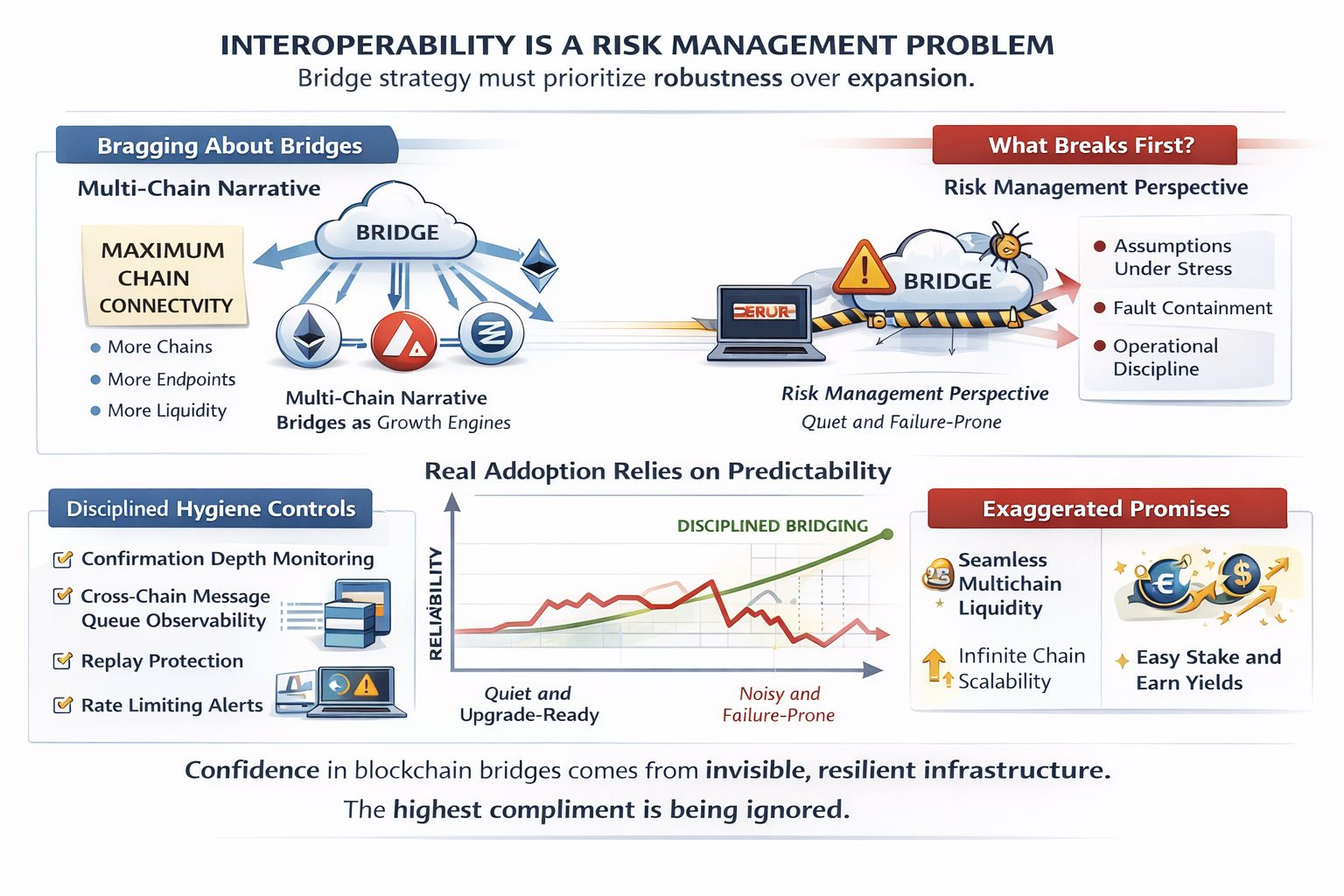
Congestion events demonstrate validity assumptions around finality. Validator churn demonstrates guarantees around liveness. An adversarial event demonstrates examples of replay and ordering loopholes. Transparent logging and demonstrably detectable defects will help to keep panic from compounding defect issues. If operator teams can quickly view and isolate these defect issues, then there will be continued trust.
International banking networks do not collapse because one clearing node slows down. They isolate and reconcile. Air traffic control systems assume equipment failures and route around them. Interoperability is not about speed; it is about safe coordination between autonomous systems.
Bridging VANRY across EVM chains should be evaluated through that lens. Execution compatibility reduces semantic drift. Conservative consensus design limits ambiguity. Clear validator governance and observability reduce blind spots. Incremental upgrades reinforce stability rather than expand attack surface.
None of this produces viral headlines.
Success in interoperability will look quiet. Tokens moving without drama. Relayers syncing reliably. Upgrades rolling out without chain splits. Congestion being absorbed without existential risk. Operators sleeping through the night.
The highest compliment for infrastructure is invisibility.
Interoperability, when executed with discipline, does not feel innovative. It feels uneventful. That uneventfulness is the product. Builders migrate when they are confident that assumptions will hold under pressure. Institutions integrate when systems behave predictably during abnormal conditions.
In the end, bridging VANRY across EVM chains is not about expanding territory. It is about extending reliability across domains. If executed correctly, it will not demand attention. It will fade into the background of production systems, predictable, inspectable, resilient.
That is what a confidence machine looks like: software that quietly coordinates complexity so that operators can focus on building, not firefighting.
