

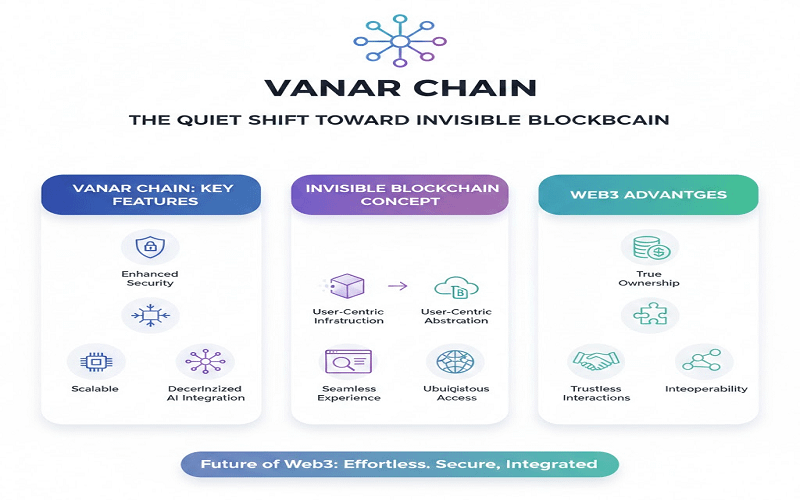
Vanar Chain is easier to understand if you stop looking at it as a token story and start looking at it as plumbing. Not glamorous. Not loud. Just there, doing a job most people never think about. That shift in perspective changes how #Vanar makes sense.
A lot of blockchain networks still behave like they are competing for attention. They focus on speed claims, technical specs, or bold visions about replacing entire systems. VANAR Chain feels more grounded. The emphasis appears to be on usability and real deployment rather than narrative dominance. It is closer to a foundation than a headline.
When people use the internet, they rarely think about TCP/IP protocols or server architecture. They care about whether a page loads quickly and whether it feels simple. Blockchain has not reached that stage yet. Wallet friction, seed phrases, gas confusion, and inconsistent user flows still stand in the way. Vanar’s direction suggests an attempt to reduce that visible complexity.
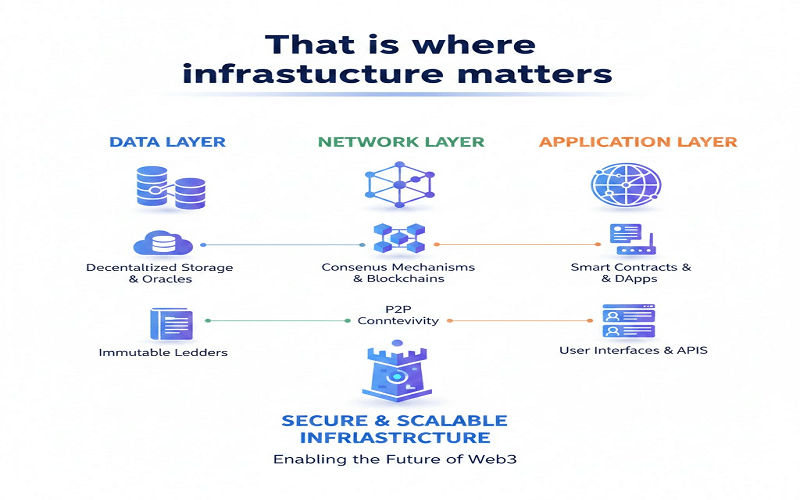
That is where infrastructure matters.
Infrastructure is not about excitement. It is about reliability. It is about reducing cognitive load. It is about creating systems where the end user does not need to understand what sits underneath. In that sense, #vanar is positioning itself as something that developers can build on without forcing users to “learn crypto” first.
The token, $VANRY , supports this system. But if the infrastructure narrative holds, its value is tied less to hype cycles and more to network activity. That is a slower path. It depends on adoption that feels organic rather than speculative.
One of the more practical windows into their direction is the creator-focused tooling available through https://tinyurl.com/vanar-creatorpad. Instead of pitching abstract decentralization, the focus is on enabling creators to launch and manage digital assets in a way that feels familiar. That framing matters. It shifts the conversation from ideology to workflow.
When you read communications from @Vanarchain , the tone often centers on building environments where blockchain fades into the background. That is not easy. It requires solving onboarding friction, transaction clarity, and integration with platforms that mainstream users already trust.
The truth is that most blockchain projects underestimate UX. They optimize for validators and traders. But mass adoption does not come from validators or traders. It comes from people who do not care what chain they are using. If Vanar can reduce visible blockchain touchpoints while preserving ownership and transparency under the hood, that is meaningful.
Still, this approach carries tradeoffs.
Competing chains also claim to prioritize usability. Many have larger ecosystems, deeper liquidity, and stronger developer communities. Infrastructure plays are hard because they require patience. Developers must choose to build. Users must stay. Liquidity must stabilize. None of that happens quickly.
There is also the broader market reality. $VANRY, like most tokens, will move with sentiment cycles. Infrastructure narratives can be overshadowed by short term speculation. Even if the technology is solid, market attention can shift elsewhere. That does not invalidate the work, but it does affect perception.
From a trading standpoint, realistic thinking helps. If someone were considering exposure to $VANRY , an approach based on structure rather than emotion would make sense.
Entry Point: Areas of consolidation after extended pullbacks, where volatility compresses rather than expands.
Take Profit: Prior resistance zones where liquidity historically enters the market.
Stop Loss: Below clear support levels, ideally where structural invalidation becomes obvious.
These are ranges, not predictions. No guarantees exist in this space. The token will behave within broader crypto cycles regardless of narrative strength.
But zooming out again, the more interesting question is not short term price movement. It is whether Vanar can quietly become part of the digital background.
Infrastructure projects rarely trend for long. They grow slowly. They integrate. They become boring. And boring can be powerful. Think of cloud hosting providers. Most users cannot name them, yet entire industries rely on them.
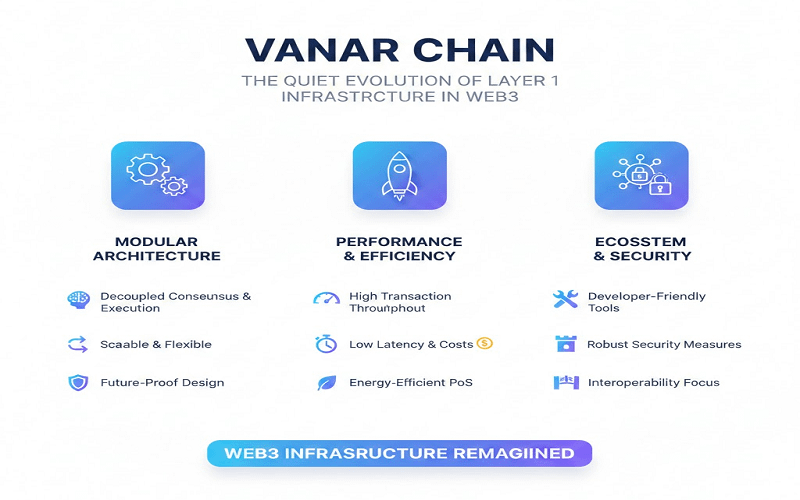
Vanar seems to be aiming for something similar inside blockchain. Instead of trying to be the loudest Layer 1, it appears focused on creating a developer friendly environment where blockchain is embedded, not showcased. That distinction matters.
Adoption through creators is also strategic. Creators already understand digital ownership. They already manage communities. If onboarding tools reduce friction, creators become distribution channels without requiring them to become crypto educators. That lowers the barrier.
At the same time, execution risk remains real. Building infrastructure that feels invisible demands precision. Wallet abstraction, transaction design, and interface decisions all affect trust. One poor user experience can outweigh months of backend progress.
There is also the issue of network effects. Infrastructure thrives when usage compounds. If developer growth stalls, the system risks remaining underutilized. Momentum is subtle but essential.
What makes VANAR Chain worth observing is not noise but restraint. It does not position itself as revolutionary in tone. It presents as a framework. And frameworks, when done well, outlast trends.
Whether $VANRY ultimately reflects that depends on sustained network activity. Tokens tied to utility must prove that utility consistently matters. That takes time.
The broader crypto space is still learning that invisibility is a feature. The best technology often disappears into the background. If #Vanar succeeds, most users may never realize they are interacting with it at all.
