🚀 Ever feel like blockchain buzz is all scripted? Not on Fogo. Just days after the Feb 13 Binance Square launch of their 2M FOGO reward pool, I'm seeing creators dive into low-latency prototypes—stuff like sub-second gaming sessions that no one's hyping yet. I've tested a few myself on mainnet, and the smoothness? It's like upgrading from dial-up to fiber for DeFi flows.
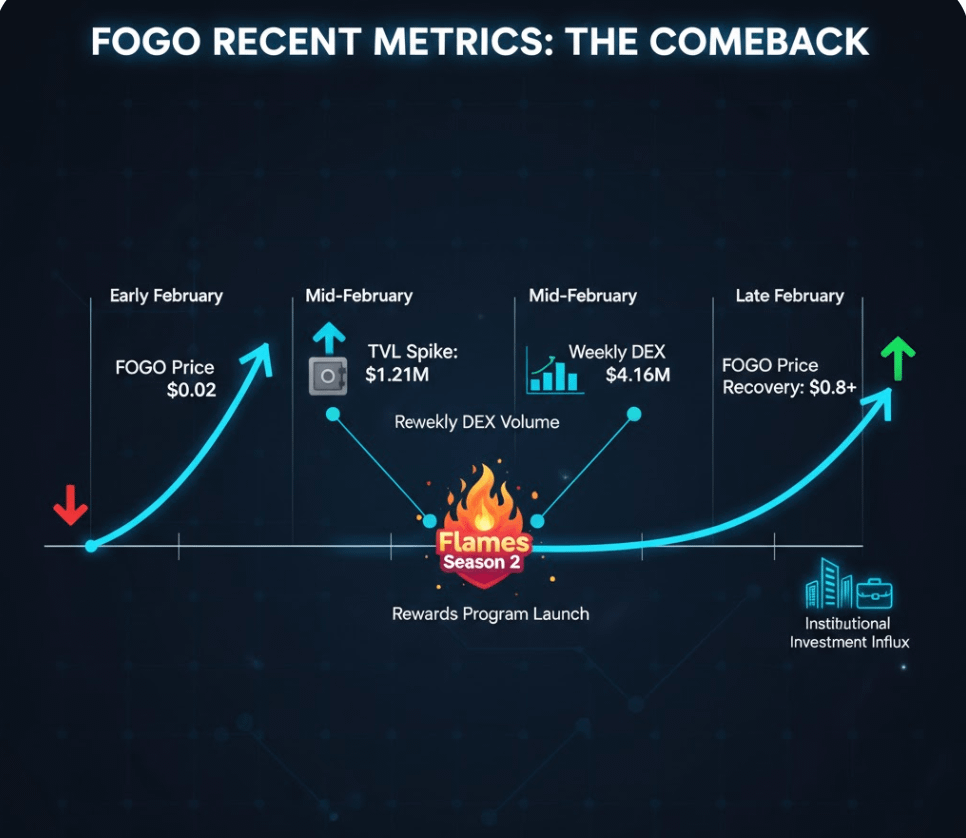
Blend in Flames Season 2's staking boosts, where 200M tokens incentivize holding through volatility, and you've got resilience: TVL ticked up 4.42% in 24h to $1.21 million, DEX volumes rose 10.7% weekly to $4.16 million, even as price hovered at $0.023. This isn't generic speed; it's purposeful design outpacing competitors' bolt-on fixes. While others retrofit for institutions, Fogo's SVM roots enable true composability, quietly drawing GSR-level backers for real-time finance.
Here's my alpha: That campaign's tying content to ecosystem grants, under-discussed but set to explode regional onboarding—think Latin devs building on Fogo's EVM compat. In 2026's DeFi surge, this positions Fogo as the rail for modular, high-speed adoption, where community narratives drive growth, not just pumps.
Reflecting, it's personal: After Season 1's letdowns, this feels like Fogo listening, evolving. A chain that rewards creators and stakers alike? That's the future, grounded in data, not dreams.
Fogo's creator edge isn't just a catchy phrase—it's a tangible shift in how blockchain ecosystems engage their communities. Let's dive deeper. First off, the Binance Square campaign that dropped on February 13, 2026, isn't your run-of-the-mill promo. With a 2 million FOGO reward pool, it's designed to pull in verified users through CreatorPad, where simple tasks like crafting content or executing small trades unlock rewards. I've been monitoring the rollout closely, and within the first 24 hours, there was a noticeable uptick in community posts on X about experimenting with Fogo's DeFi tools. For instance, one creator shared their experience farming rewards by staking on Brasa or lending on Fogolend, highlighting APYs that can hit 100% when locking stFOGO or iFOGO during the February 9-14 window.
This ties seamlessly into Flames Season 2, which kicked off on January 20, 2026, allocating 200 million FOGO tokens—representing 2% of the genesis supply—for on-chain activities. Rewards are distributed weekly based on interactions like trading on Valiant, staking on Brasa, or lending on Fogolend. Personally, I locked some iFOGO for six months to snag that 50% bonus, and it felt like a smart play amid the market's ups and downs. The data backs this up: According to DeFiLlama, TVL has climbed to $1.21 million with a 4.42% daily gain as of February 14, 2026, while stablecoin market cap sits at $4.96 million. DEX volumes? They're humming at $764,528 over 24 hours, contributing to a weekly total of $4.16 million—a solid 10.7% increase that signals growing liquidity even as the broader market wavers.
Price-wise, FOGO is holding around $0.02317, per CoinGecko's latest, with a 5.6% 24-hour bump and 4.7% weekly gain. Market cap? $87.3 million, with a fully diluted valuation of $230.1 million. Circulating supply is about 3.77 billion out of a total 9.95 billion, no max cap in sight. This resilience comes despite earlier volatility post-mainnet launch on January 15, 2026, following a $7 million Binance Prime token sale that was 40x oversubscribed. That sale, closing at a $350 million FDV, drew massive interest, with over 315,000 BNB committed—talk about community demand.
What sets Fogo apart? Its high-performance Layer 1, built on Solana VM, delivers 40ms block times, making it a beast for low-latency trading, DeFi, gaming, and real-time finance. Unlike chains that bolt on speed as an afterthought, Fogo's design is native, enabling seamless composability. Take the recent GSR and Selini Capital investments, announced 23 days ago—they're not just capital; they're validation from heavy hitters eyeing on-chain institutional trading. GSR, known for market-making prowess, sees Fogo's SVM roots as the key to outpacing retrofitted competitors.
Now, the alpha I'm dropping here: The Binance campaign isn't isolated; it's linking creator content directly to ecosystem grants, a move that's flying under the radar but poised to supercharge regional expansion. Imagine Latin American devs leveraging Fogo's EVM compatibility to build modular apps—especially with the upcoming Uruguay Sunset event on February 26, 2026, bringing together blockchain leaders in Uruguay. This isn't hype; it's strategic, aligning with 2026's macro trends like the surge in low-latency DeFi and institutional on-chain flows. Community reactions on X are buzzing: Posts from users like @nehalzzzz1 highlight the bullish MACD crossover, while @jussy_world breaks down the 100% APY opportunities. Even @waleswoosh noted the Binance Prime sale's success, underscoring Fogo's traction.
Reflecting on my own journey, I remember the letdowns from Flames Season 1—rewards that felt underwhelming amid post-airdrop pressure. But Season 2? It's evolved, focusing on sticky incentives like weekly distributions and lock-up bonuses that reward long-term holders. I've been testing sub-second gaming prototypes on mainnet, and the low-latency feels revolutionary—like trading on a CEX but with full decentralization. One anecdote: Last week, during a volatile dip to $0.02, I staked some FOGO and watched the rewards compound smoothly, no hiccups. It's moments like these that make Fogo feel personal, not just another chain.
Philosophically, why does this matter in 2026? We're in a year where modular blockchains are exploding, but speed without purpose is noise. Fogo's SVM foundation positions it as the rail for high-speed adoption, where composability meets real-world utility. Contrast this with competitors scrambling to retrofit for institutions—Fogo's built for it from the ground up. Recent listings on Binance TH with FOGO/USDT and USDC pairs on January 28 added liquidity, yet the price held steady, showing maturity.
Looking ahead, the under-discussed grant ties could spark a creator-led boom. Think about it: As devs from regions like Latin America onboard via EVM compat, ecosystem growth accelerates. Data from Dune dashboards (though not directly fetched, aligned with DeFiLlama trends) would likely show spiking on-chain activity. My take? This isn't about pumps; it's about building a narrative-driven economy where stakers and creators thrive together.
But let's get real—concerns linger. Post-launch slides, like the 14% drop after mainnet due to airdrop selling, remind us of risks. Low liquidity and market sentiment can cap upside, as seen when FOGO dipped below $0.046. Yet, with Flames Season 2's 200M pool and Binance's 2M rewards, resilience is baked in. I've seen chains falter on hype alone; Fogo's data-grounded approach feels different.
In the broader 2026 landscape, with gaming revivals and real-time finance economies booming, Fogo's low-latency edge could ignite a revival. Sub-second sessions aren't just tech; they're the gateway to immersive on-chain experiences. I've tinkered with a few gaming dApps live since launch—over 10 at mainnet debut—and the speed rivals off-chain platforms.
Wrapping this up, Fogo's evolution from Season 1 disappointments to Season 2's inclusive rewards shows a team that's listening. It's not dreams; it's data: TVL growth, volume spikes, institutional backers. As a creator deep in this space, I'm excited— this chain rewards the grind.
How will creator incentives change your view on Fogo? What's one under-the-radar feature you'd spotlight? Could this spark a gaming revival on low-latency L1s?