

What is @Fogo Official at its core?
In short, #fogo is Built by traders. Powered by builders. They take the chain seriously, they take profits seriously, and they keep the culture loud.
That's their official tagline. It's confident, street-level, and anti-corporate. Whimsical, but not in a cute way — more like a performance car brand that's also a little bit a cult.
The "fire" identity (Fogo literally means fire in Portuguese) runs through everything — flames, heat, speed, burning through limits.
🔥The Firedancer was invented as
The Engine That Was Built to Break Everything
— and Fogo was the Chain Crazy Enough to Let It Run.
🔥Dancing with Fire, The Origin Story

There is a building somewhere in Chicago that doesn't have a name on it. No logo. No sign. Just a building, anonymous on purpose, full of servers that are doing something most people wouldn't believe is possible — executing trades in fractions of a millisecond, faster than a human neuron can fire, faster than a blink, faster than almost anything.
That building belongs to Jump Trading.
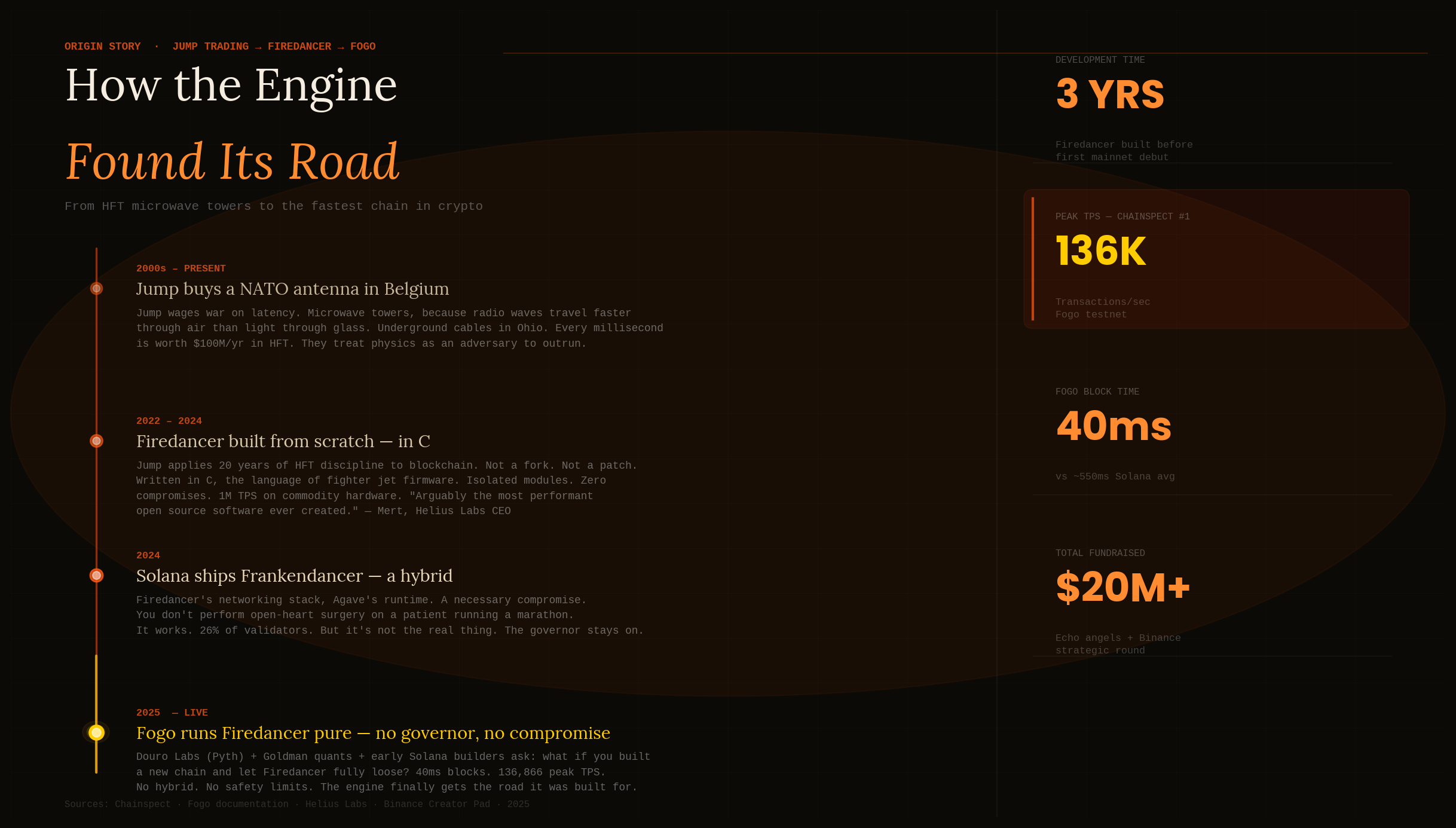
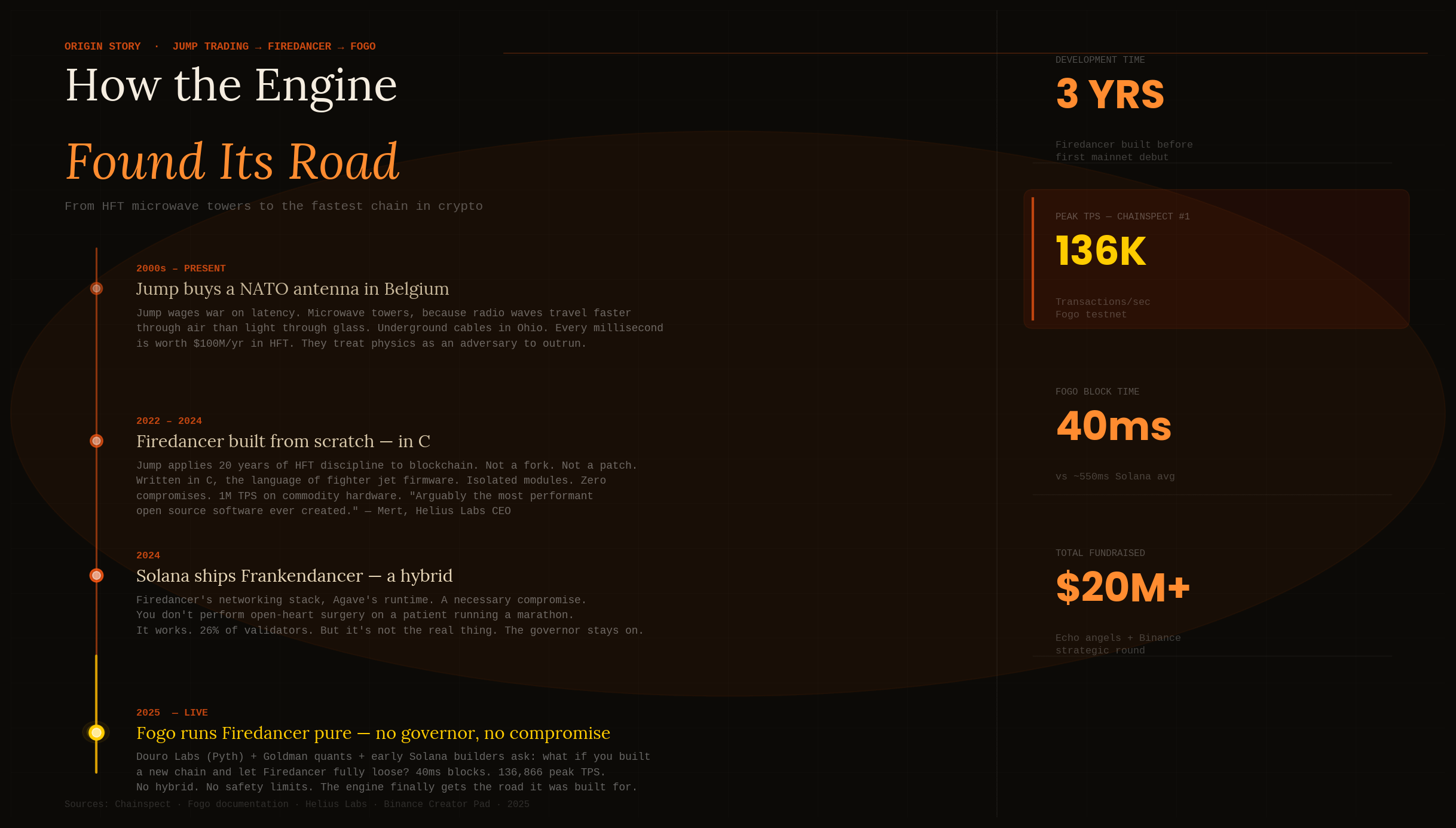
And for the last twenty-plus years, Jump has been waging a quiet, relentless war against time itself. They don't just try to be fast. They try to get as close to the laws of physics as silicon and electricity will allow. When fiber optic cables were too slow — because even light bends and slows when you force it through glass — Jump bought microwave towers. Actual towers. Including a former NATO military antenna in Belgium, because a straight line of radio waves through air is faster than light bouncing off the walls of an underground cable. When even towers weren't enough, they started digging. There are stories of HFT firms laying secret fiber lines under Ohio farmland, cutting straight-line paths between exchanges because the commercially available routes were curved, and curves cost milliseconds, and milliseconds cost money.
This is the world Jump Trading was born into and thrived inside of. A world where the only limit is physics, and the engineers treat physics like an adversary to outrun.
So when Jump decided to build something for the blockchain space, they didn't build a trading bot or a liquidity protocol.
They built an entirely new validator client — from scratch, in C, one of the lowest-level programming languages that exists — and they called it Firedancer.
Before you can understand what Firedancer is, you need to understand what a validator client actually does. Think of a blockchain like a city, and every validator like a civil servant who checks the work of everyone else — verifying transactions, signing off on blocks, keeping the city running. Now imagine that every single one of those civil servants is using the same software. Not just the same agency, the same exact program, built by the same team, with the same codebase, the same bugs hiding in the same corners. If something breaks in that software, every single person in city hall goes down at once. That's not a hypothetical risk on Solana — it's something that has actually happened, multiple times, in the form of network outages that froze the whole chain.
Firedancer is the answer to that problem, and then some. Jump didn't patch the old software. They didn't fork it. They erased it from the equation entirely and wrote a new one — not in Rust like Solana's original client, but in C and C++, the language of operating systems and fighter jet firmware, the language you choose when you need to squeeze maximum performance out of every single CPU cycle. While the original Solana client was built in startup mode — fast to ship, fast to iterate, move quick and fix things later — Firedancer was built with twenty years of high-frequency trading discipline behind it. Every module isolated. Every process sandboxed. Every potential bottleneck treated like an enemy. Not optimized for time-to-market. Optimized for time-to-transaction.
When Jump's chief scientist demonstrated Firedancer at Breakpoint 2024, it processed over one million transactions per second on commodity hardware. Not custom silicon. Not specialized chips. Regular servers that you could buy. One. Million. Transactions. Per. Second.
Helius Labs CEO Mert called it "arguably one of the most performant pieces of open source software ever created." Solana co-founder Anatoly Yakovenko said this might be "the last large-scale systems project that humans built all on their own" — which is one of those statements that sounds like a compliment and also sounds like something you say right before the machines start finishing the work themselves.
Here is the part where things get strange, though. Here is the twist.
Solana didn't actually run Firedancer in its purest form. The version that went live on Solana mainnet — after three years of development, after hundreds of testnet blocks, after all of it — is something called Frankendancer.
A hybrid. Firedancer's networking stack bolted onto Agave's runtime, the old system's bones still holding up the new engine. It works. It's faster. It represents 26% of Solana validators.
But it's not the real thing. The compromises exist because Solana is a massive, live, decentralized network, and you don't perform open-heart surgery on a patient who is awake and running a marathon. You go slowly. You introduce client diversity incrementally. You keep the safety governor on.
A team of people watched all of this happen and made a different choice.
They came from Douro Labs, the team behind Pyth, the oracle network that powers billions in on-chain value. They came with Goldman Sachs quants and early Solana builders. And they asked a question that sounded simple but had massive implications: what if you just built a new chain, and ran Firedancer on it the way it was always meant to run?
No hybrid. No governor. No compromises. Pure Firedancer, from day one.
That chain is Fogo.🔥
The name means fire in Portuguese. And there's something fitting in that, because what Fogo is doing feels less like a product launch and more like letting a controlled burn go fully wild. The numbers from devnet were surreal — block times under 20 milliseconds in early testing, 46,000 real transactions per second in conditions that mirror actual usage. The testnet has held around 40ms blocks as more validators join and the network gets real-world stress tested, which is still faster than most databases you've interacted with today. Faster than the gap between you reading this word and the next.
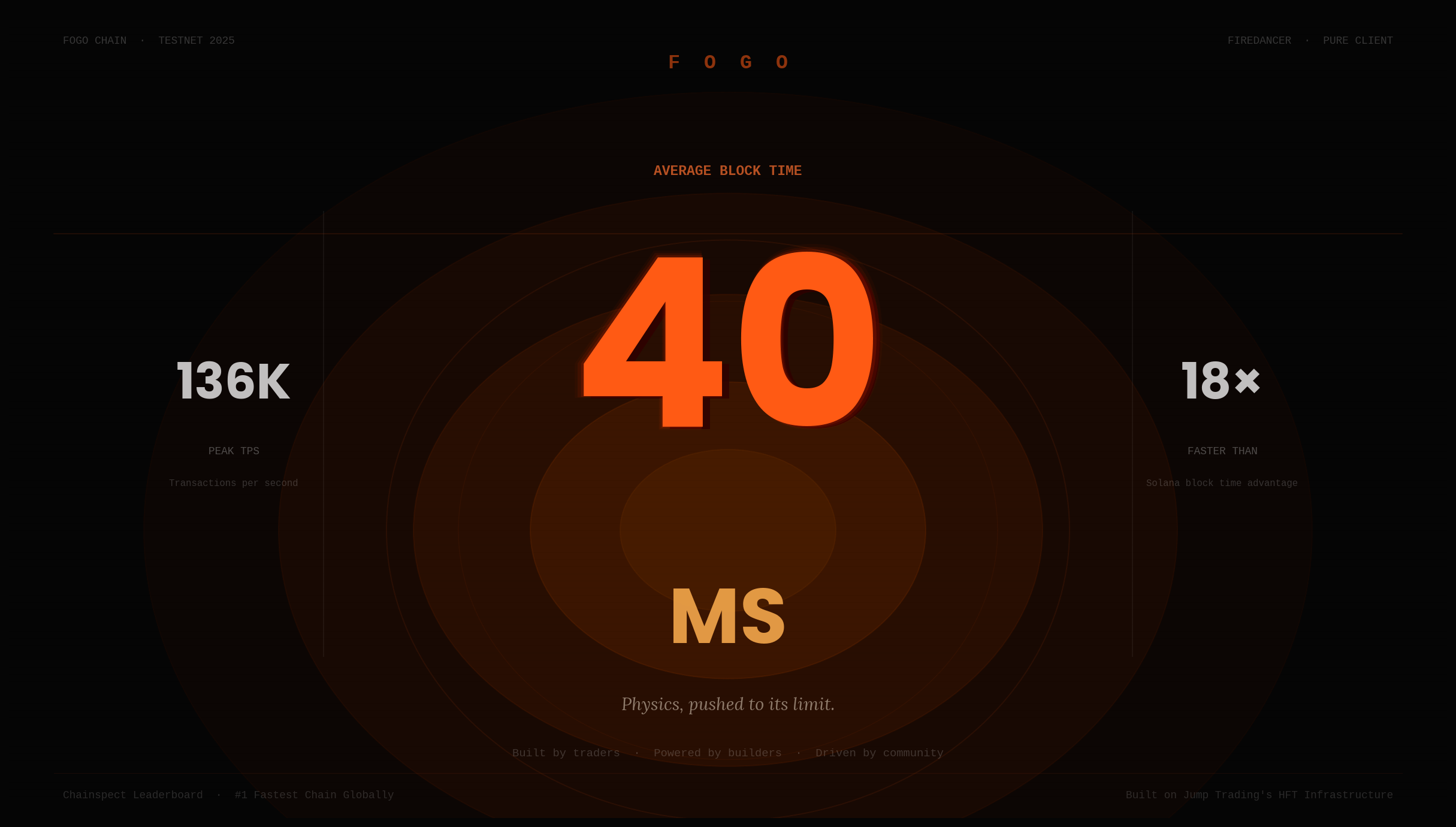
For comparison, traditional finance — the world Firedancer's creators came from — operates at the speed of milliseconds because even there, milliseconds are the battlefield. A 1ms advantage in HFT has been estimated to be worth $100 million in annual opportunity. And here is Fogo, running blocks in 40ms. On a decentralized blockchain. Open to anyone.
But Fogo didn't just drop Firedancer on a generic architecture and call it a day. They redesigned the validator model entirely around the assumption that speed is non-negotiable. The validator set is curated — a handpicked group of 20 to 50 nodes, all required to run Firedancer, with economic penalties built in for lagging behind. No room for slow validators dragging down the average. No weakest link. The network is only as fast as its floor allows, and they set the floor very high.
Then there's the geography. Fogo uses what they call multi-local consensus — validators cluster together physically, colocated in the same data centers, often in the same city, so that the time for a signal to travel between them shrinks almost to nothing. Right now they're anchored heavily in Tokyo, because Asia leads global trading hours and latency between nodes in the same room is effectively zero. As the trading day moves — Tokyo to London to New York — the consensus zone can follow it, like a chain that shadows the sun. They took the "follow the sun" model that global financial firms use to hand off operations across time zones, and they encoded it into the protocol itself.
It is, in a very literal sense, a chain built by traders, for the problems that traders actually lose sleep over.
The tradeoff is real and worth naming, because the best writing doesn't hide what's complicated. Running a curated, colocated validator set means Fogo is not Ethereum. It is not maximally decentralized. The people who believe that every blockchain should be permissionless from the validator level down will find things to argue with here, and their arguments are not wrong. More validators, geographically spread, running different clients — that is the decentralization dream, and Fogo doesn't fully live it, at least not yet.
What Fogo is betting is that there's a different kind of value that's been missing. The value of a chain that doesn't flinch. That doesn't clog when volumes spike. That doesn't insert unpredictable delays when you are sitting on a position and every millisecond of execution lag is real money. The institutional world — the quants, the market makers, the on-chain order book builders — has been watching crypto promise speed for years and then watching chains melt under load. Fogo is a direct answer to that, and whether you think the tradeoff is worth it is probably a function of what problems you're trying to solve.
What makes all of this interesting beyond the specs is what it says about where we are in this industry's life cycle. For a long time, the people who knew the most about high-performance computing — who built microwave towers and ran cables under Ohio fields and programmed in C because nanoseconds mattered — those people built infrastructure for traditional finance. Blockchain was interesting to them as an investment, sometimes as a sandbox, but not as a place to actually apply the full depth of what they knew.
Firedancer changed that. It is the moment where Jump's deepest technical capabilities met the blockchain world and the result was something that no existing chain could fully absorb without compromise. Solana tried and had to split the difference.
Fogo said:
we'll start from scratch, we'll build the road that this engine was actually designed for, and we'll see what it can do.
The answer so far is: things nobody believed a blockchain could do. And the engine is still warming up.
Built by traders. Powered by builders. Driven by community. This is where you belong.
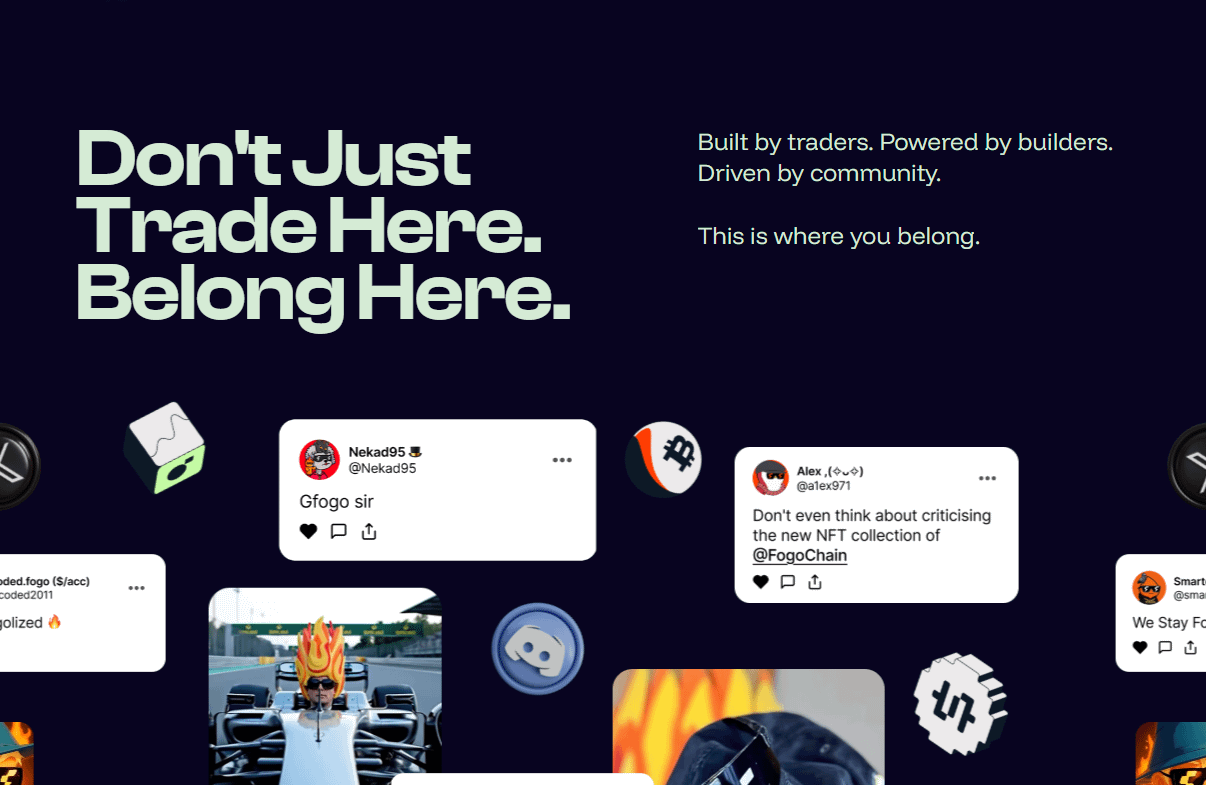
That's the line on Fogo's website. It sounds like marketing until you trace the lineage — Jump's towers in Belgium, the quants from Goldman, the Pyth oracle team, the years of building Firedancer in the dark, and now a chain designed to be the one place that engine has ever run at full throttle.
It still sounds like marketing. But this time, the receipts are real.
