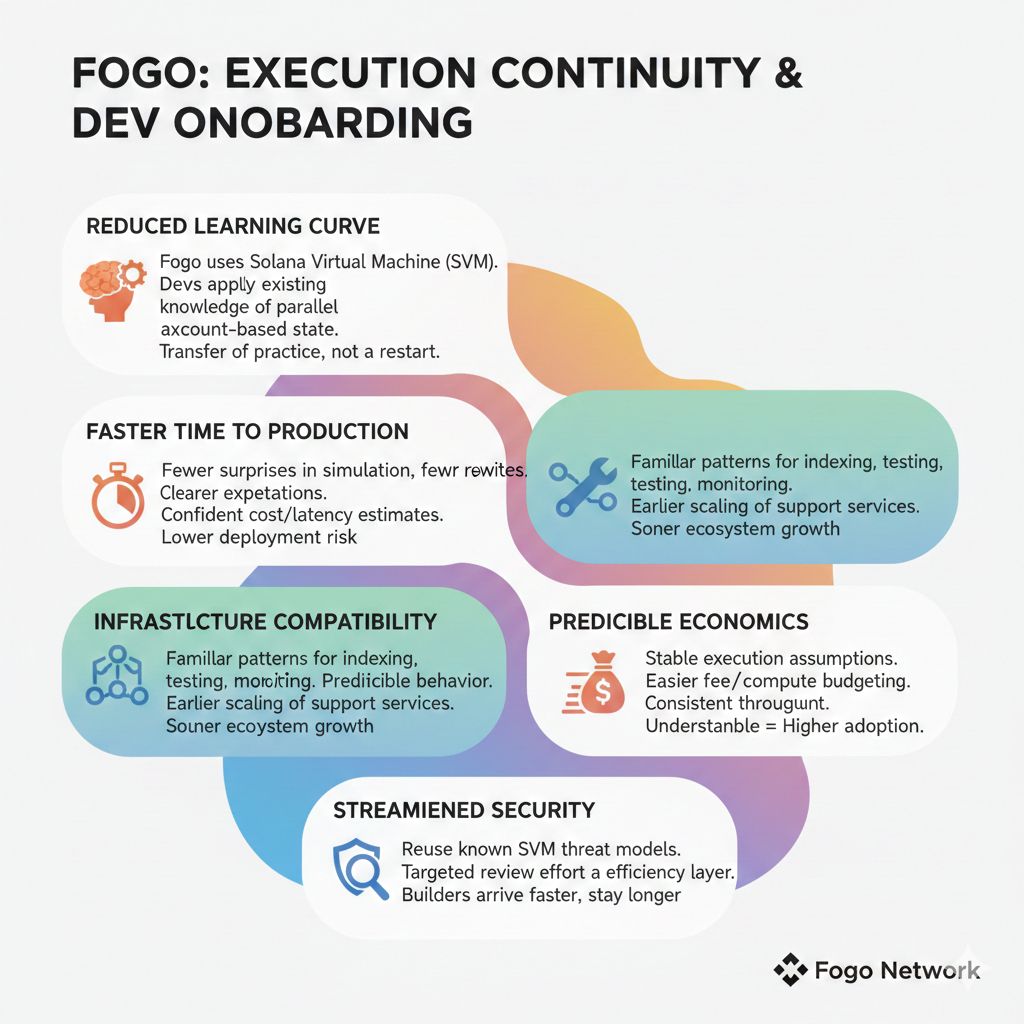
A new Layer 1 usually asks developers to relearn how programs run, how state is stored, and how transactions interact. That learning cost slows real adoption. @Fogo Official reduces this barrier by using the Solana Virtual Machine. In My research, this choice matters less for branding and more for workflow continuity. Developers who already understand parallel execution and account-based state can apply that knowledge directly. It becomes a transfer of practice rather than a restart.
I have seen that onboarding time is mostly shaped by hidden differences in execution logic. When those differences shrink, teams move faster from testing to production. There are fewer surprises in simulation, fewer rewrites in contract design, and clearer expectations around performance under load. This stability changes planning behavior. Teams can estimate costs and latency with more confidence, which lowers deployment risk.
Infrastructure also benefits from compatibility. Tools for indexing, testing, and monitoring follow familiar patterns. I read about that operational teams care less about raw speed and more about predictable behavior. When runtime rules feel known, infrastructure providers scale support earlier. So on the ecosystem level, services appear sooner because technical uncertainty is lower.
Economic effects follow technical continuity. When execution assumptions remain stable, budgeting for fees and compute becomes easier. It becomes practical to design applications that rely on consistent throughput rather than theoretical limits. We Become aware that adoption grows when performance is not only high but understandable.
Security review gains efficiency as well. Auditors can reuse known threat models from SVM environments and focus on what is truly new in the architecture. There are still risks, but review effort is more targeted. The result is a network where familiarity acts as an efficiency layer, shaping how quickly builders arrive and how long they stay.