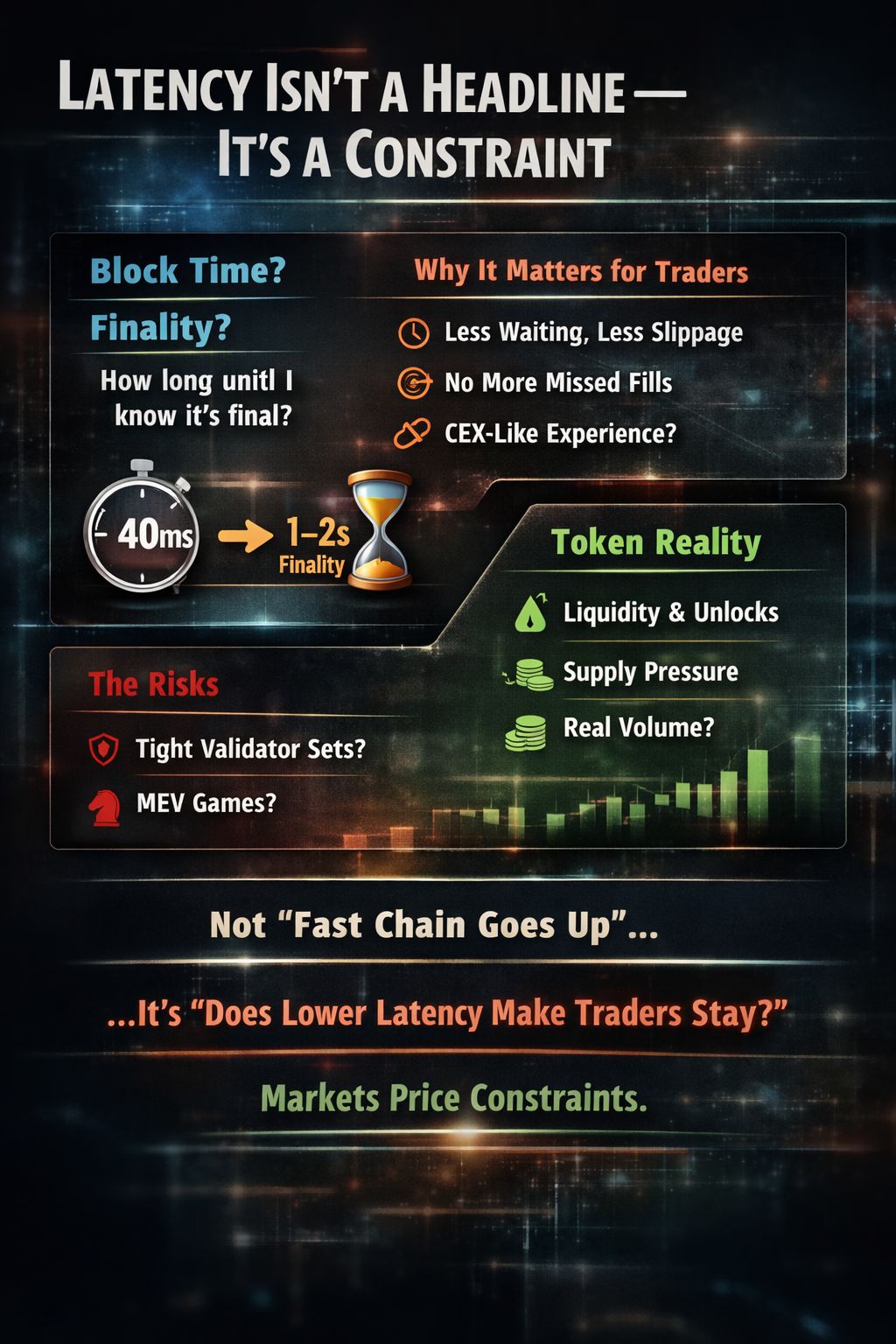
One thing I keep noticing in crypto is how easily the word “fast” gets thrown around. But what does fast actually mean? Block time? Finality? Or just good marketing?
Let’s say a chain advertises 40ms block times. That sounds impressive. But the real question, at least for me as a trader, is simple: how long until I can trust that my transaction is truly final? Block production and finality aren’t the same thing. Blocks show activity. Finality is the moment you stop worrying about reorgs and reversals.
If a network can reliably deliver finality in around one to two seconds, that’s meaningful in day-to-day trading. Because the most frustrating part of on-chain activity isn’t fees — it’s waiting. It’s slippage widening while your transaction sits pending. It’s missed fills because the state changed before you did.
My thesis is straightforward. A chain that sells “speed” as a headline won’t last. But a chain that compresses latency enough to change user behavior — that’s different. If trading on-chain starts to feel closer to a centralized exchange experience, without constant wallet popups and approval fatigue, that’s where real adoption can happen.
Of course, there are trade-offs. Ultra-low latency designs can create pressure around validator requirements and network topology. Tighter setups may improve performance, but they can also shift the decentralization profile. And wherever milliseconds matter, sophisticated players will compete for micro-edges. Speed isn’t inherently fair — it just raises the stakes.
Then there’s the token itself. Technology alone doesn’t protect price. Liquidity depth, emission schedules, unlocks, and organic volume matter more than clean demos. Small caps can rerate quickly, but they can also drift just as fast when attention rotates elsewhere.
So for me, the trade isn’t “fast chain goes up.”
The trade is whether lower latency actually makes traders want to stay — even when the hype fades.
Because in the end, markets don’t price slogans.
They price constraints.