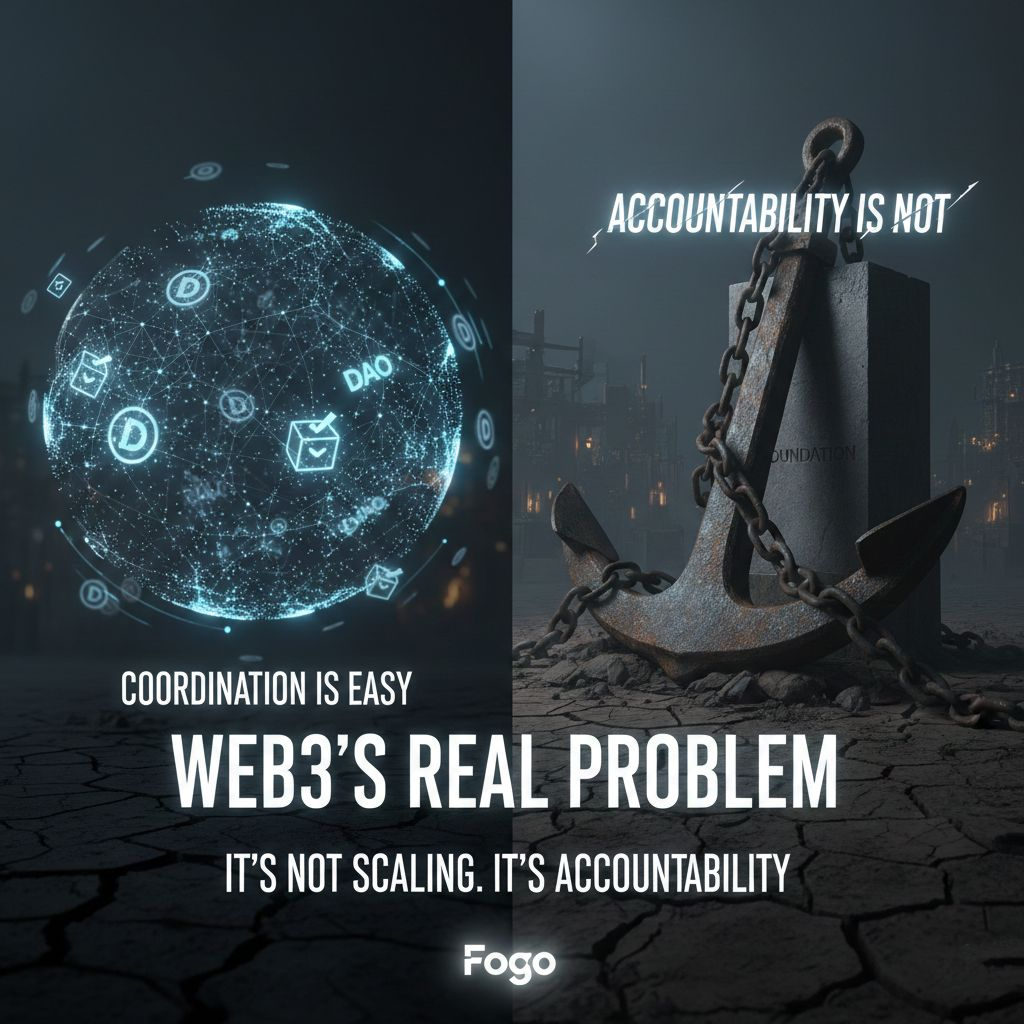
If we’re honest, Web3 doesn’t have a scaling problem.
It has an accountability problem.
We are very good at gathering people around an idea. We can coordinate money, attention, votes, memes, liquidity, all in a matter of hours. We can spin up a DAO in a weekend. Launch a token in a day. Raise capital faster than most startups can open a bank account.
But when something goes wrong, or even just quietly fades out, no one is really responsible.
That’s the part we don’t talk about.
We talk about decentralization. We talk about ownership. We talk about innovation. We say we’re building a new financial system, a new internet, a new social layer.
What we don’t talk about enough is who is accountable when things stop working.
Because things do stop working. All the time.
Protocols stall. Roadmaps drift. Governance votes pass and then sit there, unimplemented. NFT projects promise long-term value and then slowly go silent. Not dramatic collapses. Not even obvious scams. Just slow decay.
The Discord gets quieter. The updates get shorter. The founders “shift focus.” The token still exists, but the purpose feels thinner every month.
No one technically broke the rules. No one hacked anything. But the trust erodes anyway.
This is what coordination without accountability looks like.
We’ve designed systems where participation is easy and exit is even easier. If incentives dry up, you move to the next thing. If governance gets messy, you stop voting. If the market cools, you pivot or disappear.
The cost of leaving is low. The cost of under-delivering is often zero.
And we pretend this is fine because the code is still there. The contracts still run. The blockchain still produces blocks.
But infrastructure running is not the same as systems working.
We’ve tried to patch this with more governance. More tokens. More voting mechanisms. Sub-DAOs. Councils. Working groups. Staking. Slashing. New frameworks every few months.
On paper, it looks structured. In reality, a lot of it depends on good faith and momentum. And momentum is not a durable incentive.
If people act responsibly only while it’s profitable or exciting, then responsibility isn’t built into the system. It’s temporary.
That’s the uncomfortable part. We built coordination machines. We did not build accountability machines.
And accountability is not something you can bolt on later. It has to be in the foundation.
This is why the base layer matters more than we admit.
We tend to debate speed and fees like they are the central issues. They matter, of course. But speed doesn’t solve misaligned incentives. Low fees don’t fix disappearing teams. High throughput doesn’t create follow-through.
The deeper question is simpler. What behavior does the network actually reward? What does it punish? What does it ignore?
If a chain makes it easy to launch but doesn’t meaningfully anchor long-term participation, then short-term thinking will dominate. Not because people are evil. Because the system allows it.
This is where Fogo enters the conversation in a way that feels less flashy and more structural.
Fogo is a high-performance Layer 1 that utilizes the Solana Virtual Machine. That description alone doesn’t sound revolutionary. Another L1. Another attempt at better infrastructure.
But the important part isn’t novelty. It’s intention.
If Web3’s core issue is coordination without accountability, then the underlying network has to support more than just activity. It has to support consequence.
Performance matters here, not as a marketing bullet point, but as a constraint remover. When a network is slow or expensive, builders move complexity off-chain. Governance becomes symbolic. Game logic becomes centralized. NFT utilities become promises instead of systems.
A performant base layer makes it harder to justify those shortcuts.
Using the Solana Virtual Machine is also a practical choice. It lowers friction for developers. It reduces the need to relearn everything. It anchors the network in an existing ecosystem of tooling and experience.
That might sound boring. It is boring. And that’s the point.
The real work now is not inventing new slogans. It’s tightening incentives.
$FOGO, in that context, is not interesting because it exists. It’s interesting if it meaningfully ties participation to responsibility. If validators have real skin in the game. If network behavior reflects long-term alignment instead of short-term extraction.
Tokens have often been treated as attention magnets. Or as speculative chips. Rarely as instruments of sustained accountability.
If a token secures the network in a way that makes poor behavior costly and long-term contribution rational, then we’re inching toward something more stable.
For NFTs, this matters because ownership without durability is hollow. If the chain underneath them is reliable, fast, and structured around real incentives, then NFT projects can build systems that last. Not just art drops and temporary communities, but ongoing logic and evolving assets that don’t quietly break.
For DAOs, it matters because governance only works when outcomes are enforceable. Votes should trigger actions that can’t be ignored. Treasury decisions should be transparent and binding. A solid base layer reduces the gap between decision and execution.
For on-chain games, it’s even more obvious. If the game economy, assets, and rules are meant to live on-chain, the network has to handle that consistently. Not just during hype cycles, but during quiet months too.
This is not about excitement. It’s about reliability.
Web3 does not need more noise. It needs systems where walking away has a cost. Where staying committed is the rational choice. Where responsibility is not optional.
Fogo feels like a serious attempt to address that at the infrastructure level. Not by promising cultural change. Not by shaming bad actors. But by shaping incentives where they actually live.
Will that alone fix everything? Of course not.
But if we keep ignoring accountability at the base layer, we’ll keep rebuilding the same fragile structures on top.
At some point, growing up as an industry means accepting that decentralization is not the absence of responsibility. It’s the distribution of it.
And distribution only works when the weight is real.
Maybe that’s what Web3 actually needs now. Less talk about what we’re disrupting. More attention to what we’re sustaining.
Less coordination theater. More accountability by design.
Quiet systems. Real consequences. Fewer excuses.
That doesn’t sound exciting. But it sounds necessary.