
I didn’t understand Fogo’s design the first time I read it.
I expected rotation.
Most networks talk about fairness by moving leadership around. Rotate proposers. Rotate validators. Rotate responsibility. It sounds balanced on paper. But when I looked closer at Fogo’s single active zone model, it became clear this wasn’t about taking turns. It was about choosing deliberately, then committing fully.
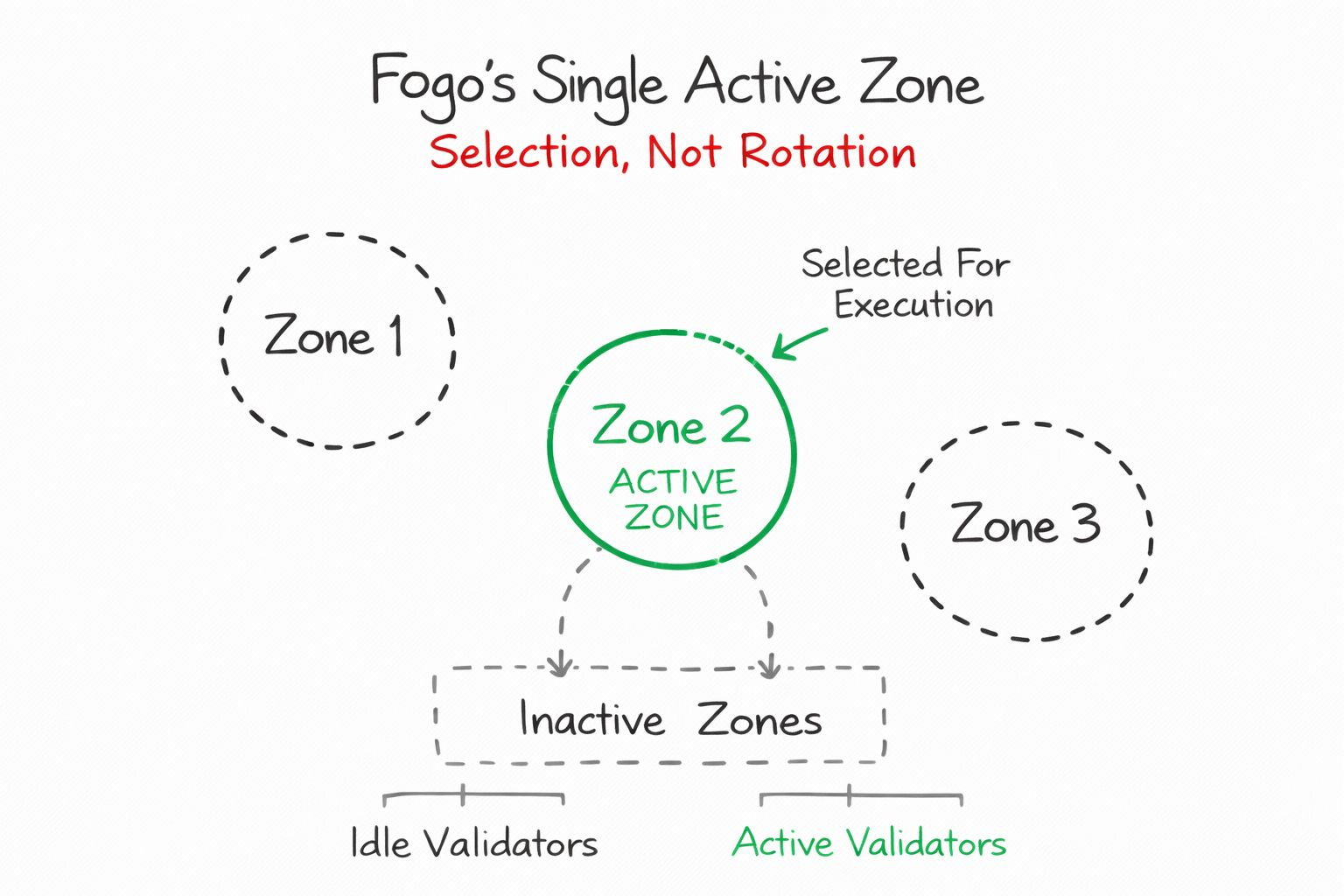
Selection changes the psychology.
In Fogo, only one zone is active at a time. That choice is intentional. Instead of spreading attention across many semi-active regions, the network concentrates execution, coordination, and accountability into a single locus. There’s no illusion that everyone is equally active all the time. One zone carries the load. Others wait.
Waiting is not exclusion.
It’s discipline.
What struck me is how different this feels operationally. Rotation implies inevitability. Your turn will come whether you’re ready or not. Selection implies judgment. The network chooses who is active based on readiness, performance, and alignment with current conditions. That choice can change, but it is never automatic.
Automatic systems hide responsibility.
From a technical perspective, a single active zone reduces coordination overhead. Fewer cross-zone messages. Less state reconciliation. Fewer edge cases where partial progress creates ambiguity. Execution becomes cleaner because everyone knows where “now” is happening. There is one present moment, not many parallel maybes.
Clarity beats parallelism when latency matters.
But the deeper impact is behavioral. When you know only one zone is active, you behave differently. You don’t assume redundancy will save you. You don’t expect another zone to quietly pick up the slack. The active zone must perform, because there is no fallback pretending to be live.
Pressure sharpens systems.
I also realized why Fogo avoids calling this rotation. Rotation implies fairness through movement. Selection implies fairness through merit and timing. The network is honest about scarcity. Not everyone is active at once. Not every validator is central all the time. And that honesty prevents complacency.
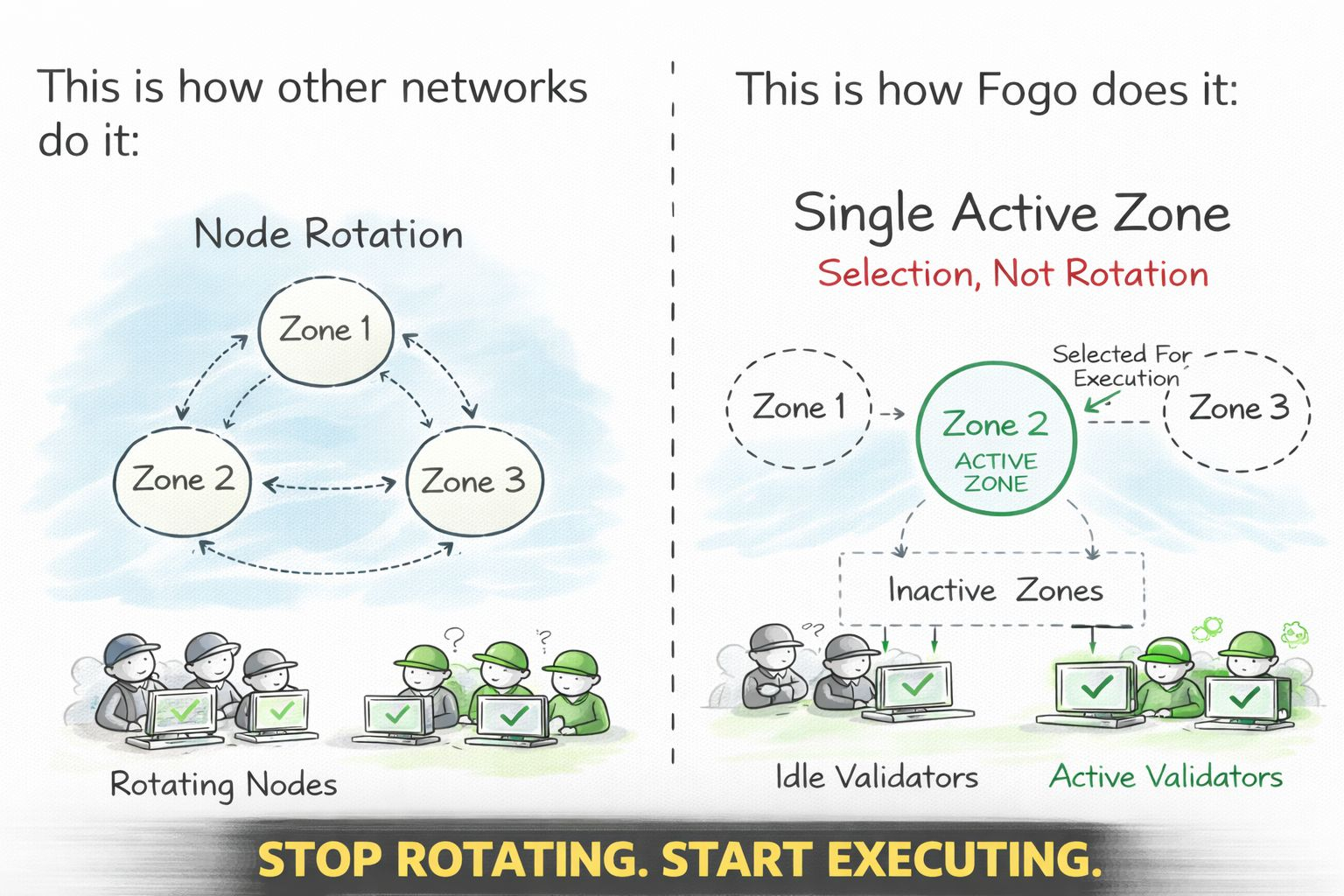
Scarcity creates focus.
As someone who’s watched systems fail quietly due to over-distribution, this resonates. When everything is active, nothing is accountable. When one zone is active, responsibility is visible. If something goes wrong, there’s no confusion about where it happened or who was involved.
Blame doesn’t diffuse.
It lands.
There’s also a human parallel here. In real work, progress doesn’t happen everywhere at once. Teams choose priorities. They focus. They commit. Fogo’s single active zone feels less like abstract decentralization and more like how serious systems actually operate under constraints.
Reality is selective by nature.
This doesn’t make Fogo rigid. Selection can change. Zones can become active when conditions shift. But change is explicit, not continuous. Transitions are events, not background noise. That alone reduces cognitive and technical load.
Change should be visible.
In the end, Fogo’s single active zone isn’t about limiting participation. It’s about respecting execution. By choosing one place where the network is fully alive, Fogo avoids the soft failures that come from pretending everything is equally important.
Rotation spreads responsibility.
Selection defines it.
And once I saw that, the design stopped feeling unusual. It started feeling honest.
