Over years blockchains have been competing based on theoretical performance measures, including transaction per second, block times, and scaling plans. The focus is changing as the decentralized applications become mature. It is no longer a matter of how fast a blockchain can reach in the laboratory but its stability in a real-life setup.
Fogo addresses this issue by making infrastructure a priority. Constructed as a high performance Layer1 which is compatible with the Solana Virtual Machine, @Fogo Official is not intended to re-architecture execution logic. Rather, it reinvents the ways of interaction among consensus members in geographical locations and hardware configurations. It is not speed but performance which is predictable.
The average latency is hardly important in distributed systems. The user experience at a large scale is often determined by tail latency, which is the slowest percent of operations. In cases where the change in a block requires a majority of the validators to approve a block, settlement time is calculated by the slowest of the validators.
Fogo is aware that decentralization does not require uncontrolled variance. When validator performance varies greatly due to hardware variation, network quality or bugs in the software, consensus will be flimsy and the system, although technically sound, will be unstable in its operation.
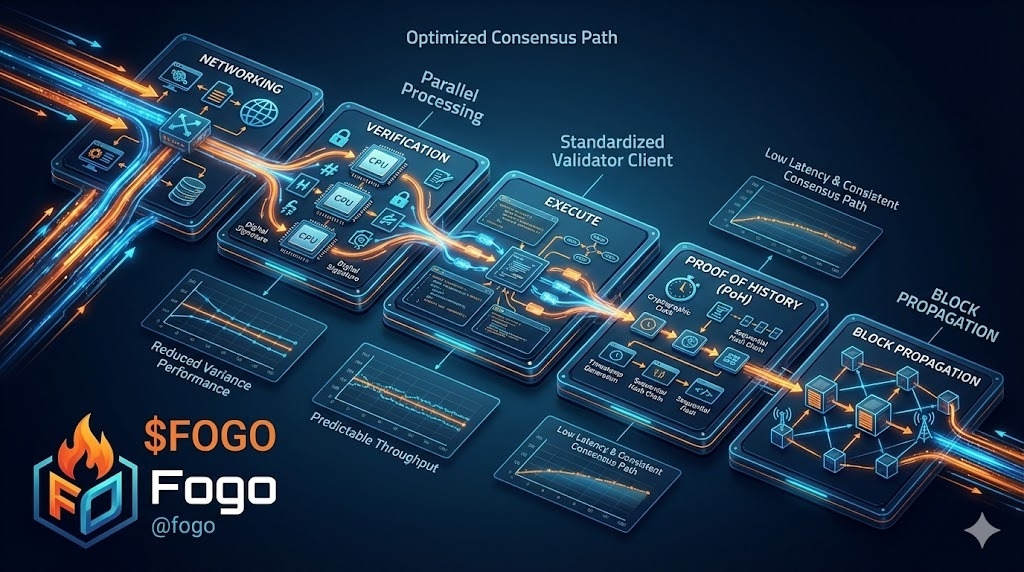
That is reflected in Fogo design philosophy. It does not tolerate extreme performance diversity, but instead suggests normal high-performance validator implementations. It is Fire dancer-principled, and has an architecture of modular processing units connected to specific sets of CPU cores. Networking and signature verification are completed in parallel loops that are optimized. Data flow Zero-copy reduces memory overhead and bottlenecks. What has been achieved is not only an increased throughput but a narrower performance spread. Variance reduction can be more useful than peak capacity in large scale systems.
The other important learning is geographic awareness. The majority of blockchains consider the network to be a virtual cloud of nodes. However, the passage of data is done through submarine cables, routers and regional data centers. All the consensus messages need to bargain on physical infrastructure that is controlled by distance and congestion.
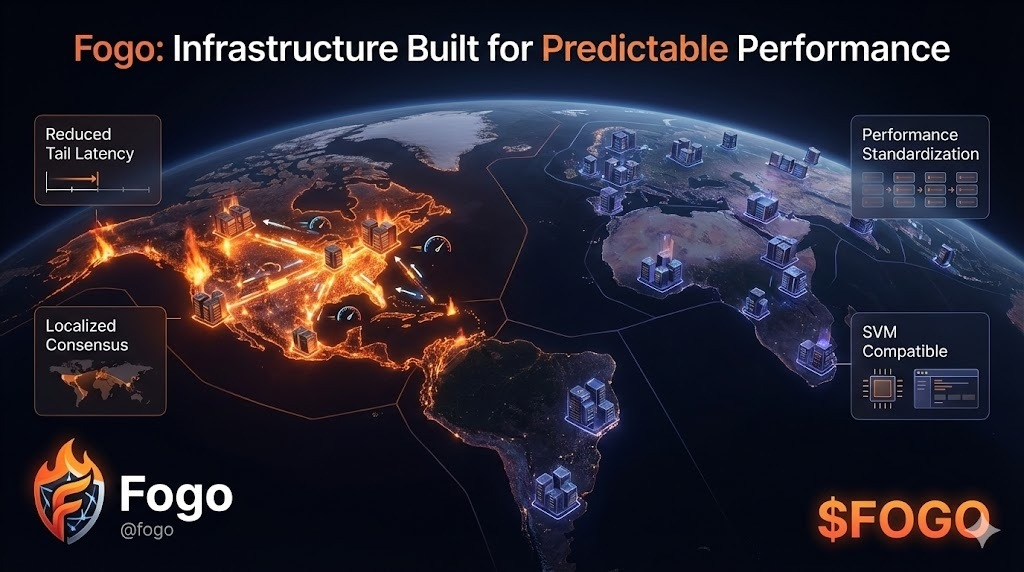
In order to restrict the geographic movement of the active quorum, Fogo introduces validator zones. At any given epoch, a single zone is involved directly in block production and voting; the remaining zones remain in consensus, but remain out of consensus.
This spinning formation introduces a focused group of consensus that is closer to communication. In certain systems, active zones may be placed into local cycles of activity by a follow-the-sun rotation. Centralization is not the goal: the security levels and the weighted mechanisms of stakeholders are still preserved. Rather, it pragmatically eliminates the unnecessary long distance coordination on the critical path. Fogo decreases the latency by zeroing the number of validators in real time decision making without compromising cryptographic integrity.
The design of infrastructure is not enough. Bribes become behavioral. $FOGO is the main theme in maintaining the presence of validators and the safety of the network. The token allows consensus through delegation of stake, rewards, and inflation. New tokens are given to delegators and validators every epoch according to the number of vote credits earned (with an annual fixed rate of inflation).
This brings a definite connection between engagement and financial compensation. Validators remain online and successfully validate blocks with better returns on behalf of their delegators. Indifferent or untrustworthy conduct has been discouraged economically.
Transaction charges are based on a balanced model. Base fees are partly burnt and partly redistributed; priority fees are directly given to block producers. This aligns incentives between those users that desire faster inclusion, and those validators that optimize block packing. The token model is therefore not an operational performance independent model.
A high protocol level performance should be usable on the app level. A recurring problem of Web3 is that wallet signatures and complicated transaction handling are required.
Fogo has a session-based authorization scheme that reduces that friction. Users will be able to provide scoped, time-limited permissions to applications instead of asking the user to sign full-time. These permissions define programs that one can invoke, amount of money that can be spent and termination of the session.
The method allows the users to have a better experience with trading interfaces, gaming ecosystems and mobile applications. Notably, self-custody is still there. The primary wallet retains the supreme power, and temporary session keys operate under rigid boundaries.
The optional fee sponsorship allows apps to abstract gas costs and remain transparent. The developers are in a position to furnish adaptable payment schemes, without losing the user control. This, in effect, brings the blockchain experience nearer to the Web2 patterns without affecting decentralization.
It is a strategic decision of Fogo to remain Solana-VM compatible. The developers are saving time in that they can transfer the already existing programs, tools, and infrastructure without having to start anew. This lowers the level of fragmentation and allows optimization of innovation as opposed to reinventing. When the cost of time to develop the product and integration may be high in an ecosystem, compatibility may be more valuable than novelty. The wider implication is that Fogo does not represent a philosophical discontinuity, but simply a refinement of the structure.
There are lots of Layer-1 stories that discuss disruptive change. Fogo is more calculated. It concedes that consensus algorithms are already in theory already highly optimized. Rather than rewriting the algorithms, it looks at the actual real-world environment that it is executed in.
The primary design constraints are network distance, hardware variance, and predictability of operations. Fogo aims at obtaining incremental but significant improvements in terms of settlement speed and reliability by optimizing around them. To builders, it entails construction of the infrastructure that is designed to be in continuous use and not spikes. To validators, there is a better understanding of what performance is expected. To the users, there is the result of smoother interactions and faster confirmations. The thesis underlying $$FOGO s that it is not the speed, but the minimization of unpredictability through a global network.
With the increasing use of blockchain, networks addressing practical constraints will probably be more resilient than those that are optimized to purely theoretical standards. In this sense, Fogo is a more infrastructure-oriented development, constructed upon the manner in which distributed systems utilize planetary scale behavior in reality.