
Here’s something most people won’t say out loud:
Layer 1s don’t fail because the tech is bad.
They fail because nobody serious signs long-term commitments.
That’s the filter I use now.
Not TPS. Not roadmap threads. Not influencer excitement.
Contracts.
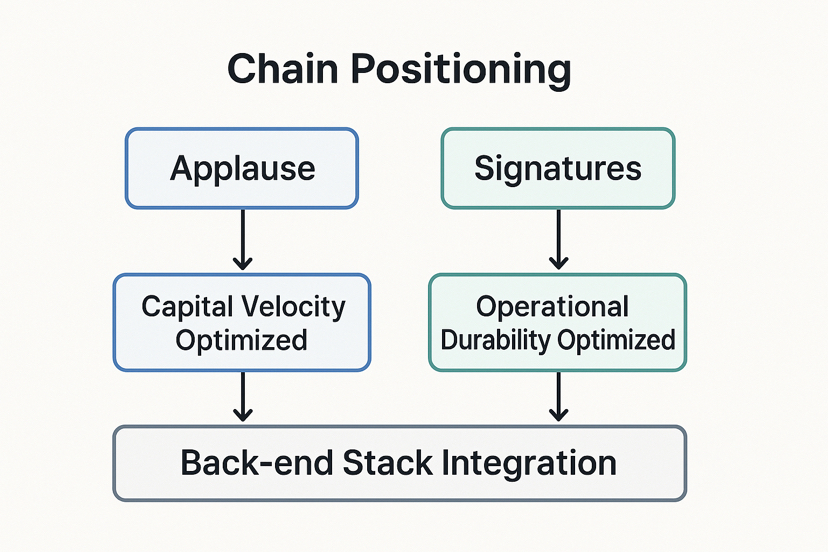
Vanar isn’t positioning like a chain that wants applause. It’s positioning like a chain that wants signatures.
And those are two very different games.
If you study how gaming infrastructure actually scales, it doesn’t explode overnight. It embeds. It integrates. It becomes part of the backend stack where nobody tweets about it — but nobody can remove it either.
That’s stickiness.
Most L1s are optimized for capital velocity. Vanar feels optimized for operational durability.
That trade-off is controversial because durability is invisible in early stages. You can’t chart it. You can’t farm it. You can’t screenshot it.
But institutions price it differently.
Gaming studios don’t ask, “Is this trending?”
They ask, “Will this embarrass us under load?”
That’s where the conversation gets serious.
If Vanar is genuinely architected around application stability — especially for gaming and metaverse environments — then the real signal won’t be token price spikes. It’ll be quiet expansion: deeper integrations, recurring partnerships, long-term ecosystem alignment.
And that’s not sexy.
Crypto markets are addicted to volatility. Infrastructure markets are addicted to reliability.
Vanar seems to be choosing its addiction carefully.
Here’s the contrarian angle:
If Vanar starts behaving like a hype machine, I’d be worried.
Because that would mean it’s optimizing for attention instead of institutional confidence.
And institutional confidence compounds differently. It builds slowly — then becomes extremely hard to displace.
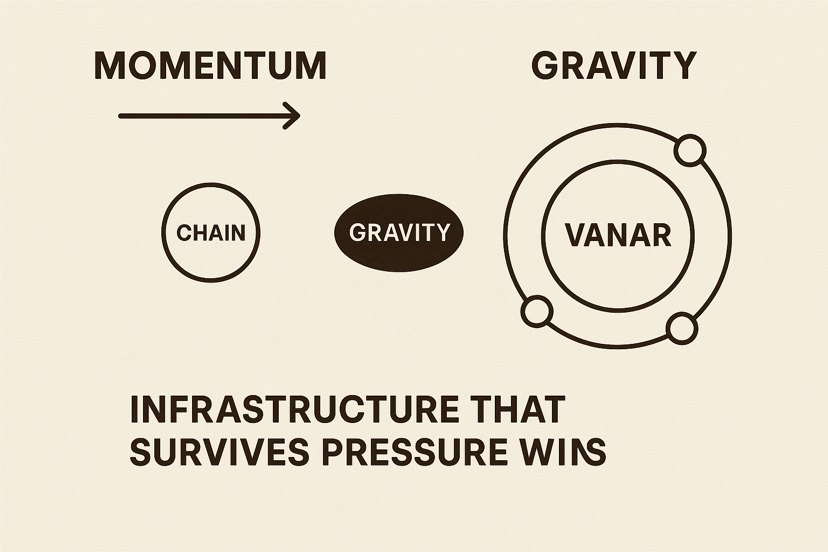
Another thing most people overlook: once a gaming ecosystem launches on a chain and builds player wallets, assets, and internal economies around it, migration becomes painful. That friction creates gravity.
Gravity is more powerful than narrative.
Right now, Vanar feels like it’s building gravity.
Not momentum — gravity.
There’s a difference.
Momentum is loud.
Gravity is quiet — until everything starts orbiting it.
If the next phase of crypto isn’t just financial primitives but actual consumer-grade digital worlds, then infrastructure that survives pressure wins.
Not the loudest chain.
The most dependable one.
That’s why I don’t evaluate Vanar by short-term engagement metrics.
I evaluate it by one question:
Is this chain trying to be impressive… or indispensable?
Because only one of those survives institutional scrutiny.
And the chains that become indispensable don’t usually look exciting while they’re doing it.
