
@Fogo Official The first time I paid attention to Fogo, it was not because it was everywhere, but because it wasn’t. It existed without forcing itself into every conversation, without trying to anchor its identity to a single dramatic claim. After watching multiple infrastructure cycles unfold, this absence of urgency felt unusual. Most systems arrive with a need to prove themselves immediately. They emphasize potential before demonstrating endurance. Fogo, in contrast, seemed comfortable with the slower process of becoming understood through repeated interaction rather than explanation. That difference created a kind of cautious curiosity. It did not promise transformation. It suggested continuity.
This approach enters an environment shaped by years of experimentation and impatience. The industry has spent a long time chasing visible progress, often equating advancement with speed alone. Faster confirmations, lower costs, and higher throughput became symbols of success, yet these improvements did not always translate into a calmer user experience. What people encountered instead was inconsistency. Sometimes everything worked perfectly. Other times, the same action felt uncertain. This inconsistency created a quiet psychological distance between users and the systems they were meant to trust. People learned to compensate by double-checking, retrying, and hesitating. Over time, these small interruptions became part of the expected experience.
Fogo appears to be built around a different observation. It does not treat performance as a momentary achievement but as a continuous responsibility. It recognizes that trust is not formed when a system performs well once, but when it performs predictably across many ordinary situations. This shifts the focus away from exceptional scenarios and toward routine ones. The real measure becomes whether people can interact without adjusting their behavior to accommodate uncertainty. When this happens, attention moves away from the infrastructure entirely. Users stop thinking about whether something will work and begin assuming that it will.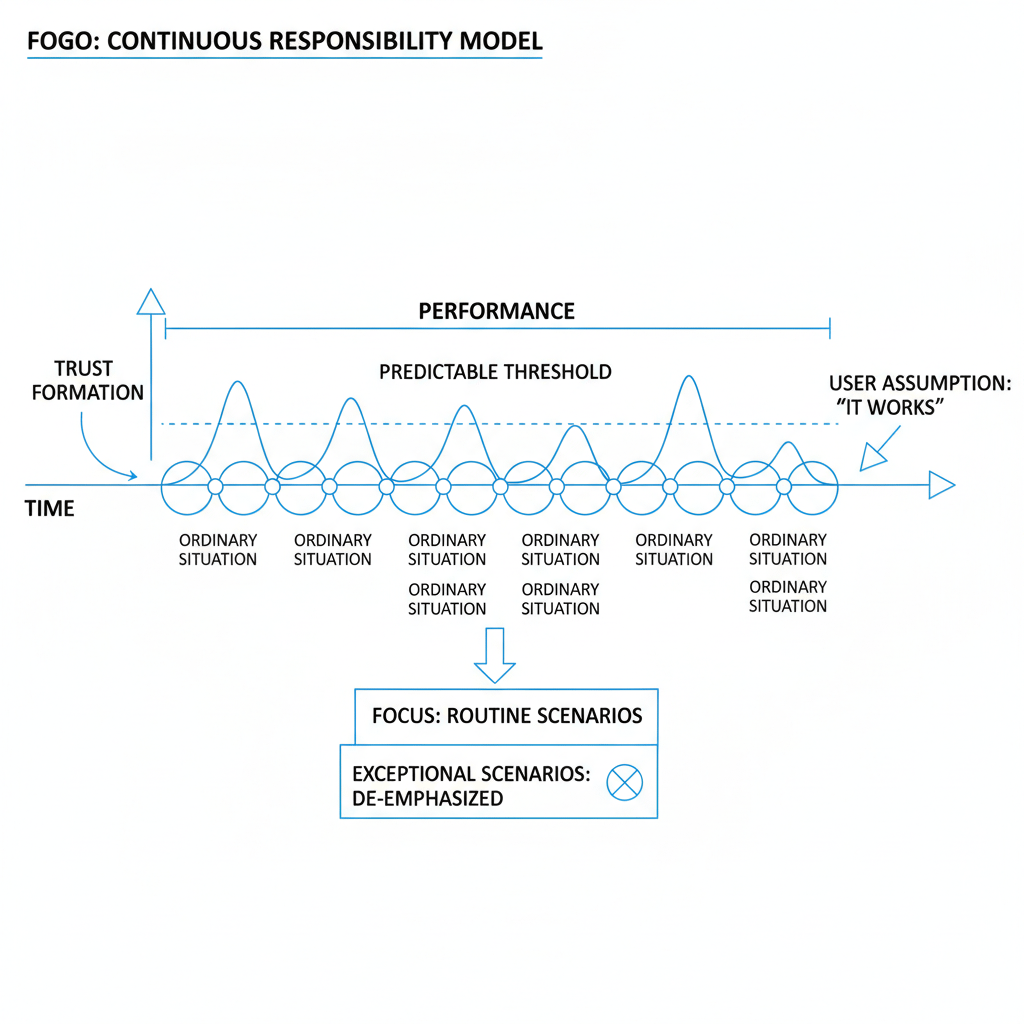
This philosophy introduces deliberate restraint. Instead of exposing every possible capability, the system seems to prioritize coherence. It does not try to present itself as infinitely flexible at the cost of clarity. This can make it appear less ambitious at first glance, but it reflects a deeper intention. Complexity often reveals itself not in design documents but in moments of confusion. Every unclear response, every unexpected delay, adds a small layer of doubt. By minimizing these moments, the system reduces the need for interpretation. Interaction becomes direct, almost uneventful.
There is also a subtle shift in how progress is measured. Many projects define success through milestones that can be announced and celebrated. Fogo’s progress feels quieter. It is reflected in how little attention is required to use it. This makes it harder to observe in traditional ways. There is no single event that confirms its maturity. Instead, maturity reveals itself gradually, through the absence of friction. Users return not because they are impressed, but because they are uninterrupted. Their engagement becomes habitual rather than deliberate.
This pattern of growth tends to be slower, but it is often more stable. Systems that integrate into daily behavior do not depend on constant rediscovery. They become part of the environment rather than an attraction within it. This transition from novelty to normalcy is subtle, and it often goes unnoticed while it is happening. Only later does it become clear that the system has shifted from being an experiment to being infrastructure. Fogo seems to be positioning itself within this transition, not by accelerating attention, but by reducing the reasons for disengagement.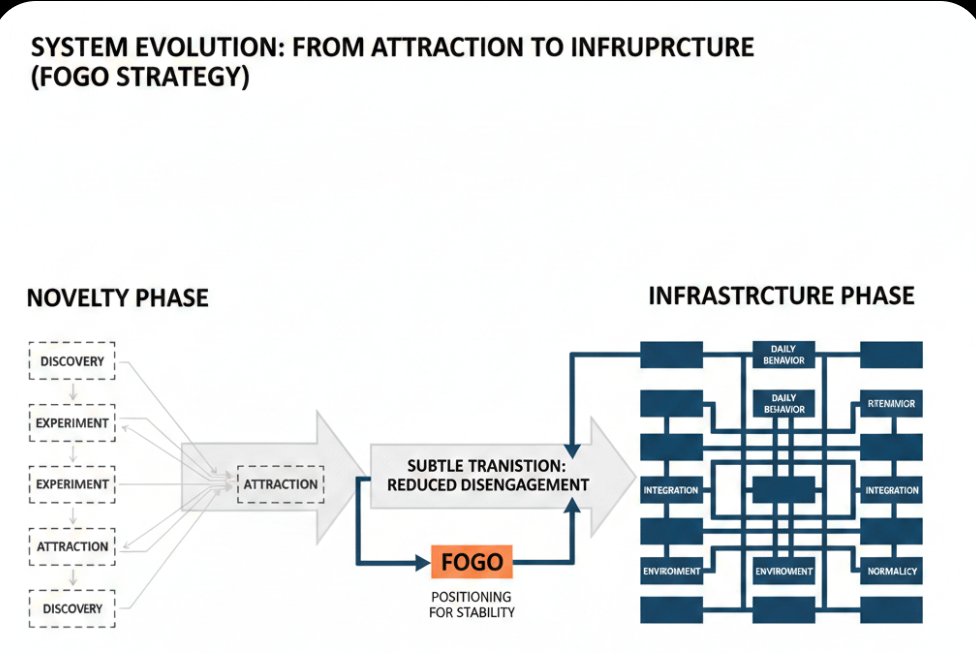
At the same time, this approach is not without risk. Stability is easy to claim but difficult to sustain. Early consistency does not guarantee long-term resilience. As participation grows, new pressures emerge. Behavior becomes less predictable. Edge cases appear. Maintaining coherence requires continuous discipline. It requires resisting changes that introduce short-term advantages but long-term uncertainty. This is not a technical challenge alone. It is a philosophical one. The system must remain aligned with its original intention even as its environment evolves.
Another challenge lies in perception. Quiet systems are often underestimated. They do not generate the kind of excitement that draws immediate attention. Their value becomes visible only over time. In an industry driven by rapid narrative shifts, this can make it difficult to distinguish between what is temporarily popular and what is gradually becoming essential. Fogo’s restraint may limit its visibility in the short term, but it also protects it from the instability that accompanies constant reinvention.
What stands out most is the sense that Fogo is not trying to change how people think about infrastructure. It is trying to remove the need for people to think about it at all. This reflects a deeper understanding of how technology becomes meaningful. The most influential systems are not those that demand awareness, but those that support activity without interrupting it. They create a stable background against which everything else can move freely.
There are still unanswered questions. It remains unclear how this approach will respond to unexpected conditions, how it will adapt without losing its simplicity, and how it will maintain clarity as its ecosystem grows. These questions are not signs of weakness. They are part of the natural process of becoming established. Every enduring system has faced a similar period of uncertainty. What determines its trajectory is not the absence of challenges, but the consistency of its response to them.
For now, Fogo does not present itself as a finished solution. It presents itself as a system in the process of becoming reliable. This distinction matters. Reliability is not a feature that can be implemented once. It is a pattern that must be maintained continuously. It is built through repetition, through the quiet confirmation that actions lead to expected outcomes. Over time, this repetition shapes perception. The system becomes less noticeable, not because it is insignificant, but because it is dependable.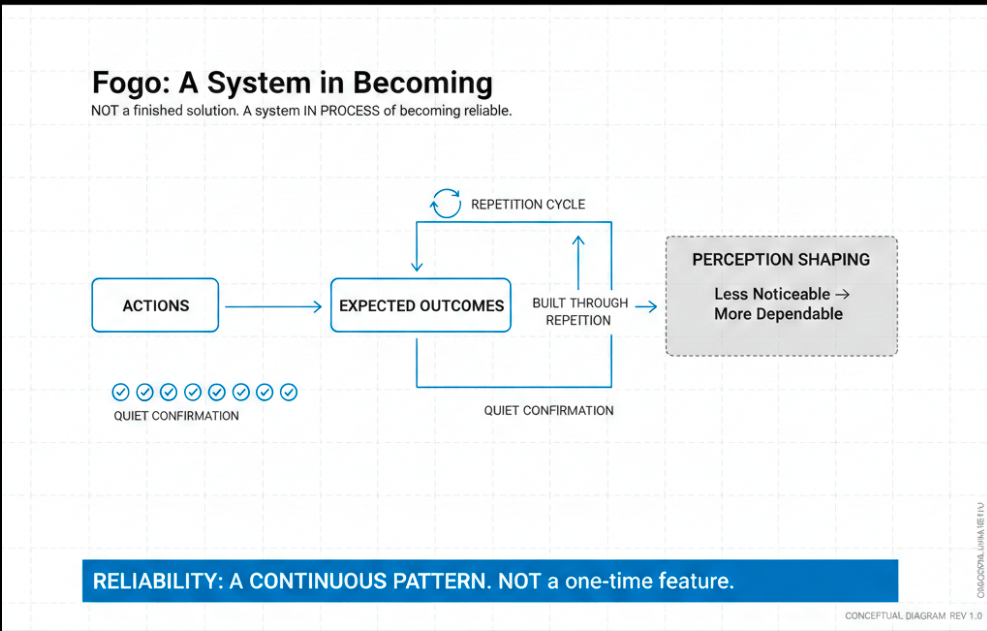
In the end, the significance of Fogo may not be defined by what it achieves dramatically, but by what it allows to happen naturally. Its progress may be measured not in moments of attention, but in the gradual disappearance of hesitation. If it continues along this path, its presence will not be marked by sudden recognition, but by quiet integration into routine. It will not feel like something new. It will feel like something that was always meant to work this way.
