

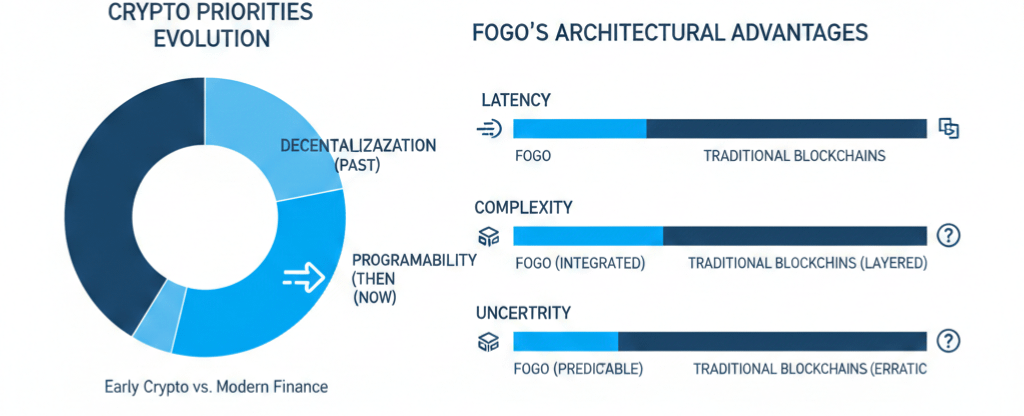
With the past, speed wasn't a major factor with cryptocurrency. People were prepared to wait. They waited for wallets to react, for bridges to respond, and for confirmations. The expectation was straightforward: it was acceptable as long as it ultimately worked. However, patience subtly vanished somewhere along the line, particularly once DeFi developed and significant finance joined the market. When traders who were accustomed to milliseconds in traditional finance began to engage with cryptocurrency, fast enough suddenly didn't feel like it.
Something like Fogo begins to make sense in that setting.
Blockchains have been attempting to develop into financial infrastructure for years, but the majority of them were never created with real trading activity in mind. Decentralization was the primary goal of their architecture, followed by programmability and trading as an add-on application. Friction resulted from that layering. outside oracles. books of off-chain orders. fragmented liquidity. Each additional component created areas of failure, complexity, and delay. Although users adjusted, this does not equate to satisfaction.
Fogo takes a different approach to this. It views trading as the foundation rather than as merely another use case. There is more to the choice to integrate a Firedancer-based validator client with the Solana Virtual Machine than only aiming for increased performance. It shows that businesses and individuals that are concerned about latency, execution quality, and consistency, rather than just retail participants playing with tiny sums, may be the next wave of customers.
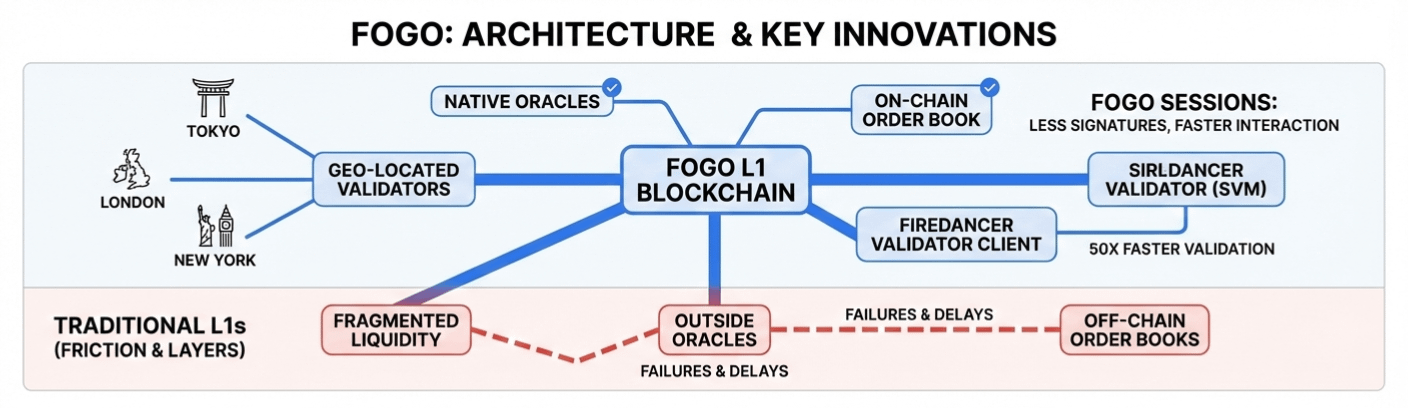
Particularly telling is the notion that validators are geographically situated close to major financial centers such as Tokyo, London, and New York. It recognizes something that crypto has frequently overlooked: when milliseconds count, geography still matters. This was discovered decades ago by traditional finance. The fact that digital and physical infrastructure are interdependent and not distinct realities is something that cryptocurrency is just now beginning to acknowledge.
The choice to incorporate core trade primitives straight into the protocol is even more notable. Native oracles and an on-chain order book eliminate previously weak layers. Uncertainty is decreased with each reliance you eliminate. Furthermore, one of the most unseen expenses in cryptocurrency is uncertainty. Uncertainty not transaction fees, not gas fees. When systems seem unpredictable, users hesitate. When execution seems erratic, traders quit.
On paper, Fogo Sessions which let users communicate without signing each transaction might appear to be a minor usability enhancement. However, tension builds up on a psychological level. Hesitancy arises with each signature, affirmation, and additional procedure. Those little hesitancies eventually mold behavior. People frequently stick with systems that feel natural to use, rather than those that have the best technology.
However, caution is taught by experience. Numerous technically impressive crypto schemes have failed to keep users. Adoption is not guaranteed by technology alone. Liquidity draws liquidity to itself. Users remain in the same locations as other users. Trust develops gradually and erodes rapidly. It appears like FOGO recognizes the gravity of the market it is entering because it is already listed on significant exchanges and has the support of seasoned individuals from Jump Crypto and Citadel. Infrastructure alone, however, is only half the fight. Whether or not actual traders decide to remain is the other half.
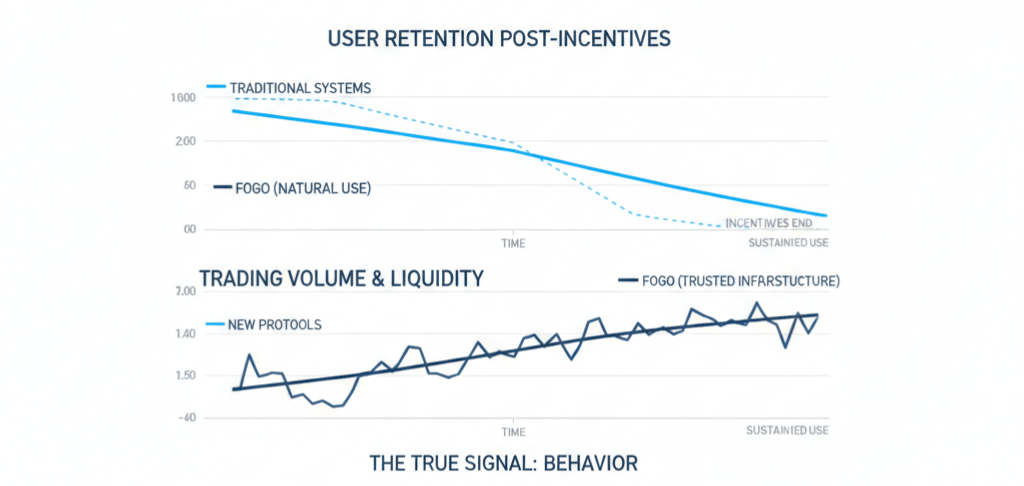
A portion of the tale is told via token supply, market capitalization, and fundraising rounds, but the human side is not. The actual signal will be more subdued. It will manifest in regular use. among traders who come back every day without considering other options. among programmers who create without considering system constraints. Because the infrastructure just works, users completely lose sight of it.
You cease searching for loud signals after a sufficient number of cycles. Instead, you begin to observe subtle behavior. You observe retention. After the incentives wear off, you see if people depart. You observe if the system seems natural or if it is artificially sustained.
Fogo promises speed, and it won't be the only chain to do so. However, its design decisions imply that it recognizes a more profound change in the cryptocurrency space, moving from experimental networks to financial systems that are driven by performance.
It's still early for now. Additionally, the early phases are always silent. The slow, steady trend of actual usage over time will tell the true story, not announcements or analytics.
