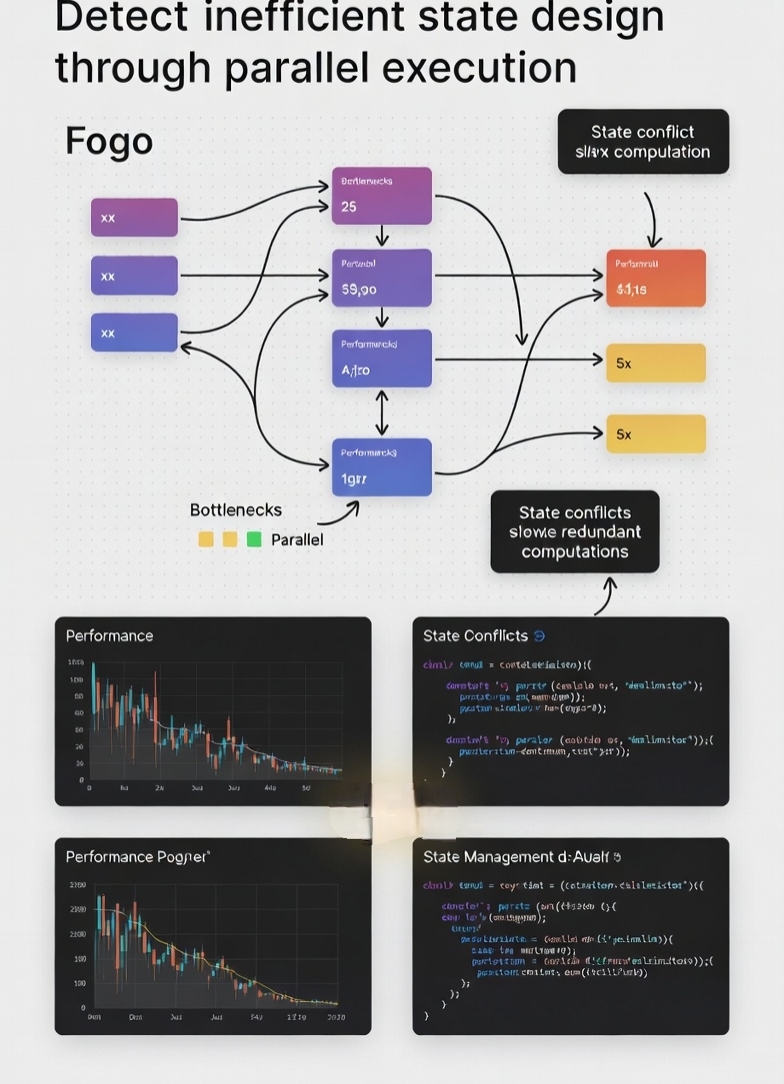
Fogo uses parallel execution not just for speed, but as a diagnostic tool for developer discipline. Because the network runs on a 40ms block time, any "bottleneck" in an application’s state design becomes immediately visible as a transaction failure or a massive spike in localized latency.
The Detection Mechanism
Fogo's runtime, built on the SVM (Solana Virtual Machine), requires every transaction to declare exactly which "accounts" (pieces of data) it will read or write.
Lock Contention: If a developer creates a "global" account that every user must write to (like a single global counter), Fogo cannot run those transactions in parallel. While Solana might buffer this slightly, Fogo’s aggressive speed means these transactions "collide" instantly.
Parallelism Audit: By forcing transactions into parallel lanes, Fogo effectively "audits" the code. If an app’s state is poorly designed (centralized), its throughput collapses. This forces builders to shard their state—splitting one big account into many smaller ones—to allow the hardware to process them simultaneously.
On Fogo, "bad state" isn't just slow; it's a structural failure that the parallel scheduler rejects to protect the rest of the network's speed.
Comparative Fact
Unlike general-purpose chains that mask inefficiency through longer block times, Fogo’s Firedancer-based client exposes "State Contention" as the primary enemy of performance, shifting the burden of optimization from the chain back to the developer's architecture.