

Most new Layer 1 blockchains struggle with the same invisible handicap: they start from zero. Zero developer familiarity, zero production history, zero ecosystem gravity. That empty starting point forces years of rebuilding assumptions that other environments have already stress-tested. Fogo is deliberately avoiding that reset by anchoring its architecture around the Solana Virtual Machine (SVM) not as a shortcut, but as a strategic foundation.
The real value of choosing SVM is not the headline throughput number people quote on social media. It’s the structural head start. An execution environment that has already shaped how serious builders think about concurrency, state access patterns, composability, and performance discipline changes the probability curve for a new chain. It does not guarantee adoption nothing does but it meaningfully lowers the friction of the first serious deployments.
When you treat SVM as more than a buzzword, what you’re really talking about is a runtime that rewards parallelism and punishes careless state contention. Over time, that produces a developer culture oriented toward performance resilience rather than “it works for now.” By adopting SVM at the execution layer, Fogo imports that performance-oriented mental model and tooling familiarity, while still retaining flexibility at the base layer where real differentiation lives.
That base layer is not cosmetic. Consensus design, validator incentives, networking topology, and congestion handling determine whether a chain behaves predictably during stress or deteriorates into instability when demand spikes. Two networks can share the same execution engine and feel radically different under pressure. The engine shapes ergonomics; the chassis determines survivability.
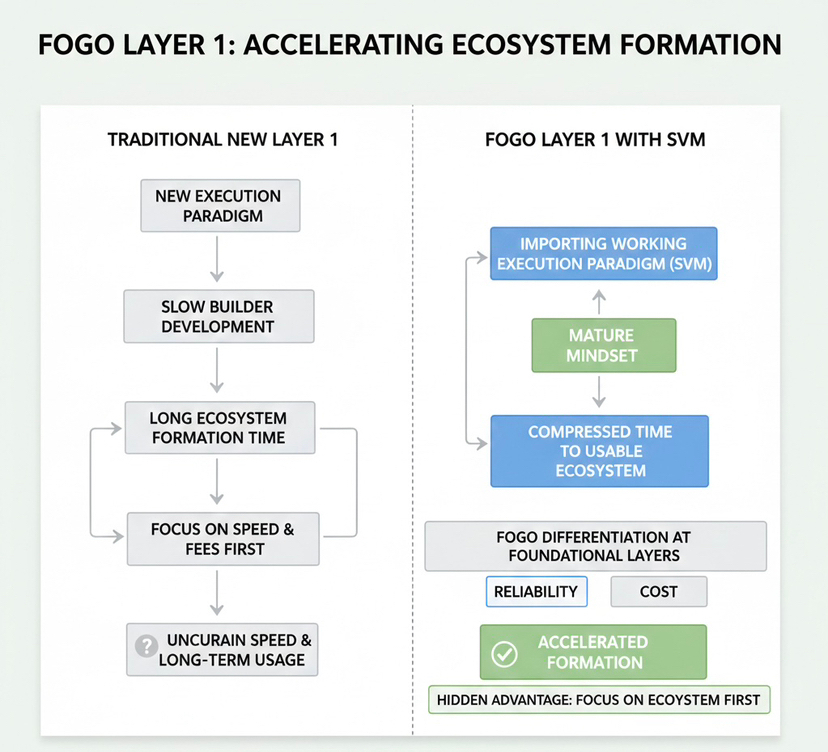
The hidden advantage here is time compression. Most L1s face the cold-start loop: builders wait for users, users wait for apps, liquidity waits for volume, and volume stays thin because liquidity is shallow. By building around SVM, Fogo reduces cognitive switching costs for developers already familiar with high-throughput paradigms. Even if code requires adaptation, the transferable asset isn’t copy-paste contracts — it’s architectural instinct.
That instinct matters because ecosystems compound. When multiple high-performance applications coexist within the same execution paradigm, composability accelerates. More venues create more routing paths. More routing paths tighten spreads. Tighter spreads attract liquidity providers. Deeper liquidity increases execution quality. Execution quality reinforces trust. That feedback loop is what turns a network from experimental to credible.
Of course, reuse is not magic. Liquidity does not teleport. Trust is not inherited. A bridge does not equal adoption. Every new base layer context introduces subtle differences — fee mechanics, networking behavior, validator performance characteristics — that can alter how applications behave under real load. Those details require audits, operational hardening, and disciplined iteration.
So the question is fair: if it runs SVM, is it just another clone?
The grounded answer is no — because an execution environment is only one component of the system. If Solana provided a powerful engine, Fogo is attempting to engineer a different vehicle around it. The engine influences how applications are written. The chassis determines how the system handles turbulence.
Right now, the absence of loud marketing pivots or headline chasing doesn’t automatically signal weakness. Often it suggests structural work — improving onboarding flow, tightening reliability, smoothing performance consistency — the unglamorous layers that determine whether builders treat a chain as a serious deployment environment or a temporary experiment.
The long-term thesis is straightforward: SVM on an L1 is not just about compatibility. It’s about compressing the timeline from zero to usable ecosystem by importing a mature execution paradigm while differentiating where it matters most — base layer stability and stress behavior.
The metric that will ultimately matter is not demo performance. It’s how the chain behaves when it carries real weight. Do builders deploy with conviction? Does liquidity deepen organically? Does performance remain consistent during chaotic demand rather than only in calm conditions?
When those answers turn positive under stress, the architecture stops being a narrative and starts being an ecosystem.