
The real value of Fogo choosing the Solana Virtual Machine is not the headline metric people repeat. It’s the starting position it creates.
Most new Layer-1 chains begin from zero: a fresh execution environment, unfamiliar tooling, uncertain performance behavior, and a long road before serious builders even consider deploying. That cold start quietly kills many networks before they ever reach real adoption.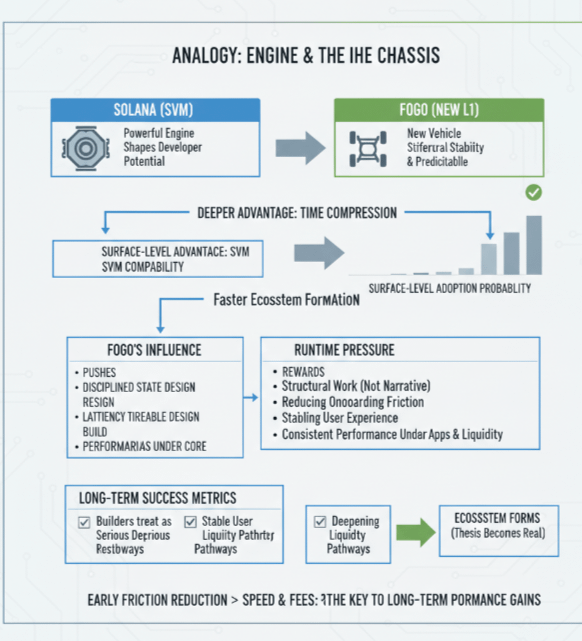
Fogo is taking a different path. By building around a production-proven execution engine, it skips the phase where developers must relearn how to design for speed, concurrency, and composability. That choice doesn’t guarantee adoption, but it changes the early probabilities in a meaningful way. It lowers friction for the first real deployments, and in Layer-1 competition, reducing early friction often matters more than theoretical performance gains.
SVM stops being a buzzword the moment you look at how it shapes developer behavior. It pushes builders toward parallelism, toward disciplined state design, and toward treating latency and throughput as product features rather than backend details. The runtime rewards systems that avoid contention and exposes designs that can’t scale. Over time, that pressure creates a culture where developers build for load from day one instead of fixing performance later.
By adopting SVM, Fogo is importing more than code compatibility. It’s importing a mature execution philosophy, familiar tooling patterns, and a mindset built around performance reliability. At the same time, it keeps room to differentiate where it matters most — in the base-layer decisions that determine how the network behaves when demand spikes, how predictable latency remains, and whether transaction inclusion stays stable under chaotic conditions.
This is where the hidden advantage appears. Most new Layer-1 networks struggle with the cold start loop: builders hesitate because there are no users, users hesitate because there are no applications, liquidity waits for volume, and volume never arrives because liquidity is shallow. It’s a self-reinforcing delay that can stretch for years.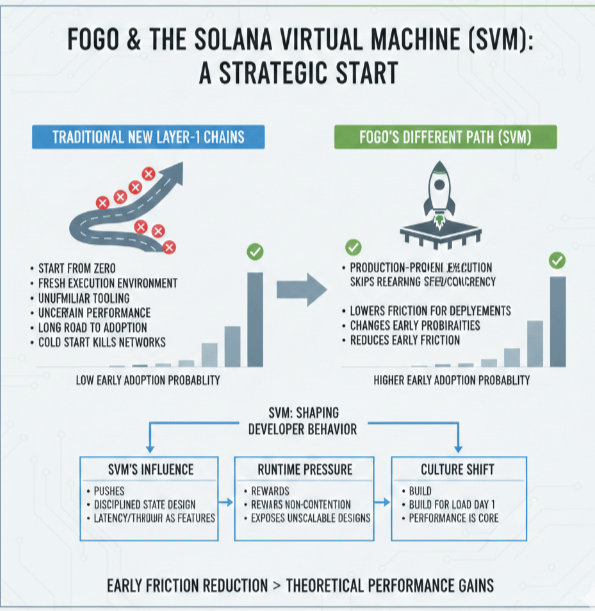
Fogo’s SVM foundation can compress that loop. Not because contracts magically copy over, but because developer instincts transfer. Architects who already understand concurrency patterns, state layout discipline, and high-throughput design don’t need to relearn the fundamentals. That muscle memory alone can shorten the distance between first deployments and first real usage.
Still, reuse isn’t magic — and the honest view makes the thesis stronger. What transfers cleanly is the mental model: building for parallel execution, designing around state access, expecting performance to be measurable and constantly tested. What does not transfer automatically is liquidity, user trust, or network effects. Those have to be rebuilt from scratch. Bridges don’t move depth, deployments don’t move users, and even small differences in networking, fees, or validator behavior can change how applications perform under stress.
Where the SVM-on-L1 idea becomes powerful is ecosystem density. Dense ecosystems don’t just look busy — they behave differently. More applications create more routing paths, more paths tighten spreads, tighter spreads attract volume, deeper volume pulls liquidity providers, and stronger liquidity makes execution feel reliable rather than fragile. Builders benefit because their apps plug into existing activity instead of standing alone, while traders benefit from markets that feel efficient rather than experimental.
This is why the “Is it just a clone?” question matters — and also why it’s incomplete. An execution engine is only one layer of a blockchain. Two networks can share the same engine and still behave very differently in real conditions. The base layer — consensus mechanics, validator incentives, networking structure, congestion handling — determines whether performance stays consistent when the network is under pressure. If the engine is shared, the chassis is where differentiation lives.
A simple analogy makes this clearer. Solana created a powerful engine. Fogo is building a new vehicle around that engine with different structural choices. The engine shapes developer ergonomics and raw performance potential. The chassis determines stability, predictability, and whether the system holds together when everyone shows up at once.
That’s why SVM compatibility is only the surface-level advantage. The deeper advantage is time compression — the ability to move from zero to a usable ecosystem faster than most new chains can manage.
Right now, Fogo doesn’t look like it’s chasing headlines, and that absence isn’t necessarily negative. Often it signals a phase focused on structural work rather than narrative building. The most meaningful progress at this stage is usually invisible: reducing onboarding friction, stabilizing the user experience, and making performance consistent as usage grows. Those are the improvements that keep applications and liquidity from leaving once they arrive.
The takeaway stays simple. SVM on an L1 isn’t only about running familiar programs. It’s about importing a working execution paradigm and an experienced builder mindset, compressing the time required to form a usable ecosystem, while still allowing differentiation at the foundational layers that determine reliability and cost. That’s the advantage many traders miss because they focus first on speed and fees, while ecosystem formation is what actually decides whether a chain survives long term.
If I were watching Fogo closely now, I’d care less about how it performs in demos and more about how it behaves under real weight. I’d watch whether builders treat it as a serious deployment environment, whether users experience it as stable, whether liquidity pathways deepen enough to make execution feel clean, and whether performance stays consistent when stress arrives. When those signals begin to align, the thesis stops being theoretical — and that’s when a Layer-1 stops being a story and starts behaving like an ecosystem.